Detroit’s Mental Health Hospitals: A Quick Guide for Patients and Families
If you need to find a mental hospital in Detroit, here are the main options available as of June 2026:
| Facility | Location | Who It Serves |
|---|---|---|
| StoneCrest Center | Detroit, MI | Adolescents, adults, seniors |
| Henry Ford Behavioral Health Hospital | West Bloomfield, MI | Adolescents, adults, seniors |
| High Intervention Program (HIP) | Detroit Receiving Hospital | Adults in psychiatric crisis |
| Walter Reuther Psychiatric Hospital | Westland, MI | State-operated, all adults |
| Center for Forensic Psychiatry | Saline, MI | Forensic psychiatric patients |
Detroit has a long and layered history with psychiatric care — from the sprawling Eloise complex that once housed 10,000 residents at its peak, to a new generation of modern, evidence-based hospitals opening their doors as recently as 2025. Whether you’re looking for acute crisis care, age-specific inpatient treatment, or state-operated facilities, the Detroit area has more options than most people realize.
This guide covers both the history and the present — so you can understand the full picture, and find the right care quickly.
I’m Sean Swain, a Detroit-based hospitality operator and local guide who has spent years helping visitors and medical professionals navigate the city, including those traveling to access a mental hospital in Detroit for themselves or a loved one. My work connecting guests to Detroit’s neighborhoods gives me a ground-level view of the resources this city offers.
Mental hospital detroit glossary:
From Eloise to Modern Care: The Evolution of Psychiatric Facilities in Detroit
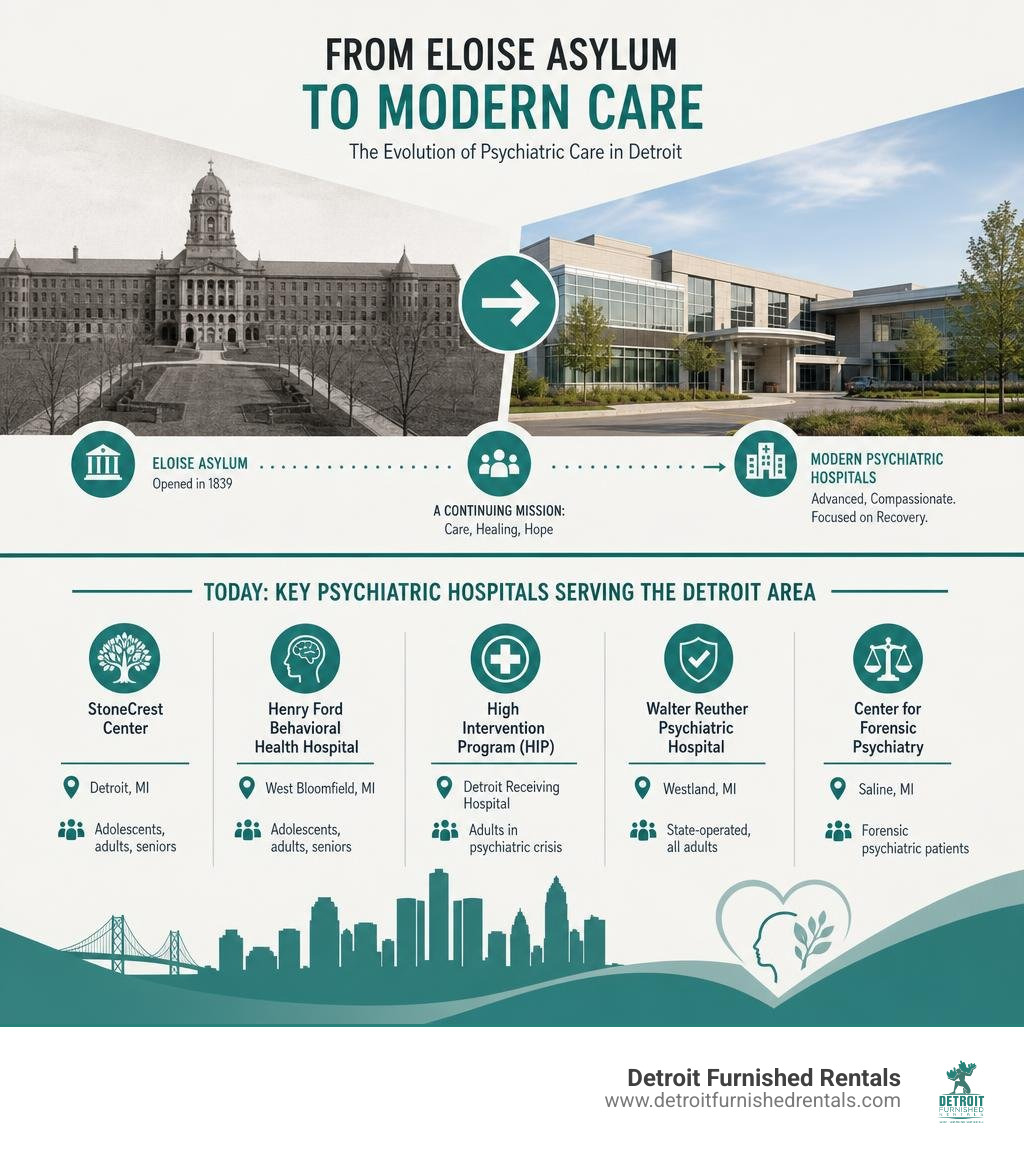
To truly understand how we treat mental health today, we have to look back at where we started. Detroit’s psychiatric history is deeply tied to one name that still sends a shiver down the spines of locals: Eloise. Long before we had the highly specialized, compassionate care models of June 2026, psychiatric care in Wayne County was concentrated in a massive, self-sustaining city-within-a-city.

Originally founded in 1832 as the Wayne County Poor House, the facility that would become the Eloise Psychiatric Hospital began on 280 acres of land purchased in 1834. What started as a refuge for 35 residents in 1839 quickly evolved. As Detroit’s population ballooned during the industrial boom, so did the need for psychiatric and medical care.
At its peak during the Great Depression, Eloise was an absolute titan. It housed more than 10,000 residents, patients, and staff. It wasn’t just a mental hospital Detroit residents relied on; it was a fully self-sufficient ecosystem. Eloise had its own police force, fire department, post office, railroad station, bakery, and active farm operations.
While historical treatment methods at Eloise included early, often crude psychiatric interventions, the facility was also a pioneer in several medical fields. It housed the very first kidney dialysis unit in the State of Michigan and was an early adopter of music therapy, recognizing the profound impact of creative expression on the human mind.
As psychiatric medicine shifted away from large, institutionalized custodial care toward community-based treatment, Eloise began a long, gradual wind-down. The psychiatric division started closing its doors in 1977, with the final patients transferred out in 1982. To fill the massive void left by its closure, the state opened the Walter P. Reuther Psychiatric Hospital in 1979 near the former Eloise property, transitioning Michigan’s public psychiatric care into a more modern era.
If you want to explore how these early foundations shaped our current medical landscape, you can Read about the history of Detroit hospitals to see the broader evolution of healthcare in our region.
The Legacy of Eloise Psychiatric Hospital
The stories left behind in the wake of Eloise are both historically significant and deeply woven into local folklore. Among its most notable residents was the famous inventor Elijah McCoy, who spent the final year of his life as a patient at Eloise before passing away in 1929. The facility was also the final resting place for several notable figures of the era, including professional baseball players Jul Kustus and Larry LeJeune.
Today, much of the massive complex has been demolished or redeveloped into a golf course, condominiums, and a strip mall. However, the historic Kay Beard Building—which once housed up to 400 patients—still stands as a quiet monument to the past.
In popular culture, the abandoned structures of Eloise have taken on a life of their own. Reputed to be highly haunted, the site has inspired numerous paranormal television investigations, books, and even a Hollywood horror film. While the ghost stories draw in thrill-seekers, we prefer to remember Eloise for the thousands of dedicated healthcare workers who did their best to provide sanctuary and pioneering care during a challenging era in medical history.
Finding a Modern Mental Hospital Detroit Residents Can Trust
Today, the landscape of psychiatric care in Southeast Michigan has evolved far beyond the institutional models of the past. Modern facilities focus on short-term, acute stabilization, evidence-based therapies, and smooth transitions back into community life. If you or a loved one is searching for a mental hospital in Detroit, you will find highly specialized, state-of-the-art facilities designed to treat specific age groups and psychiatric conditions.
We have moved away from isolating patients. Instead, our modern psychiatric network is integrated directly into our broader medical infrastructure. To see how these facilities fit into the city’s larger medical framework, you can Explore the comprehensive Detroit Hospital Systems.
StoneCrest Center: A Leading Mental Hospital Detroit Option for Specialized Care
Located right in the heart of the city, StoneCrest Center is widely recognized as a premier inpatient psychiatric hospital in Detroit, Michigan. StoneCrest prides itself on offering highly personalized, person-centered inpatient treatment in a secure, structured, and compassionate environment.
What makes StoneCrest stand out is its ability to treat a highly diverse range of patients across their entire lifespan. Their core programs include:
- Adolescent Program: Specialized care for teens dealing with acute emotional and behavioral struggles.
- Adult Program: Comprehensive stabilization for adults experiencing severe depression, bipolar disorder, schizophrenia, or PTSD.
- Generations Program: A dedicated track for seniors aged 55 and older, focusing on age-related mental health challenges, co-occurring disorders, and memory issues like Alzheimer’s disease and dementia.
- Developmental Disability Specialty: StoneCrest is unique in its structured support for adults who are developmentally disabled or struggle with intellectual disabilities alongside psychiatric diagnoses.
StoneCrest utilizes a multidisciplinary approach, blending traditional medical and psychiatric interventions with expressive therapies like art, music, and therapeutic recreation. They accept all commercial insurance plans, as well as Medicare and Medicaid, making high-quality care accessible to the broader Detroit community.
Henry Ford Behavioral Health Hospital: A State-of-the-Art Mental Hospital Detroit Facility
Marking a major milestone for mental healthcare in Southeast Michigan, the Henry Ford Behavioral Health Hospital officially admitted its first patients in January 2025. This brand-new, state-of-the-art, 192-bed facility was built through a joint venture between Henry Ford Health and Acadia Healthcare. Located in a therapeutic, wooded setting in West Bloomfield, it serves as a modern beacon of healing for adolescents, adults, and seniors across the metropolitan area.
The hospital was designed from the ground up to promote healing, featuring six secure outdoor spaces and abundant natural light. A cornerstone of their treatment philosophy is Dialectical Behavior Therapy (DBT), an evidence-based modality that helps patients build emotional regulation, mindfulness, and healthy distress tolerance.
The facility offers a full continuum of inpatient care, specializing in:
- Acute mood disorders (such as major depressive disorder and bipolar disorder)
- Thought disorders (including schizophrenia and schizoaffective disorders)
- Dual diagnosis and co-occurring substance use disorders
- Medical stabilization integrated with psychiatric care
Because this facility serves as an academic training site for psychiatry residents, medical students, and nurses, patients benefit from cutting-edge clinical practices. To understand how this facility fits into the larger Henry Ford network, you can Learn more about Henry Ford Hospital and its clinical legacy.
High Intervention Program (HIP) at Detroit Receiving Hospital
For those facing immediate, high-acuity psychiatric emergencies within the city limits, the High Intervention Program (HIP) at Detroit Receiving Hospital is a vital safety net. Operating inside one of Detroit’s premier urban trauma centers, HIP consists of two interconnected, highly specialized programs: a 24/7 Crisis Center (Psychiatric Emergency Room) and an Intensive Care Inpatient Psychiatry unit.
The statistics behind HIP speak to its incredible community impact:
- The Crisis Center serves more than 10,000 patients per year, providing immediate psychiatric evaluations.
- The team handles over 1,200 psychiatric consultations for the main medical emergency room annually.
- Through aggressive, individualized crisis intervention, the program boasts an inpatient admission rate of less than 30%, successfully stabilizing the majority of patients and connecting them to outpatient resources without requiring a long hospital stay.
For those who do require inpatient care, HIP operates a secure, 19-bed locked Intensive Care unit. This unit specializes in treating high-risk patients, including those with severe mood or psychotic disorders, acute suicidal ideation, high aggression, or complex comorbid medical and psychiatric conditions. If you need to understand the logistics of this central trauma hub, check out our Detroit Receiving Hospital Guide.
State-Operated Inpatient Psychiatric Hospitals in Michigan
While private and joint-venture hospitals handle a large portion of acute psychiatric admissions, the State of Michigan also operates its own inpatient psychiatric network. Managed by the Michigan Department of Health and Human Services (MDHHS), these state-operated facilities are fully accredited by The Joint Commission and focus on long-term care, forensic psychiatry, and specialized rehabilitation.
If you are looking for official state resources, policies, or patient rights forms, you can consult the State Operated Inpatient Psychiatric Hospitals directory.
| State Hospital | Location | Contact Number | Primary Focus & Specialization |
|---|---|---|---|
| Walter Reuther Psychiatric Hospital | Westland, MI | 734-367-8400 | Long-term psychiatric care and rehabilitation for adults. |
| Center for Forensic Psychiatry | Saline, MI | 734-429-2531 | Evaluates and treats patients involved in the legal system (forensic cases). |
| Caro Psychiatric Hospital | Caro, MI | 989-673-3191 | Long-term inpatient psychiatric care for adults. |
| Kalamazoo Psychiatric Hospital | Kalamazoo, MI | 269-337-3000 | The state’s oldest continuously operating psychiatric facility, serving adults. |
These state facilities provide critical long-term support for individuals who cannot be safely managed in short-term private units, ensuring that no resident is left without options for care.
Navigating Inpatient Psychiatric Care: Admissions, Therapies, and Discharge
Admitting a loved one to a mental hospital in Detroit can feel overwhelming, but understanding the structured process can bring peace of mind. Modern inpatient care is highly organized, focusing on rapid stabilization, intensive therapy, and proactive aftercare.
The Admission and Assessment Process
Except in rare circumstances, patients do not walk directly into an inpatient psychiatric unit. Instead, the admission process typically begins with a referral. This referral usually comes from an emergency room physician, a primary care doctor, or a community crisis center.
Upon arrival, every patient undergoes a comprehensive psychiatric and physical assessment. This assessment is used to create a highly customized treatment plan tailored to the individual’s unique needs, medical history, and co-occurring conditions.
Evidence-Based Treatment and Therapies
Once admitted, patients follow a highly structured daily schedule. Depending on the facility, treatment programs typically incorporate a blend of:
- Individual Therapy: One-on-one sessions with a therapist to process emotions and develop coping mechanisms.
- Group Therapy: Peer-led and clinician-guided sessions focusing on skill-building, managing symptoms, and sharing experiences.
- Family Therapy: Involving loved ones to improve communication and build a supportive home environment for long-term healing.
- Experiential Therapies: Creative outlets such as art, music, and recreational therapy to encourage self-expression.
- Medication Management: Continuous monitoring and adjustment of psychiatric medications by a licensed psychiatrist.
Length of Stay and Discharge Planning
In modern psychiatric care, inpatient stays are designed to be short-term. The average length of stay is 7 to 10 days, though this varies depending on how quickly a patient stabilizes.
Importantly, discharge planning begins the very day a patient is admitted. Social workers and discharge planners collaborate with the patient, their family, and outpatient providers to establish a secure aftercare plan. This plan might include appointments with outpatient therapists, partial hospitalization programs, or connections to local community support groups. To learn more about how these structured programs look in practice, you can read about Inpatient Psychiatric Care at Henry Ford Health.
Frequently Asked Questions about Detroit Psychiatric Care
How do I get admitted to a psychiatric hospital in Detroit?
Most inpatient psychiatric admissions begin in an emergency room. If you or a loved one is in crisis, going to the nearest emergency department is the fastest way to receive an assessment. The ER physician can write a referral for inpatient care. Alternatively, you can contact crisis centers like the High Intervention Program at Detroit Receiving Hospital, or reach out directly to intake specialists at private facilities like StoneCrest Center for a free, confidential screening. Admissions can be voluntary (the patient agrees to treatment) or involuntary (initiated by medical professionals or family members through a court petition when a patient poses an immediate danger to themselves or others).
What is the average length of stay for inpatient mental health treatment?
The average length of stay in an acute mental hospital Detroit facility is 7 to 10 days. The primary goal of inpatient care is acute stabilization—getting a patient through the immediate crisis, adjusting medications safely, and establishing a plan for ongoing outpatient care. It is not meant for long-term residency.
What insurance plans are accepted at Detroit mental health facilities?
Most major inpatient psychiatric hospitals in the Detroit area accept a wide variety of insurance plans. This includes major commercial insurance providers, as well as Medicare and Medicaid. Additionally, every state and private facility has dedicated Office of Recipient Rights staff on-site. These advocates ensure that patient rights are protected, that care is delivered ethically, and that patients have access to advocacy resources throughout their stay.
Conclusion
Navigating psychiatric care is a deeply personal journey, whether you are researching the historic roots of Detroit’s medical systems or looking for immediate, modern care for a loved one. From the historic legacy of Eloise to the state-of-the-art, therapeutic environments of our newest 2025 and 2026 facilities, Detroit continues to expand and refine its mental health resources.
If you are a traveling medical professional, a psychiatric resident, or a family member coming to the city to support a loved one during their treatment, finding a comfortable, peaceful place to stay is essential. At Detroit Furnished Rentals, we specialize in offering fully equipped, centrally located, and pet-friendly short to mid-term furnished apartments throughout Detroit, Michigan. We aim to provide a quiet, stress-free sanctuary so you can focus on what matters most: health, healing, and family.
To help plan your time in the city and find the most convenient accommodations near our major medical centers, Plan your stay with our Detroit Hospitals Guide. We are here to welcome you home.