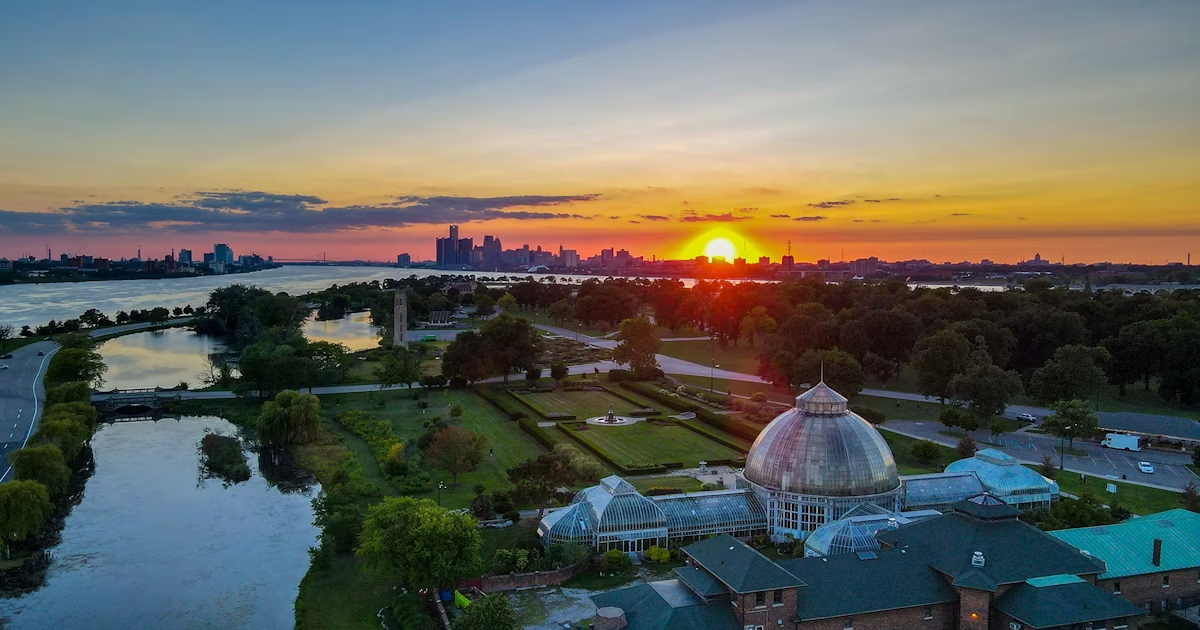
Detroit Belle Isle: The Island Park You Need to Visit in 2026
Detroit Belle Isle is a 982-acre island park sitting in the Detroit River, just minutes from downtown. It is the largest city-owned island park in the United States and draws more than 5 million visitors a year.
Here’s what you need to know at a glance:
| Feature | Details |
|---|---|
| Location | Detroit River, connected via MacArthur Bridge |
| Size | 982 acres (1.534 sq mi) |
| Park Hours | Daily, 5:00 AM – 10:00 PM |
| Vehicle Entry | Michigan Recreation Passport required |
| Pedestrians & Cyclists | Free access |
| Top Attractions | Aquarium, Conservatory, Scott Fountain, Dossin Museum, Oudolf Garden |
| Management | Michigan DNR + Belle Isle Conservancy |
| Trail Access | Southern trailhead for Michigan’s Iron Belle Trail |
Whether you’re visiting for a morning run, a family outing, or a weekend of exploring Detroit’s history, Belle Isle has something for everyone — all within a short drive or bike ride from the city.
I’m Sean Swain, founder of Detroit Furnished Rentals. I’ve spent years exploring Detroit Belle Isle as a local — from biking its 5.4-mile loop to visiting its aquarium and gardens — and I know why it’s one of the first places I recommend to every guest who stays with us. Read on for everything you need to plan the perfect visit.

Detroit belle isle terminology:
What is Detroit Belle Isle? Location, Size, and Significance
To understand Detroit, you have to understand Detroit Belle Isle. This stunning 982-acre island park is the crown jewel of our city’s public spaces. Situated in the middle of the Detroit River, it sits right on the international border between the United States and Canada. When you stand on the island’s southern shores, you are treated to spectacular, unobstructed views of Windsor, Ontario, while the northern side offers a breathtaking panorama of the rising Detroit skyline.
In terms of scale, Belle Isle is a heavyweight. Spanning 982 acres (approximately 1.534 square miles), it is the largest city-owned island park in the United States—even eclipsing New York City’s Central Park in physical acreage. It is also the third largest island in the Detroit River, surpassed only by Grosse Ile and Fighting Island.
According to Belle Isle Park on Wikipedia, the island is the second most-visited state park in the United States, trailing only the legendary Niagara Falls State Park in New York. For millions of Michiganders and global travelers alike, this island is more than just a park; it is an escape, a historical landmark, and a vibrant community hub. Accessible from mainland Detroit via the iconic MacArthur Bridge at Jefferson Avenue, it serves as a natural sanctuary where city life seamlessly blends with the quiet rhythms of the river.
The Rich History of Belle Isle: From Hog Island to State Park
Long before Belle Isle became a manicured public park, it had a very different reputation. In the 18th century, French settlers referred to the island as Île aux Cochons (Hog Island). The name was literal: local colonists used the isolated land to let their pigs and livestock roam free, protecting them from mainland wolves.
As the city grew, Detroiters recognized the island’s potential as a scenic escape. On July 4, 1845, a group of patriotic picnickers decided the island deserved a much more elegant name. They officially rechristened it Belle Isle in honor of Miss Isabelle Cass, the daughter of Michigan Governor Lewis Cass.
In 1879, the City of Detroit purchased the island from private owners for $200,000. To turn this swampy pasture into a world-class civic space, the city hired Frederick Law Olmsted, the legendary landscape architect behind Central Park. While only portions of Olmsted’s grand vision were fully realized, his philosophy of preserving natural woodland areas while creating open, accessible spaces still guides the park’s layout today.
Over the next century, the park grew in popularity and physical size. Between 1921 and 1923, the island was expanded by 24.5 acres using landfill material from city construction projects to make room for the construction of the Scott Fountain. It also played host to historical milestones and oddities alike. In 1908, automotive pioneer Byron Carter suffered an injury on Belle Isle while trying to hand-crank a stranded motorist’s car. Sadly, he passed away from complications, a tragedy that directly motivated Cadillac’s Henry Leland to sponsor the invention of the electric self-starter—changing the automotive industry forever.
By the early 2000s, decades of deferred maintenance and Detroit’s financial struggles had taken a heavy toll on the island. When the city filed for bankruptcy in 2013, a creative solution was needed. In late 2013, the city and state signed a 30-year lease agreement, officially transitioning management of the park to the Michigan Department of Natural Resources (DNR) on February 10, 2014.
This transition was initially met with mixed emotions from local residents, as detailed in the journalistic review of History of Belle Isle’s transition. However, the state’s management brought massive, much-needed capital funding to restore the island’s crumbling infrastructure.
| Feature / Era | City of Detroit Management (Pre-2014) | Michigan DNR State Management (2014 – Present) |
|---|---|---|
| Annual Budget | Approx. $950,000 | Millions in dedicated state/federal operating funds |
| Capital Investment | Heavily deferred; estimated $350M in backlogged repairs | Over $144 million invested in renovations and infrastructure |
| Restrooms & Pavilions | Many closed, vandalized, or without running water | Fully renovated, modern, and regularly maintained restrooms |
| Roads & Traffic | Unenforced speed limits (avg. 45 mph); crumbling roads | Paved roads, strictly enforced 25 mph limit, new two-way bike track |
| Vehicle Entry Fee | Free vehicle entry | Michigan Recreation Passport required ($14/year for residents) |
| Historic Attractions | Frequent closures (Aquarium closed from 2005 to 2012) | Reopened, modernized, and heavily funded historical landmarks |
Top Attractions and Things to Do on the Island
Today, Belle Isle is a thriving playground of cultural institutions, historic architecture, and natural wonders. Whether you are a history buff, a garden enthusiast, or an active athlete, you can easily spend a full day exploring everything the island has to offer.

One of the newest and most popular additions to the island is the Oudolf Garden Detroit. Opened to the public recently, this 3-acre masterpiece was designed by the world-renowned Dutch garden designer Piet Oudolf (the creative force behind New York City’s High Line). The garden features 35,000 locally grown perennials, masterfully arranged into 1,500 distinct plant groupings across 15 beds. It is designed to look beautiful in all four seasons, offering a peaceful, artistic retreat.
For those interested in maritime history, the Dossin Great Lakes Museum is a must-visit. Spanning 16,000 square feet, the museum showcases Detroit’s historic role in Great Lakes shipping and features one of the largest collections of model ships in the world. Visitors can step inside the actual restored pilot house of the S.S. William Clay Ford to look out over the Detroit River.
As you travel along the eastern tip of the island, keep an eye out for the William Livingstone Memorial Light. Standing proudly along the shoreline, this is the only lighthouse in the United States constructed entirely of white Georgian marble.
Exploring the Historic Detroit Belle Isle Aquarium and Conservatory
No trip to Belle Isle is complete without visiting the historic pairing of the Belle Isle Aquarium and the Anna Scripps Whitcomb Conservatory. Designed by Detroit’s legendary architect Albert Kahn, both structures opened on the exact same day: August 18, 1904.
The Belle Isle Aquarium is a true architectural marvel. As the oldest continually operating public aquarium in North America, it welcomes visitors into a 10,000-square-foot gallery boasting a spectacular vaulted ceiling lined with green glass tiles. The tiles were designed to make visitors feel as though they are walking underwater. After undergoing a massive $10 million renovation, the aquarium remains open to the public from Thursday to Sunday, 10:00 AM to 4:00 PM, with free admission (though a $5 donation is warmly encouraged).
Directly next door sits the Anna Scripps Whitcomb Conservatory. This beloved institution features a soaring 85-foot-high central dome with a total volume of 100,601 cubic feet. It houses an exotic collection of flora, including one of the most significant municipally owned orchid collections in the country. To ensure you don’t miss out on seasonal hours or temporary closures, we always recommend you Plan Your Visit via Belle Isle Conservancy.
The James Scott Memorial Fountain: A Marble Masterpiece
Perhaps the most dramatic landmark on the island is the James Scott Memorial Fountain. Completed in 1925, this sprawling white marble fountain was designed by architect Cass Gilbert (who also designed the U.S. Supreme Court building) and sculptor Herbert Adams.
The fountain’s history is as colorful as its water displays. It was funded by a $500,000 bequest from James Scott, a notoriously eccentric and controversial Detroit real estate speculator. Despite his reputation, Scott left his fortune to the city on one condition: they had to build a massive fountain in his honor, complete with a life-sized bronze statue of himself.
The city agreed, and the result is an absolute masterpiece. The fountain features a lower bowl with an incredible diameter of 510 feet, and its powerful central spray shoots water up to 125 feet into the air. It is a favorite gathering spot for locals and visitors alike to cool off on warm summer days. For a deeper dive into the fountain’s fascinating history, check out our guide on the James Scott Memorial Fountain: Belle Isle’s Marble Masterpiece. And if you love historic Detroit water features, you’ll also want to read our guide to another downtown legend: Splash into History: Discover the Horace Dodge Fountain.
Outdoor Recreation and Sports on Detroit Belle Isle
For outdoor enthusiasts, Belle Isle is an unparalleled urban playground. The island is one of the official termini for Michigan’s cross-state Iron Belle Trail. The journey begins (or ends) at the beautiful Ralph Wilson Gateway, which serves as the official southern trailhead.
If you love to move, you’ll find plenty of space here:
- Biking & Running: The island features a 5.4-mile scenic outer loop and a 5.8-mile flat paved loop. Thanks to recent infrastructure improvements, Central Avenue has been transitioned to two-way traffic, accompanied by a dedicated, separated bicycle lane that makes navigating the island on two wheels safer than ever. Read more about routes in our article on Belle Isle Park: Detroit’s Island Oasis for Biking & Running.
- Paddling & Kayaking: With an accessible kayak/boat launch, the island’s calm inland canals and the surrounding river are perfect for paddling.
- Swimming: The island features a dedicated swim beach with beautiful sandy shores, perfect for relaxing on a hot summer afternoon.
- Golfing: Golfers can practice their swing at the Belle Isle Golf range, which even hosts community events like “Founders on the Fairway” golf clinics.
To get a visual sense of the island’s layout and plan your outdoor route, take a look at The Best of Belle Isle.
Planning Your Visit: Hours, Recreation Passport, and Parking
Planning a trip to Belle Isle is simple, but there are a few key rules to keep in mind to ensure a smooth visit.
- Hours: The park is open daily from 5:00 AM to 10:00 PM. On major event days, the island opens at 5:00 AM to pedestrians and cyclists, but vehicle access may be restricted.
- Recreation Passport: To bring a vehicle onto the island, you must have a Michigan Recreation Passport. As of June 2026, the passport costs $14 annually for Michigan residents (purchased during vehicle registration or via self-pay stations at the park entrance). Out-of-state vehicles can purchase a daily or annual pass at the gate.
- Free Entry Options: If you walk, run, or ride a bicycle across the MacArthur Bridge, entry is 100% free! Additionally, the Detroit Department of Transportation (DDOT) operates the #12 Conant bus route, which runs directly onto the island every 60 minutes, allowing passengers to visit without needing a vehicle passport.
- Parking & EV Charging: Parking is free in designated lots throughout the island. Do not park on the grass or outside marked spaces, as park rangers strictly enforce parking rules. For eco-conscious travelers, fast-charging EV stations are conveniently located in the Belle Isle Nature Center parking lot.
- Capacity Limits: Because of the park’s popularity, the island has a vehicle limit of approximately 3,200 cars. During peak summer weekends or holidays, the MacArthur Bridge may close to vehicle traffic for up to two hours once capacity is reached. To stay ahead of the crowds, you can text GEM to 80888 to receive real-time updates on island capacity and traffic closures.
Note for June 2026 visitors: That during major summer events, such as the annual Ford Fireworks, the island is closed to all vehicle traffic until 2:00 PM.
Recent Renovations, Management, and Future Projects
Since transitioning to a state park, Belle Isle has benefited from an incredible influx of funding and community support. The park is managed through a close partnership between the Michigan DNR and the Belle Isle Conservancy, a dedicated non-profit organization that has raised over $16 million for the park since 2012.
Recently, the state utilized $35.25 million in federal American Rescue Plan Act (ARPA) funding to kickstart several major restoration projects:
- The Belle Isle Aquarium: Received a $10 million modernization to update its historic infrastructure while maintaining its classic Albert Kahn charm.
- The Belle Isle Casino: A historic building used for weddings and community gatherings (which was never actually a gambling hall!), the Casino received $10 million in structural and aesthetic improvements.
- James Scott Memorial Fountain: A $6 million project was launched to restore and modernize the fountain’s lower bowl and water filtration systems.
One of the biggest ongoing discussions on the island surrounds the historic Belle Isle Boathouse (formerly the Detroit Boat Club). Built in 1902, this beautiful structure requires an estimated $40 million to $50 million in repairs. The DNR is actively working with the community, reviewing public comments, and exploring preservation strategies to save this historic landmark.
Want to give back during your stay? The Belle Isle Conservancy hosts the Keep Belle Isle Beautiful (KBIB) cleanup program, offering volunteer cleanup opportunities on Fridays and Saturdays through October. It’s a fantastic way to enjoy the fresh river air while keeping our beloved island pristine.
Frequently Asked Questions About Belle Isle
Is Belle Isle Park free to enter?
Yes, if you enter on foot, by bicycle, or via public transit. However, if you are driving a vehicle, you must have a Michigan Recreation Passport. This passport costs $14 for Michigan residents and can be purchased at the island’s entry gate self-pay stations.
Are dogs allowed on Belle Isle?
Yes! Belle Isle is incredibly pet-friendly. Dogs are welcome throughout the park as long as they are kept on a leash (maximum 6 feet in length). It is the perfect spot for a “dog day afternoon” stroll along the shoreline, though please remember to clean up after your furry friend.
Is Belle Isle Park wheelchair accessible?
Absolutely. The Michigan DNR and the Belle Isle Conservancy have made accessibility a top priority. The island features ADA-compliant modern restrooms, wheelchair-accessible pathways to major landmarks, an accessible playground with a rubberized surface in Kids Row, an accessible fishing pier, and an accessible kayak launch.
Conclusion
Detroit Belle Isle is more than just a park—it is a living testament to Detroit’s resilience, history, and natural beauty. From its historic aquarium to the modern blooms of the Oudolf Garden, it is a place where memories are made.
At Detroit Furnished Rentals, we love helping visitors experience the very best of our city. If you are planning an extended stay in Detroit, we offer beautiful, centrally located short- and mid-term furnished apartments. Our rentals are fully pet-friendly and come equipped with fully stocked kitchens and dedicated workspaces—ideal for working professionals and traveling families alike.
For a luxurious stay just minutes from the island, check out our stunning Detroit Belle Isle Loft and take a virtual tour with our Detroit Belle Isle Loft Walkthrough Video.
Ready to plan your Detroit adventure? Book your stay with us today, pack your running shoes, and get ready to experience the magic of Belle Isle. Don’t forget to check out our weekly guide to Detroit Events This Weekend to see what exciting activities are happening around town!