In May 2026, sellers outnumbered buyers in the U.S. housing market by approximately 47%, a shift that often leaves homeowners caught in a high-stakes waiting game. You’ve likely felt the pressure of finding housing between selling and buying a house while trying to maintain your professional routine and family sanity. It’s exhausting to imagine living out of a suitcase in a cramped hotel or dealing with the logistical nightmare of a double move. We understand that you aren’t just looking for a temporary roof; you’re looking for a sanctuary where your pets can settle and your remote work remains uninterrupted.
This guide reveals how to bridge the real estate gap with sophisticated, move-in ready housing solutions that offer both comfort and flexibility. You’ll discover how to trade the friction of transition for a seamless, elevated living experience in a space that feels curated for your specific lifestyle. We will explore the most effective strategies for securing furnished lofts and mid-term rentals that provide the stability you need to focus on your next big move. From understanding the 2026 tax landscape to selecting a neighborhood that feels like home, we provide the roadmap for a transition that feels less like a crisis and more like a retreat.
Key Takeaways
- Understand why 30 to 90 day gaps are the new standard in the 2026 real estate market and how to align your timeline without the usual stress.
- Navigate the complexities of finding housing between selling and buying a house by prioritizing move-in ready sanctuaries over cramped, soul-less hotels.
- Master the logistics of a “Two-Move” strategy to keep your professional routine and family life running smoothly while your major belongings remain in storage.
- Evaluate the true cost of your transition by looking beyond daily rates to the lifestyle benefits of integrated amenities and local convenience.
- Discover how curated aesthetics and domestic comfort can transform a period of limbo into a refreshing chapter of urban exploration and peace.
Navigating the Housing Gap: Why Real Estate Timelines Rarely Align
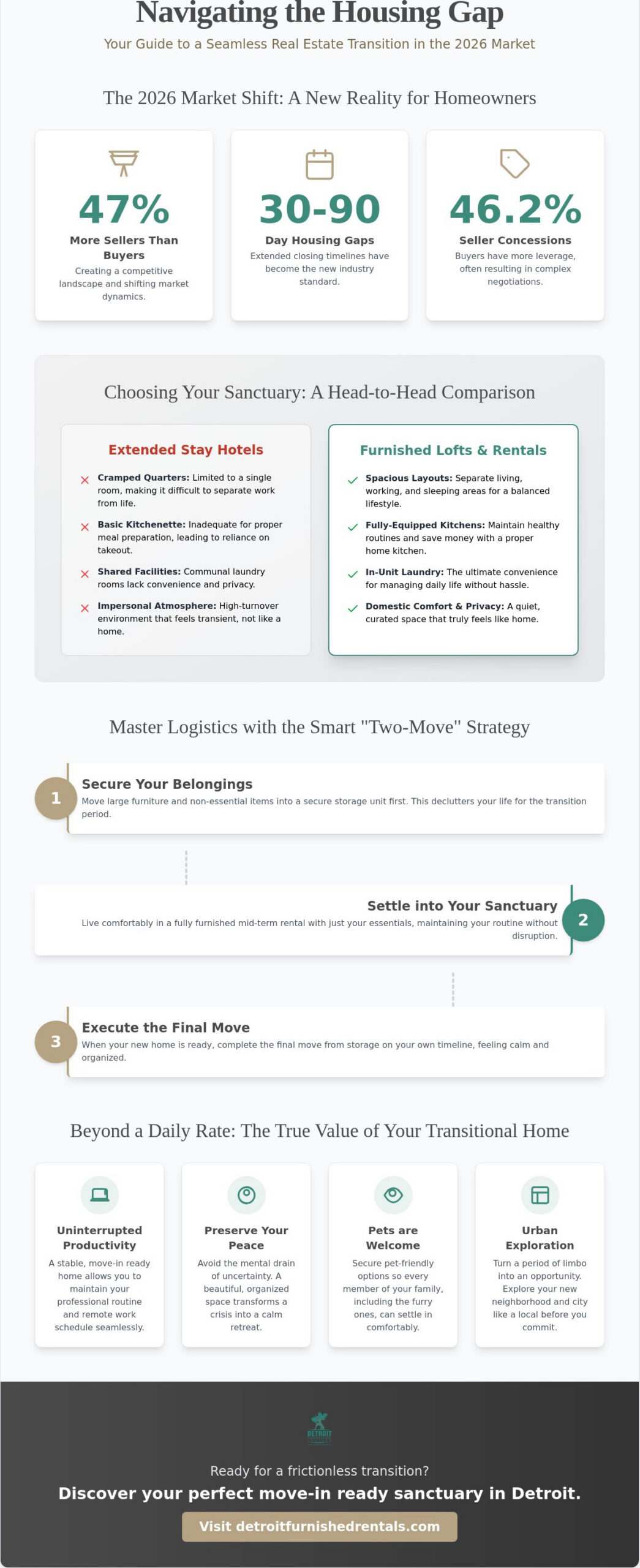
The real estate market in 2026 presents a unique paradox. While sellers currently outnumber buyers by nearly 47%, the logistics of a smooth handover have become increasingly complex. The “housing gap” is that often stressful interval between the day you hand over the keys to your old life and the moment you finally unlock the door to your new one. In the current climate, 30 to 90 day transitions are no longer outliers; they’re the new industry standard. Finding housing between selling and buying a house requires more than a temporary roof. It demands a space that supports your existing life without the friction of a traditional hotel. With seller concessions reaching 46.2% this spring, buyers have more leverage to negotiate, but those negotiations often result in extended closing timelines that leave families in limbo.
While many look toward Short-term rental options for a quick fix, these often fail to meet the needs of a modern professional. A hotel room lacks the soul and functionality of a home. This is why mid-term rentals have emerged as the strategic choice. Defined as fully furnished stays exceeding 30 days, these properties offer the stability of a residential lease with the flexibility of a boutique stay. They bridge the gap by providing a move-in ready sanctuary that feels like a destination rather than a compromise.
Common Scenarios for Temporary Housing
The path to a new home is rarely a straight line. You might face the “Sold but Not Closed” dilemma, where financing hurdles or construction delays on a new build push your move-in date back by months. Perhaps a career opportunity has whisked you to a new city before you’ve even had a chance to scout the local neighborhoods. In other cases, homeowners choose to renovate their new purchase extensively before move-in day—a perfect time to discover Crome Mechanical and plan for modern HVAC upgrades like heat pump installations. These situations require a reliable landing spot that won’t disrupt your daily flow. A furnished apartment or loft serves as the perfect buffer, allowing you to oversee your transition with a clear head.
The Psychological Impact of Move-In Readiness
Comparing Temporary Housing Options: From Hotels to Furnished Sanctuaries
Choosing the right landing spot while finding housing between selling and buying a house is a decision that impacts your mental well-being as much as your wallet. While some platforms suggest extended-stay hotels as a primary fix, these spaces often prioritize high turnover over domestic comfort. You deserve more than a cramped kitchenette and a shared laundry room. Exploring diverse housing options during your transition reveals that the most successful moves happen when the temporary environment mirrors the quality of the home you just left. Whether you are dealing with a delayed closing or a cross-country relocation, your environment should act as a sanctuary, not a compromise.
Furnished Apartments vs. Extended Stay Hotels
Furnished apartments and lofts offer a level of separation that hotels simply cannot match. Having a distinct bedroom and a dedicated living area allows you to mentally “clock out” of the day, which is essential when managing the paperwork of a home purchase. The “full kitchen” factor is also a major health benefit; avoiding constant takeout preserves your energy and budget during a high-stress period. Residential buildings provide a sense of security and quiet that is often missing from busy hotel corridors, giving you the peace of mind needed to focus on your next chapter.
The Benefits of Professional Mid-Term Management
Professional mid-term management bridges the gap between cold corporate housing and unpredictable vacation rentals. You get the benefit of high-speed internet and ergonomic workspaces as a standard, not an afterthought. These curated lofts feature high-end interiors that celebrate local architecture, making your stay feel like an intentional lifestyle choice rather than a logistical hurdle. Booking is effortless; you avoid the steep security deposits and rigid terms of traditional 12-month leases. For those seeking a truly frictionless path, browsing available furnished apartments offers a cleaner break and a fresh start.
Rent-back agreements are another common option, but they carry significant risks. You essentially become a tenant in your own sold home, which can lead to legal friction if repairs are needed or if the buyer’s financing experiences a last-minute hiccup. Vacation rentals, while charming for a weekend, often lack the essential amenities like full-sized appliances or reliable Wi-Fi required for a two-month stay. Finding housing between selling and buying a house should feel like a relief, providing you with a move-in ready space that accommodates your pets, your work, and your peace of mind.
The Logistics of Living in Limbo: Managing Storage, Pets, and Routine
Finding housing between selling and buying a house requires a tactical approach to your physical belongings and your daily rhythm. The “Two-Move” strategy is the most effective way to manage this period. It involves placing the majority of your household goods into long-term storage while moving into a furnished space with only your essentials. This prevents the exhaustion of unpacking and repacking your entire life twice within a few months. By separating what you need for daily life from what you need for your future home, you create a lighter, more agile transition.
Managing Your Belongings
Deciding between pod storage and traditional units depends on your specific timeline and accessibility needs. Pods offer the convenience of being packed at your own pace and transported directly to your final destination, but traditional units often provide better climate control. In 2026, national averages for climate-controlled storage range from $1.15 to $1.80 per square foot. This investment is crucial for protecting electronics, artwork, and wooden furniture during a 60 or 90 day gap. Your “Essentials Kit” should include sixty days of professional attire, necessary tech, and comfort items that make a temporary space feel personal. Security is also a priority; ensure your storage provider offers 24-hour monitoring and individual unit alarms to protect your household legacy.
Transitioning with Pets and Family
A signature element of a successful transition is finding housing that welcomes every member of the family. Standard hotels often impose restrictive pet policies or lack the square footage for a large dog’s bed, which can increase the stress of an already chaotic period. Opting for pet-friendly furnished apartments ensures that your four-legged companions feel the same sense of relief and belonging as you do. These residential spaces provide the room to maintain a “home base” for children, which is especially vital if the move occurs during the school year.
Maintaining professional continuity is equally paramount. Your temporary sanctuary should provide a dedicated workspace and reliable high-speed internet from the moment you walk through the door. This allows you to manage your career and the closing details of your new home without the static of a poor connection or a makeshift desk. When your routine remains intact, the housing gap transforms from a logistical nightmare into a manageable, even enjoyable, interlude.
- Essentials: Professional wardrobe, personal electronics, and important documents.
- Comforts: Favorite pillows, a few books, and family photos.
- Pet Needs: Familiar bedding, toys, and a supply of their preferred food.
- Work: Laptops, chargers, and any specialized equipment for your remote setup.
Evaluating the Real Cost of Temporary Housing Between Homes
When you are finding housing between selling and buying a house, the sticker price of a nightly rate rarely tells the whole story. A sophisticated financial strategy for your transition looks beyond the base cost to account for the lifestyle friction that drains your bank account and your energy. While staying with family might seem like the most economical choice, the hidden costs of lost privacy and professional productivity often outweigh the savings. A true sanctuary provides a return on investment by preserving your mental clarity during a high-stakes real estate transaction. You aren’t just paying for a bed; you are investing in a seamless environment that allows you to focus on your upcoming closing.
Hidden Costs of Extended Hotel Stays
The “Takeout Tax” is perhaps the most significant drain on a family’s budget during a sixty-day hotel stay. Without a private, fully equipped kitchen, you are forced into a cycle of expensive restaurant meals and delivery fees that can easily add thousands to your relocation expenses. Hotels also tend to nickel-and-dime guests with laundry fees and daily parking surcharges that aren’t always apparent at booking. Perhaps most costly is the loss of productivity. Trying to lead a remote team or manage complex mortgage paperwork from a cramped, noisy hotel room creates a level of stress that leads to “relocation burnout.”
Strategic Budgeting for the Gap
Mid-term rentals offer a more transparent and manageable financial model for stays exceeding thirty days. These properties typically bundle high-speed Wi-Fi, utilities, and professional cleaning services into a single, predictable monthly rate. This eliminates the logistical friction of managing multiple accounts for a short period. The average cost-benefit of corporate housing often outperforms luxury hotels by providing a residential scale that significantly reduces daily living expenses.
It is also wise to consider the 2026 tax landscape during your move. With the State and Local Tax (SALT) deduction cap increased to $40,000 through 2029, homeowners have more breathing room in their overall financial planning. If you are relocating for a new role, your employer may offer reimbursements that cover mid-term stays, provided they meet professional standards. To ensure your transition remains within budget without sacrificing comfort, you can view our move-in ready lofts to see how quality housing pays for itself in peace of mind.
- Dining: A full kitchen can save a family of four over $2,000 a month compared to dining out.
- Laundry: In-unit washers eliminate weekly service fees and the hassle of shared facilities.
- Productivity: A dedicated workspace prevents the professional setbacks of a “living out of a suitcase” lifestyle.
- Parking: Residential stays often include secure, on-site parking at a fraction of hotel valet rates.
Seamless Transitions: Choosing Move-In Ready Housing for Your Next Chapter
The final stage of finding housing between selling and buying a house should feel like the beginning of a new adventure, not the conclusion of a stressful ordeal. Move-in ready housing serves as the ultimate stress-reliever by removing the immediate pressure to find a permanent home in an unstable market. In 2026, where market dynamics demand patience and precision, you have the luxury of time to wait for the perfect deal to close. A curated sanctuary allows you to unpack your mind while your physical belongings remain safely tucked away in climate-controlled storage. This period of transition is an opportunity to live intentionally in a space designed for your comfort and professional success.
The Hallmark of a Quality Mid-Term Rental
Identifying a professional-grade provider requires looking past the surface-level photos. A quality mid-term rental is defined by an obsessive attention to detail that mirrors the hospitality of a boutique hotel. You should expect premium linens that invite rest, fully stocked kitchens that encourage a home-cooked meal, and curated interiors that respect the local architecture. Professional management is the backbone of this experience. It ensures that you have support if the Wi-Fi falters or if you need a local recommendation for the best commute. These properties aren’t just rentals; they’re managed lofts and apartments that prioritize your peace of mind through a seamless, digital-first check-in process.
Making the Leap to Your New Home
One of the hidden advantages of a mid-term stay is the ability to “test drive” a neighborhood before committing to a thirty-year mortgage. You can explore the local cultural fabric, sample the nearby cafes, and understand the nuances of the morning traffic without the weight of ownership. When your new keys are finally in hand, the process of “checking out” is as effortless as your arrival. There are no long-term leases to break or utility accounts to close. You simply gather your essentials and move toward your next chapter with your energy intact. To ensure a frictionless exit, follow this final checklist:
- Audit your storage: Schedule your movers for the new property at least three weeks in advance.
- Forward your mail: Update your address from your temporary sanctuary to your permanent residence.
- Digital handover: Ensure all work files and remote setups are ready for the final move.
- Personal items: Do a final sweep for chargers, documents, and pet toys before handing back the digital keys.
Choosing the right bridge housing means you don’t have to put your life on hold while the market settles. By prioritizing quality and professional oversight, you transform a logistical gap into a period of organized luxury. You’ve navigated the complexities of finding housing between selling and buying a house; now, it’s time to enjoy the sanctuary you’ve chosen for your transition.
Embrace a Frictionless Transition to Your New Home
Finding housing between selling and buying a house doesn’t have to feel like a compromise. You’ve seen how to navigate the 2026 real estate gap by prioritizing move-in ready sanctuaries that support both your professional productivity and your family’s comfort. By choosing a space with curated aesthetics and a fully equipped kitchen, you avoid the mental drain of hotel living while protecting your budget from hidden costs. This bridge period is a unique opportunity to explore new neighborhoods with the ease of a local, all while your household legacy remains secure in storage.
We provide a curated selection of move-in ready lofts and apartments specifically tailored for professionals and relocating families. Our seamless booking process for mid-term stays ensures your transition is defined by a sense of relief and belonging. Discover move-in ready lofts and apartments for your next transition and secure the peace of mind you deserve. Your next chapter is waiting, and it begins with a space that feels like home from the moment you step through the door.
Frequently Asked Questions
What is the best housing option between selling and buying a house?
Furnished lofts and mid-term rentals represent the gold standard for professionals navigating this transition. These spaces provide the domestic ease of a full home without the cramped limitations of a hotel suite. You’ll find that a residential atmosphere preserves your sanity and allows for a seamless daily rhythm. It’s about choosing a sanctuary that respects your need for space, style, and professional reliability while you wait for your new keys.
How long can I stay in a mid-term rental during a real estate gap?
Mid-term rentals are designed for flexibility, typically accommodating stays from 30 days to six months or more. This is particularly useful in the 2026 market where closing dates can shift unexpectedly due to financing or construction delays. You can easily extend your stay to match your specific real estate timeline. This ensures you aren’t left scrambling for a new roof if your move-in date is pushed back by a few weeks.
Are furnished apartments more expensive than hotels for a two-month stay?
Furnished apartments are often significantly more affordable than hotels for any stay exceeding a few weeks. When you factor in the “takeout tax” and hotel service fees, the savings of having a private kitchen and in-unit laundry become clear. You avoid the daily parking surcharges and premium laundry costs that inflate hotel bills. It’s a strategic financial choice that prioritizes your budget without sacrificing the premium quality of your living environment.
Can I find pet-friendly housing for the period between houses?
Finding housing between selling and buying a house that welcomes pets is entirely possible through professional rental platforms. Unlike many hotels with restrictive weight limits or “no-pet” zones, furnished apartments often cater to families with four-legged members. These properties provide the square footage your pets need to feel settled and safe. It’s an essential feature for maintaining family stability and peace of mind during a major life transition.
What is a rent-back agreement and should I use one?
A rent-back agreement is a legal arrangement where you remain in your sold home as a tenant for a set period. While it eliminates the need for a double move, it can create significant legal friction if property damage occurs or if the buyer’s situation changes. Many professionals prefer the clean break of a move-in ready loft. This avoids the awkwardness of being a guest in a space you no longer own.
How do I handle my mail and utilities during a temporary move?
You should set up a temporary mail forwarding service with the post office and choose a rental that includes all-inclusive utility billing. Professional mid-term stays typically bundle high-speed internet, electricity, and water into your monthly rate to eliminate logistical hurdles. This allows you to focus on your real estate transaction rather than managing multiple service accounts. It’s a simple way to keep your daily life running smoothly during the gap.
What amenities should I look for in a mid-term rental for remote work?
Look for a dedicated ergonomic desk, high-speed Wi-Fi, and a layout that offers a quiet separation between work and living areas. A sanctuary-like environment is vital for maintaining your professional productivity when your personal life is in flux. Ensure the property is located in a residential neighborhood to minimize the noise of high-turnover tourist areas. These amenities transform a temporary stay into a high-functioning home office that supports your career.
Is it better to stay with family or rent a furnished apartment?
Renting a furnished apartment is usually the superior choice for preserving your privacy and professional routine. While family offers a warm welcome, the lack of dedicated space and the potential for strained relationships can add to relocation stress. A private loft provides the autonomy you need to manage your move with dignity. It allows you to host family for dinner rather than living in their guest room for months during your transition.