Why the Gordie Howe International Bridge Matters for Detroit and Beyond
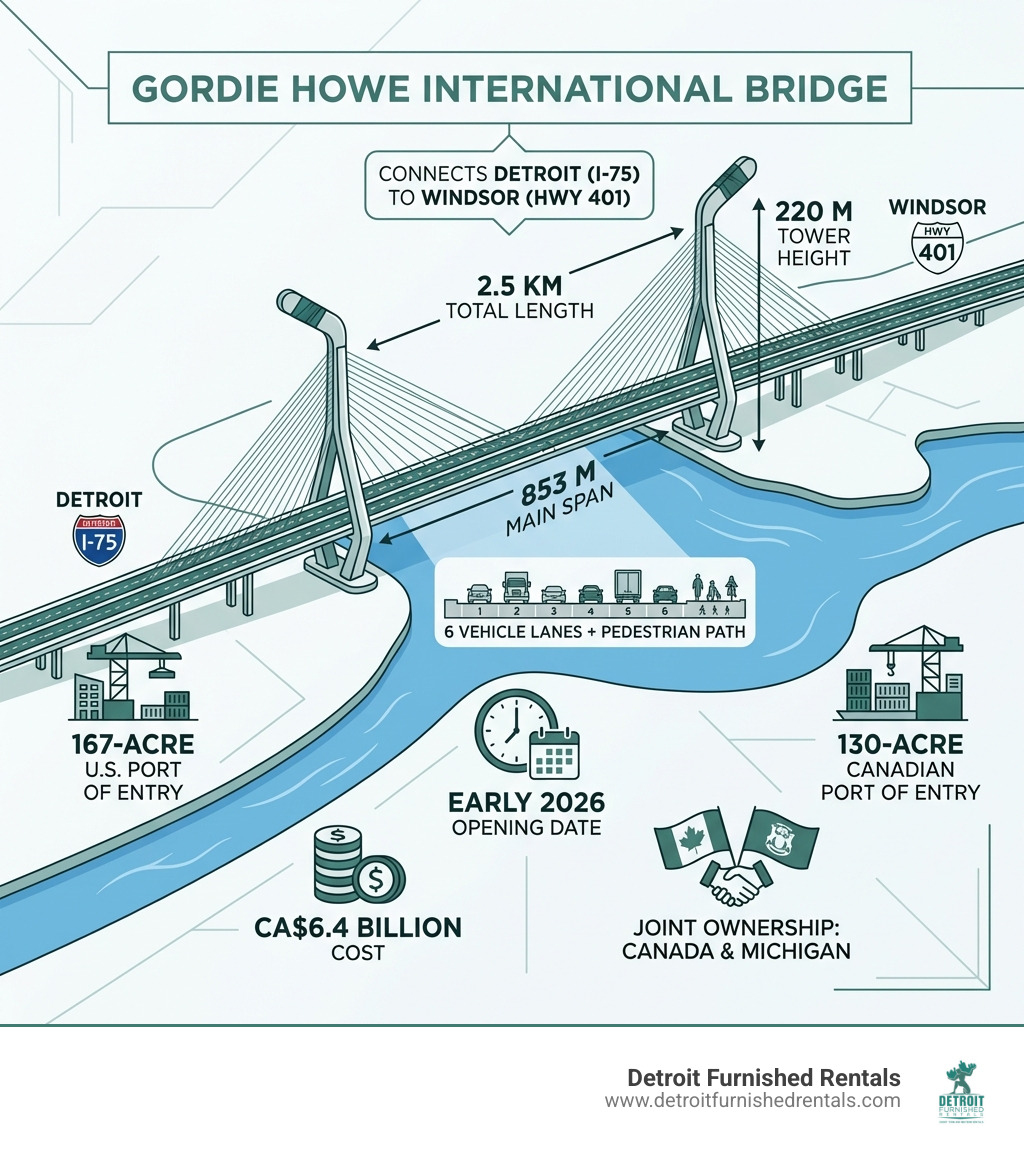
The Gordie Howe International Bridge is a 2.5-kilometer cable-stayed bridge connecting Detroit, Michigan, to Windsor, Ontario, across the Detroit River. Currently in its final construction phase, this six-lane crossing will provide direct freeway-to-freeway connectivity between Interstate 75 and Highway 401 when it opens in early 2026.
Quick Facts:
- Location: Links Detroit (I-75) to Windsor (Highway 401)
- Length: 2.5 km (1.6 miles) total; 853-meter main span
- Height: 220-meter towers designed to resemble hockey sticks
- Lanes: 6 vehicle lanes plus a dedicated pedestrian/cycling path
- Cost: CA$6.4 billion (fully funded by Canada)
- Opening: Expected early 2026
- Ownership: Jointly owned by Canada and the State of Michigan
- Unique Feature: First legal pedestrian crossing of the Detroit River
- Ports of Entry: 130 acres (Canada) and 167 acres (U.S.)
This infrastructure project represents more than just concrete and steel—it’s the largest bi-national border project along the Canada-U.S. border. The Windsor-Detroit corridor handles billions of dollars in daily trade, with the automotive industry particularly dependent on smooth cross-border supply chains. A single day of delays can halt car production on both sides of the border.
Unlike the existing Ambassador Bridge, which opened in 1929 and connects to city streets with traffic lights on the Canadian side, the Gordie Howe International Bridge will provide uninterrupted highway flow. This means faster transit times for commercial trucks, reduced congestion, and improved reliability for the 25% of U.S.-Canada truck crossings that currently pass through this gateway.
The bridge takes its name from legendary hockey player Gordie Howe, who spent 25 years with the Detroit Red Wings. The design honors his legacy with tower structures shaped like hockey sticks mid-slapshot—a fitting tribute to a man who embodied the connection between these two communities.
As Sean Swain, I’ve spent decades in logistics and transportation, including years operating commercial vehicles across North American trade routes, and I’ve seen how critical infrastructure like the Gordie Howe International Bridge shapes regional economies and cross-border commerce. My experience in freight operations gives me unique insight into why this project matters for Detroit’s continued growth and connectivity.
Technical Specifications of the Gordie Howe International Bridge
When we look at the Gordie Howe International Bridge, we aren’t just looking at a road over water; we are looking at a record-breaking engineering feat. This bridge is destined to become the longest cable-stayed bridge in North America and will rank among the top five longest bridges on the continent.

To understand the sheer scale of this project, let’s look at the Gordie Howe Bridge By the Numbers:
- Total Length: 2.5 kilometers (approximately 1.5 miles).
- Main Span: 853 meters (0.53 miles) of clear, suspended roadway without any piers in the water.
- Tower Height: 220 meters (722 feet), rivaling the height of some of Detroit’s tallest skyscrapers.
- Bridge Width: 37.5 meters (123 feet), accommodating six lanes of traffic.
- Clearance: 46 meters (151 feet) above the Detroit River to allow for massive Great Lakes freighter traffic.
- Cable Stays: 216 individual cables supporting the bridge deck.
Gordie Howe vs. Ambassador Bridge: A Comparison
For nearly a century, the Ambassador Bridge has been the primary artery for trade. However, the new bridge offers significant upgrades.
| Feature | Gordie Howe International Bridge | Ambassador Bridge |
|---|---|---|
| Type | Cable-stayed | Suspension |
| Main Span | 853 meters | 564 meters |
| Highway Connection | Direct Freeway-to-Freeway | City Streets (Windsor side) |
| Pedestrian Path | Yes (Multi-use) | No |
| Lanes | 6 | 4 |
| Ownership | Public (Canada/Michigan) | Private (Moroun Family) |
Engineering Marvels and Design Elements
The bridge is a “cable-stayed” design, which differs from a traditional suspension bridge. In this setup, the cables run directly from the towers to the bridge deck, creating a fan-like pattern. One of the most talked-about AECOM project details is the aesthetic choice for the towers. If you look closely at the “A” shape of the 220-meter towers, they are designed to resemble hockey sticks poised for a slapshot—a deliberate nod to “Mr. Hockey” himself.
Beyond the structural steel, the bridge features an “aesthetic lighting” system. This isn’t just for safety; it’s a piece of public art. Renowned artists have been commissioned to ensure the bridge becomes a visual icon of the Detroit Landmarks and Monuments collection. The towers will also feature Indigenous artwork, acknowledging that the site sits on the traditional territory of the Three Fires Confederacy.
Project Timeline and Construction Milestones
Building a multi-billion dollar international crossing is a marathon, not a sprint. The project is being delivered through a Public-Private Partnership (P3) model. The Windsor-Detroit Bridge Authority (WDBA), a Canadian Crown corporation, is overseeing the project, while the private partner, Bridging North America (BNA), is responsible for the design, build, finance, operation, and maintenance.
Here is the journey so far:
- October 5, 2018: Construction officially began.
- 2020-2022: Despite the global pandemic, work continued. While COVID-19 did cause some logistical hurdles and added roughly CA$700 million in costs, the team managed to keep the towers rising.
- June 14, 2024: A historic milestone was reached when the two halves of the bridge deck were finally joined over the Detroit River. Steelworkers from both nations shared a handshake 150 feet above the water.
- Fall 2025: Construction is expected to be substantially complete.
- Early 2026: The bridge is scheduled to open to traffic after rigorous safety testing and system checks.
This Project Overview shows that we are currently in the home stretch, focusing on the finishing touches like paving, lighting, and the complex tolling and inspection systems.
Connecting the Gordie Howe International Bridge to Major Highways
One of the biggest frustrations with existing crossings is the “stop-and-go” nature of getting to the border. The Gordie Howe International Bridge solves this by providing direct connections.
On the U.S. side, the project includes massive Michigan Interchange details. This involves three kilometers of improvements to Interstate 75 (I-75), including new primary connecting ramps and over a dozen new bridges (both road and pedestrian) in the Delray neighborhood. This ensures that a truck coming from Florida or a traveler from Ohio can get onto the bridge without ever hitting a traffic light.
On the Canadian side, the bridge connects directly to the Rt. Hon. Herb Gray Parkway, which is an extension of Highway 401. This CA$1.4 billion parkway was designed specifically to feed traffic seamlessly into the new bridge, bypassing the city streets of Windsor that often bottleneck traffic at the Ambassador Bridge.
Economic Impact and Trade Significance
We cannot overstate how important this bridge is for our local and national economies. The Windsor-Detroit gateway is the busiest commercial land border crossing between the U.S. and Canada. In 2023 alone, automotive trade between our two countries reached a staggering US$51 billion.
The total project cost is approximately $4.415 billion USD (contracted at CA$6.4 billion). While the Canadian government is footing the bill for the construction, the bridge is jointly owned by Canada and the State of Michigan. The investment is expected to pay for itself through toll revenue over the coming decades.
The project includes two of the largest border facilities in North America:
- Canadian Port of Entry (POE): Spanning 130 acres, it will be the largest on the U.S.-Canada border.
- U.S. Port of Entry (POE): Occupying 167 acres in Detroit, it features state-of-the-art inspection technology.
The FHWA Organization and oversight ensures that these facilities meet the highest standards for security and efficiency. By providing more lanes and modern processing tech, the bridge will reduce wait times, which is a massive win for the thousands of Canadian nurses and professionals who cross into Detroit daily to work in our hospitals and businesses.
Community Benefits and the Gordie Howe International Bridge Path
One of our favorite features of this project is that it wasn’t just built for cars and trucks—it was built for people. The bridge features a nearly 12-foot-wide multi-use path for pedestrians and cyclists. This path will be toll-free for non-motorized users and marks the first time in history that people can legally walk or bike across the Detroit River (outside of special events).
This path connects to the Trans Canada Trail in Ontario and the Iron Belle Trail in Michigan, creating a truly international trail system.
The Community Benefits Plan also allocated US$20 million for local improvements. In Detroit’s Delray neighborhood, this has meant:
- Home improvement grants for residents impacted by construction.
- The creation of five new pedestrian bridges over I-75 to keep the neighborhood connected.
- Job training and apprenticeships for local workers (the project reached a peak workforce of 2,300 people).
- Improvements to Sandwich Street in Windsor to enhance local business access.
Overcoming Challenges and Political Controversies
A project of this magnitude rarely happens without a fight. For decades, the primary opposition came from the late Manuel “Matty” Moroun, the billionaire owner of the Ambassador Bridge.
The Moroun family engaged in a “furious decades-long fight,” filing numerous lawsuits to block the project and spending over US$30 million on a failed 2012 Michigan ballot initiative. They argued that a second bridge was unnecessary and would harm their private business. However, courts and voters consistently sided with the public project, citing the need for redundancy, security, and direct highway access.
Even as we approach the opening date, new challenges have emerged. In early 2026, political tensions flared when Trump’s Truth Social post regarding bridge opening threatened to block the bridge from opening as leverage in trade disputes with Canada. Despite these threats, the bridge remains a joint asset of Michigan and Canada, and business leaders on both sides of the border continue to advocate for its timely opening to protect the fragile automotive supply chain.
Other hurdles included land contamination in the Delray area, which required extensive remediation, and the relocation of local wildlife, such as Butler’s garter snakes, to ensure the project met environmental standards.
Frequently Asked Questions about the Bridge
When will the bridge officially open?
While major construction is slated for completion in late 2025, the Gordie Howe International Bridge is officially expected to open to traffic in early 2026. This allows time for the final testing of tolling systems and border security protocols.
Will there be a toll to cross?
Yes, there will be a toll for motorized vehicles. Tolls will be collected on the Canadian side of the bridge. The revenue from these tolls will be used to repay the Canadian government for the construction costs and to fund the long-term maintenance of the bridge.
Can you walk or bike across the bridge?
Absolutely! This is one of the most exciting parts of the project. There is a dedicated, 3.6-meter (nearly 12-foot) wide multi-use path. Best of all, using the path for walking or cycling will be toll-free.
Conclusion
The Gordie Howe International Bridge is more than just a shortcut; it is a monument to binational cooperation and a vital organ for the North American economy. As it joins the ranks of iconic Detroit Landmarks, it promises to bring new life to the Delray neighborhood and provide a seamless link for travelers and trade alike.
At Detroit Furnished Rentals, we are excited to see how this project continues to transform our city. Whether you are a consultant working on the bridge’s final systems, a logistics professional moving to the area, or a traveler wanting to be among the first to bike across the border, we offer comfortable, centrally located, and pet-friendly furnished apartments right here in Detroit. We are proud to support the workers and visitors who are helping Detroit grow into its next great chapter. The future of the Motor City is looking brighter (and better connected) than ever!