Why Detroit Landmarks and Monuments Matter to the City’s Identity
Detroit Landmarks and Monuments tell the story of a city that rose to become America’s industrial powerhouse, weathered decades of decline, and is now experiencing a remarkable rebirth. From Art Deco skyscrapers to public sculptures, from historic forts to modern museums, these sites offer a window into the Motor City’s complex history and resilient spirit.
Most Iconic Detroit Landmarks and Monuments:
- The Spirit of Detroit – 26-foot bronze sculpture symbolizing faith, family, and community
- Guardian Building – Art Deco “Cathedral of Finance” with stunning Pewabic tile work
- Renaissance Center – Seven-tower complex representing Detroit’s modern revival
- Monument to Joe Louis – 24-foot bronze fist honoring the boxing champion
- Michigan Central Station – Beaux-Arts masterpiece being restored as an innovation hub
- Fisher Building – “Detroit’s Largest Art Object” with golden terra cotta tower
- Motown Museum – Birthplace of the legendary Motown Sound
- Detroit Institute of Arts – Home to Diego Rivera’s famous Detroit Industry Murals
- Soldiers and Sailors Monument – One of America’s first Civil War memorials (1872)
Detroit’s architectural legacy reflects three distinct eras. During its rise, wealthy auto barons commissioned lavish buildings like the Guardian and Fisher Buildings in the 1920s. The city’s decline left structures like Michigan Central Station abandoned for decades. Now, in its rebirth, preservation efforts and adaptive reuse projects are breathing new life into these landmarks while new monuments celebrate the city’s diverse cultural heritage.
These landmarks aren’t just beautiful buildings or commemorative statues. They’re permanent records of Detroit’s contributions to American industry, music, art, and civil rights. The Guardian Building showcases the artistic ambition of the Jazz Age. The Monument to Joe Louis honors a national hero who broke racial barriers. The Motown Museum preserves the house where Berry Gordy launched the careers of Diana Ross, Stevie Wonder, and The Temptations.
What makes Detroit Landmarks and Monuments unique compared to other major American cities is how directly they reflect the automotive industry’s influence. The Fisher Building was funded by Fisher Body profits. The Henry Ford Museum celebrates American innovation. Even the Spirit of Detroit sculpture is sometimes dressed in sports jerseys to support Detroit’s teams during playoffs—a tradition that shows how these landmarks remain active participants in city life, not just historical relics.
Whether you’re interested in Art Deco architecture, African American history, automotive heritage, or unique public art installations like the Heidelberg Project, Detroit offers something extraordinary. The city’s landmarks range from the refined elegance of Belle Isle’s monuments to the raw, transformative power of street art created from neighborhood decay.
I’m Sean Swain, and through operating Detroit Furnished Rentals, I’ve spent years exploring and sharing the stories behind Detroit Landmarks and Monuments with guests from around the world. My background in Detroit hospitality and deep connection to the city’s revitalization gives me unique insight into which landmarks offer the most authentic experience of the Motor City’s past, present, and future.
Simple Detroit Landmarks and Monuments glossary:
Architectural Marvels: The Cathedrals of Commerce
Detroit’s architectural landscape is a dazzling testament to its industrial golden age, when the city was known as the “Paris of the Middle West.” The Roaring Twenties, fueled by the booming auto industry, saw a surge in construction, resulting in some of the most stunning Art Deco buildings in the United States. Visionary architects like Albert Kahn left an indelible mark, creating structures that were not just functional but artistic masterpieces. These buildings, often called “Cathedrals of Commerce,” reflect the ambition and prosperity of an era, and their ongoing preservation efforts are a key part of Detroit’s rebirth.

The Guardian Building
Standing proudly in downtown Detroit’s Financial District, the Guardian Building is an undeniable jewel among Detroit Landmarks and Monuments. Completed in 1929, this 43-story skyscraper was designed by Wirt C. Rowland of Smith, Hinchman & Grylls. It is a spectacular example of Art Deco and Mayan Revival architecture, earning it the nickname “Cathedral of Finance.” Its exterior is a vibrant mix of orange “Guardian brick” (originally “Union Trust Brick”) and colored terra cotta, culminating in a striking spire that reaches 632 feet.
Inside, the lobby is a breathtaking display of craftsmanship, featuring intricate Pewabic Pottery tile, Monel metal screens, and stunning mosaics by Ezra Winter. Rowland’s attention to detail was so meticulous that he even designed the furniture, tableware, and uniforms for the building’s restaurant. The Guardian Building was designated a National Historic Landmark on June 29, 1989, solidifying its place in American architectural history. It was also a hub of innovation, being one of the first buildings to extensively use Monel metal for exposed metalwork and featuring an early automatic elevator system. During World War II, it even served as the U.S. Army Command Center for war production. Today, it continues to offer modern office spaces with tremendous views, enhancing the environment of any business that chooses to call it home. You can explore its rich history further at Rich in History.
The Fisher Building
Just as impressive, and equally a product of Detroit’s automotive wealth, is the Fisher Building, often hailed as “Detroit’s Largest Art Object.” This magnificent 30-story skyscraper, located in the New Center area, was commissioned by the Fisher brothers (of Fisher Body fame) who famously told architect Albert Kahn to “go wild” and build “the most beautiful building in the world.” Completed in 1928, it’s a premier example of Art Deco style, characterized by its luxurious materials and intricate detailing.
The Fisher Building is clad in over 325,000 square feet of exterior marble, making it the largest marble-clad commercial building in the world. Its soaring barrel-vaulted lobby is adorned with stunning frescoes, mosaics, and bronze work, showcasing a level of artistry that dedicated 25% of the building’s original $9 million cost (about $116.5 million today) to art and decoration. The building’s golden tower, originally covered in gold leaf tiles, was famously covered in asphalt during WWII to avoid attracting enemy bombers, later replaced with green tiles that are illuminated at night to mimic their original golden glow.
The Fisher Building also houses the historic Fisher Theatre, which opened in November 1928. Originally a lavish movie palace with an Aztec-themed interior and even live macaws, it was renovated in 1961 into a legitimate theater, becoming a cornerstone of Detroit’s performing arts scene. The building’s history is intertwined with the city’s narrative of economic boom, the Great Depression (which halted plans for a larger three-tower complex), and continuous revitalization. Today, it remains a vibrant hub for offices, retail, and entertainment, and is both a National Historic Landmark and a Michigan State Historic Site. Learn more about its legacy at Fisher Building – Historic Detroit.
Michigan Central Station
Among the more poignant Detroit Landmarks and Monuments is the Michigan Central Station, a Beaux-Arts architectural masterpiece that once stood as a symbol of Detroit’s might and connectivity. Opened in 1913, it was the tallest railway station in the world at the time of its construction. However, with the decline of passenger rail service, the station closed its doors in 1988, falling into decades of decay and becoming a stark symbol of Detroit’s challenges.
For years, its imposing facade and crumbling interior served as a backdrop for urban explorers and a powerful reminder of a bygone era. But true to Detroit’s resilient spirit, this story took a dramatic turn. In 2018, Ford Motor Company acquired the iconic structure, starting on a massive, multi-year restoration project to transform it into a modern innovation hub. This ambitious undertaking is breathing new life into the building, reimagining it as a center for future mobility technologies. The rebirth of Michigan Central Station is a powerful narrative of Detroit’s broader revitalization, showing how historic structures can be preserved and repurposed to drive future progress. You can see more images and learn about its architectural style at More images.
The Renaissance Center
If the historic skyscrapers represent Detroit’s past grandeur, the Renaissance Center embodies its resilience and future aspirations. Completed in 1977, this distinctive complex of seven interconnected glass towers on the Detroit Riverfront was designed by architect John Portman. It was conceived as a symbol of Detroit’s rebirth, a “city within a city” meant to revitalize the downtown core.
The central tower stands as Michigan’s tallest building, offering panoramic views of the city and the Detroit River. The Renaissance Center houses offices, retail shops, and restaurants, creating a dynamic environment that attracts both locals and visitors. Its gleaming modernity stands in contrast to the ornate Art Deco structures, showcasing the diverse architectural evolution of Detroit. As a prominent feature of the modern Detroit skyline, it signifies the ongoing efforts to rebuild and redefine the city’s identity.
An In-Depth Guide to Detroit Landmarks and Monuments
Beyond the towering buildings, Detroit’s story is also told through its public art, sculptures, fountains, and memorials. These Detroit Landmarks and Monuments are not just decorative; they are powerful narratives cast in stone and bronze, reflecting the city’s cultural identity, its heroes, and its struggles. They are places where history comes alive, allowing us to connect with the past and understand the spirit that continues to shape the Motor City.
Iconic Detroit Landmarks and Monuments You Can’t Miss
When we talk about the most iconic Detroit Landmarks and Monuments, a few instantly come to mind, representing the heart and soul of the city.
The Spirit of Detroit is arguably the most recognizable symbol of the city. Created by Marshall Fredericks and unveiled in 1958, this 26-foot bronze sculpture depicts a seated human figure holding a family in one hand and a radiating orb, symbolizing God, in the other. Located outside the Coleman A. Young Municipal Center, it’s a powerful emblem of unity, faith, and the collective strength of the people. This beloved sculpture is so ingrained in the city’s culture that it’s often dressed in giant jerseys to celebrate local sports victories, becoming a focal point for celebrations, protests, and observances. You can dig into its history at The Spirit of Detroit.
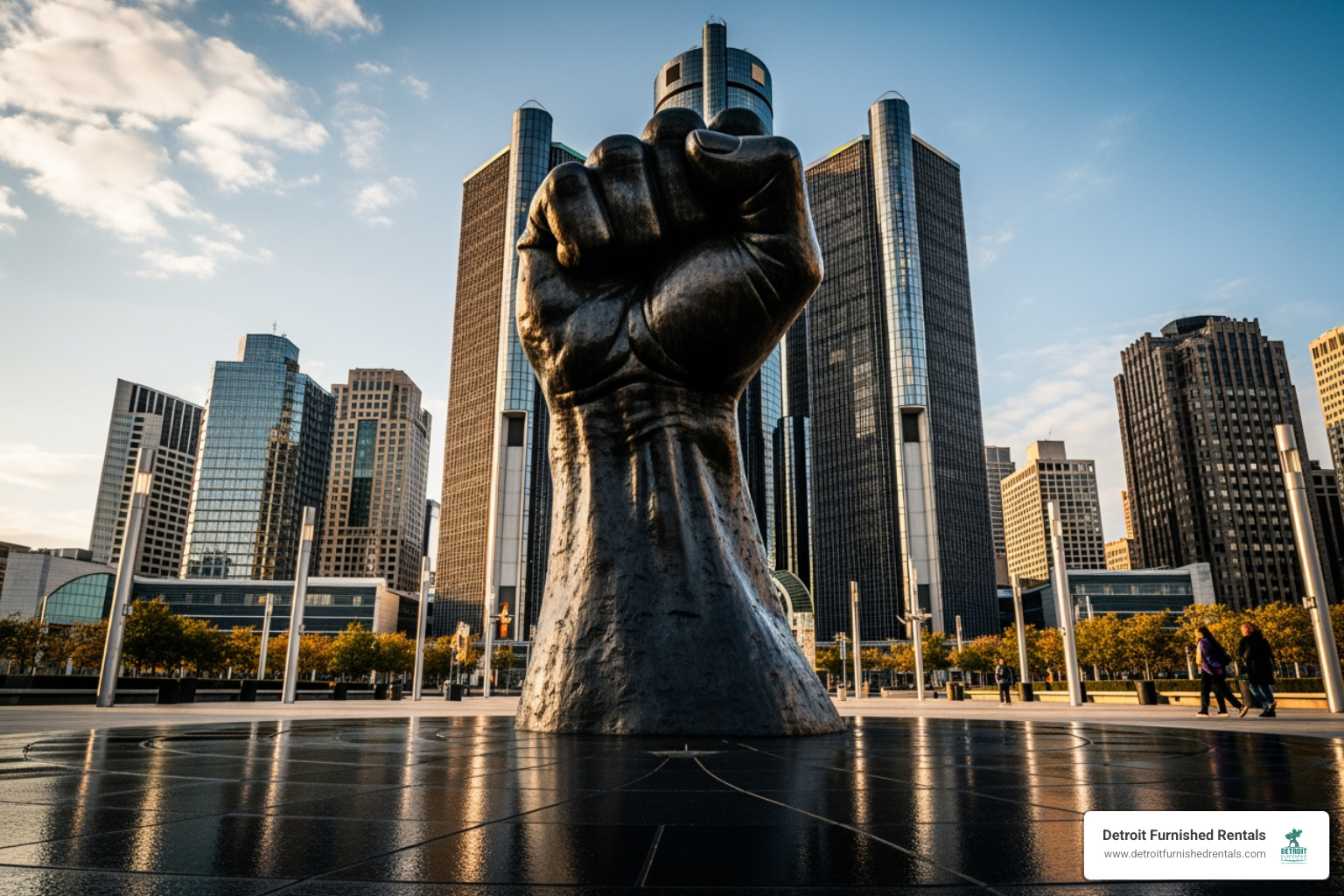
Another powerful piece is the Monument to Joe Louis, affectionately known as “The Fist.” Dedicated in 1986, this 24-foot bronze sculpture is a tribute to the legendary world heavyweight boxing champion, Joe Louis. Often seen as a symbol of power and resilience, “The Fist” commemorates Louis’s incredible achievements, including his historic victory over Nazi-backed Max Schmeling in 1938, which made him a national hero. Louis’s story goes beyond boxing; he also served in the army during WWII and integrated the Professional Golf Association. The monument, located on Jefferson Avenue across from Hart Plaza, stands as a testament to his impact on sports and civil rights.
In the heart of Campus Martius Park stands the majestic Soldiers and Sailors Monument. Dedicated in 1872, it is one of America’s first Civil War memorials. Standing over 60 feet tall, this bronze and granite masterpiece, sculpted by Randolph Rogers, features four figures representing the military branches and is topped by a figure symbolizing Michigan. It serves as a solemn reminder of the sacrifices made during the Civil War and is a central gathering point in downtown Detroit. You can find its location and more details at Soldiers and Sailors Monument.
Monuments to History and Heritage
Beyond these prominent figures, other Detroit Landmarks and Monuments quietly tell stories of diverse contributions to the city and nation.
The Statue of General Thaddeus Kosciuszko, erected in 1911, honors the Polish-Lithuanian military engineer who played a crucial role in the American Revolutionary War. A replica of a monument in Krakow, Poland, this statue reflects Detroit’s strong Polish-American community and its appreciation for international heroes who fought for freedom. You can locate this historical tribute at Statue of General Thaddeus Kosciuszko.
The Hand of God Sculpture is another significant piece of public art. Donated to Detroit in 1970 by the United Auto Workers (UAW), this striking sculpture is a testament to the labor movement’s influence and the city’s industrial heritage. Its hand is famously modeled after the artist’s own left hand. You can find this powerful artwork at Hand of God Sculpture.
Finally, gracing Belle Isle is the neat Russell A. Alger Memorial Fountain, unveiled in 1921. Designed by the renowned Daniel Chester French (who also created the Lincoln Memorial) and Henry Bacon, this fountain features a seven-foot bronze figure and honors Russell A. Alger, a Civil War general who also served as Governor of Michigan, U.S. Senator, and Secretary of War. It’s a beautiful example of classical public art in one of Detroit’s most cherished parks. You can view its location at Russell A. Alger Memorial Fountain.
The Soul of the City: Essential Museums and Cultural Hubs
Detroit’s soul resonates not only through its architecture and monuments but also within its world-class museums and cultural institutions. These spaces are vital to understanding the city’s past, celebrating its innovations, and showcasing its vibrant artistic and musical heritage. From the birthplace of Motown to vast collections of global art, these cultural hubs are essential Detroit Landmarks and Monuments in their own right.
World-Class Art and History
The Detroit Institute of Arts (DIA) stands as a monumental cultural cornerstone. Housed within its grand walls are masterpieces from across the globe, including works by Van Gogh, Degas, Rembrandt, and Renoir. Perhaps its most iconic feature is Diego Rivera’s “Detroit Industry Murals,” a stunning fresco cycle that depicts the city’s industrial might and the lives of its working people. It’s a powerful reflection of Detroit’s history, considered one of the most significant works of public art in the United States.
Just a short drive away in Dearborn, The Henry Ford Museum of American Innovation and Greenfield Village offer an unparalleled journey through American history. The Henry Ford Museum focuses on American innovation, housing iconic artifacts such as the chair Abraham Lincoln was assassinated in and the Rosa Parks bus. Greenfield Village, an 80-acre outdoor museum, transports visitors back in time with historic buildings, working farms, and recreations of Thomas Edison’s lab and the Wright Brothers’ workshop. These institutions are vital for understanding the industrial and social forces that shaped not only Detroit but the entire nation.
The Charles H. Wright Museum of African American History is dedicated to exploring and celebrating African American history and culture. It is a vital institution that preserves and interprets the experiences of African Americans, contributing significantly to the city’s rich cultural mix and offering deep insights into civil rights and resilience.
Celebrating Detroit’s Unique Culture
No discussion of Detroit Landmarks and Monuments would be complete without mentioning the Motown Museum, also known as Hitsville U.S.A. Established in 1959 by Berry Gordy in the original Motown house, this is where legends like Stevie Wonder, Diana Ross, and The Temptations started their careers. It’s a unique, tour-only museum experience that often encourages singing and dancing, connecting visitors directly to the magic of the Motown Sound. It’s a place where you can feel the energy of a musical revolution that swept the globe.
For automotive enthusiasts, the Ford Piquette Avenue Plant Museum holds immense historical significance. This is the very factory where the Model T was born, forever changing transportation and industry. It offers a fascinating look into the early days of automotive manufacturing and Henry Ford’s production methods. To further explore the giants of the auto industry, we also recommend a visit to the Automotive Hall of Fame in Dearborn, which celebrates the people whose innovations changed our lives forever.
Off the Beaten Path: Hidden Gems and Unique Art Installations
Beyond the grand structures and renowned museums, Detroit harbors a collection of “hidden gem” Detroit Landmarks and Monuments that offer a unique, often unconventional, perspective on the city’s creative spirit and community-driven revitalization. These sites showcase Detroit’s ability to transform, adapt, and express itself through art, history, and grassroots efforts.
Unconventional Art and Culture
One of the most striking and thought-provoking of these is The Heidelberg Project. Started in 1986 by artist Tyree Guyton, this outdoor art environment transformed abandoned houses on Heidelberg Street into vibrant, polka-dotted installations made from discarded items. Guyton’s response to neighborhood decline was to turn it into art, creating a powerful statement about urban renewal and the resilience of a community. It’s a treasured, albeit sometimes controversial, part of the city’s artistic landscape, and a must-see for anyone seeking unique public art. You can learn more about its mission at The Heidelberg Project.
The Dabls Mbad African Bead Museum, founded by Olayami Dabls, offers a fascinating journey into African history and culture through the intricate art of beads. Located on Grand River Avenue, its dazzling exterior facade is part art installation, part bead store, and part museum. Here, you can learn about the complex meanings and cultural significance of African beads, making it a truly enriching experience.
Another whimsical, offbeat landmark is Hamtramck Disneyland. Created over 30 years by Ukrainian immigrant Dmytro Szylak, this folk art assemblage in his backyard features towering structures of windmills, carousels, and jet planes made from found objects. Though Szylak passed away in 2015, his legacy lives on, and his “Disneyland” continues to charm visitors. When exploring embedded neighborhoods like The Heidelberg Project and Hamtramck Disneyland, we encourage everyone to remember to respect residents and private property.
Historic Sites with Unique Stories
Historic Fort Wayne, originally constructed in the 1840s, offers a glimpse into Detroit’s military past. Strategically located near the Detroit River, it served to protect the United States from potential British threats from Canada. Today, this Civil War-era fort operates as a museum and event space, providing insights into Detroit’s role in national defense and regional identity.
Detroit also played a crucial role in the Underground Railroad. The First Congregational Church of Detroit was one of the last stops for many escaped slaves before they crossed into Canada to freedom. Visiting this site and others like the Second Baptist Church helps us understand the profound history of resilience and the fight for freedom deeply embedded in Detroit’s fabric. You can find more information about the church’s history at First Congregational Church of Detroit.
Finally, Pewabic Pottery is a National Historic Landmark that showcases the Arts and Crafts movement. Founded in 1903 by Mary Chase Perry Stratton, it’s renowned for its iridescent, handcrafted ceramic tiles. You can find Pewabic tiles adorning many notable buildings in Detroit, including the Guardian Building, and even across the country. It’s a working pottery studio and museum, offering a unique blend of art, history, and craftsmanship.
How to Experience Detroit’s Landmarks
Exploring the vast array of Detroit Landmarks and Monuments can be an exhilarating experience, but a little planning goes a long way. Whether you prefer the structure of a guided tour or the freedom of self-guided exploration, Detroit offers various ways to immerse yourself in its rich history and vibrant culture.
| Feature | Guided Tours | Self-Guided Exploration |
|---|---|---|
| Pros | Expert commentary, pre-planned routes, often includes transportation, access to special areas, group dynamics. | Flexibility, pace control, find hidden gems, cost-effective, personalized itinerary, spontaneous stops. |
| Cons | Less flexibility, fixed schedules, can be more expensive, less time for personal interests, large groups. | Requires research and planning, potential for getting lost, may miss key insights, transportation logistics. |
Exploring Historic Detroit Landmarks and Monuments
For those who love to wander, a Downtown Walking Tour is an excellent way to experience many of the city’s architectural marvels and public art. Start at Campus Martius Park, home to the Soldiers and Sailors Monument, and make your way towards the Detroit Riverfront. Along the way, you will encounter the Spirit of Detroit, the Monument to Joe Louis, and the stunning Art Deco facades of the Guardian Building and other historic skyscrapers.
The Woodward Avenue Corridor is another fantastic route, stretching from downtown through Midtown, home to the Detroit Institute of Arts and the Charles H. Wright Museum. The QLine streetcar runs along Woodward, making it easy to hop on and off to explore various sites. For a unique perspective, consider using the Detroit People Mover, an liftd rail system that loops around downtown, offering quick and easy access to many key Detroit Landmarks and Monuments.
Do not forget Belle Isle Park, a stunning urban oasis designed in the spirit of Frederick Law Olmsted’s landscape work. Here, you can find the Russell A. Alger Memorial Fountain, the Anna Scripps Whitcomb Conservatory, and the Belle Isle Aquarium, all offering a blend of natural beauty and historical significance.
To truly make the most of your visit, plan your route in advance and consider visits during daylight hours to fully appreciate the artistic details. Morning or late afternoon light often provides the best conditions for photography. Combining monument tours with visits to nearby attractions, like a stroll through Eastern Market or a visit to a local coffee shop, can improve your experience.
When you are ready to explore Detroit Landmarks and Monuments at your own pace and comfort, consider staying with us at Detroit Furnished Rentals. Our centrally located, fully equipped, and pet-friendly apartments provide the perfect home base for your urban adventures. We offer the convenience and modern amenities you need to relax after a day of findy, ensuring you are well-rested and ready for your next Detroit exploration.
Conclusion
Detroit is a city of stories, etched into its steel, sculpted in its bronze, and preserved within its hallowed halls. The Detroit Landmarks and Monuments we’ve explored today are more than just points on a map; they are living testaments to Detroit’s incredible journey of rise, decline, and rebirth. From the opulent Art Deco “Cathedrals of Commerce” like the Guardian and Fisher Buildings, reflecting the city’s industrial golden age, to the powerful symbols of resilience like the Monument to Joe Louis and the Spirit of Detroit, each site tells a piece of the Motor City’s complex and inspiring narrative.
The city’s architectural landmarks beautifully illustrate how Detroit’s history has unfolded, from the boom of the auto industry to periods of challenge and now, a vibrant resurgence driven by preservation efforts and innovative repurposing, such as the change of Michigan Central Station. These landmarks play a crucial role in defining Michigan’s overall identity, showcasing a state that values innovation, art, and community.
What truly makes Detroit Landmarks and Monuments unique is their direct connection to the city’s automotive heritage and its profound impact on American culture, civil rights, and music. They offer an experience unlike any other major American city, a dynamic timeline of artistry, architecture, and enduring pride.
We believe that to truly appreciate the soul of Michigan, one must experience these sites firsthand. So, plan your visit to this remarkable city. Immerse yourself in the history, marvel at the architecture, and feel the vibrant energy of a city continually reinventing itself. And when you do, allow Detroit Furnished Rentals to be your comfortable and convenient home base. We’re here to help you explore Detroit’s monuments and landmarks from a comfortable home base.