What Are Short Terms Lets — and Are They Right for You?
Short terms lets are residential properties rented out for periods of less than 30 nights, offering a flexible alternative to hotels and long-term leases.
Quick answer — what you need to know:
| Question | Answer |
|---|---|
| What is a short-term let? | A furnished property rented for less than 30 nights |
| Who are they for? | Travelers, corporate professionals, traveling nurses, relocating families |
| Do you need a permit? | Yes, in most cities — rules vary by location |
| Are they more expensive than long-term rentals? | Yes, but they include furniture, utilities, and flexibility |
| What’s the biggest legal risk? | Operating without a permit can result in daily fines |
Whether you need a comfortable base while on a medical assignment, a furnished space during a work relocation, or simply a flexible place to land without signing a 12-month lease — short-term lets fill a real gap. They sit between a hotel (too impersonal, no kitchen) and a traditional apartment (too much commitment).
The rules around them, though, are anything but simple. Permit fees, occupancy limits, zoning restrictions, and tax obligations vary widely from city to city — and getting it wrong can be costly.
I’m Sean Swain, founder of Detroit Furnished Rentals, and my experience with short terms lets spans from renting out my first apartment on Airbnb while working as an over-the-road trucker to building a full portfolio of professionally managed furnished properties in the Detroit metro area. In this guide, I’ll walk you through everything — from the basics to the regulations — so you can navigate the market with confidence.
Understanding the Basics of Temporary Housing

Temporary housing is an umbrella term for any living arrangement designed to bridge a gap in your life. Whether you are transitioning between homes, in town for a corporate project, or exploring a new city, temporary housing provides the comfort of a home without the anchor of a long-term contract.
Historically, people on the move had to choose between cramped hotel rooms or empty apartments that required renting furniture and setting up utilities. Today, professionally managed furnished rentals have changed the game. They offer the consistency and safety of a hotel combined with the space, privacy, and comforts of a real home.
For business travelers, remote workers, and traveling medical staff, these managed properties are a lifesaver. Instead of dealing with spotty Wi-Fi or trying to cook a meal with a microwave and a bathroom sink, guests enjoy fully functional spaces designed for living and working. To understand how these options fit your specific travel or relocation plans, check out our guide on Short Term Housing Options Explained Hotels Rentals And More.
Defining Short Terms Lets vs. Mid-Term and Long-Term Rentals
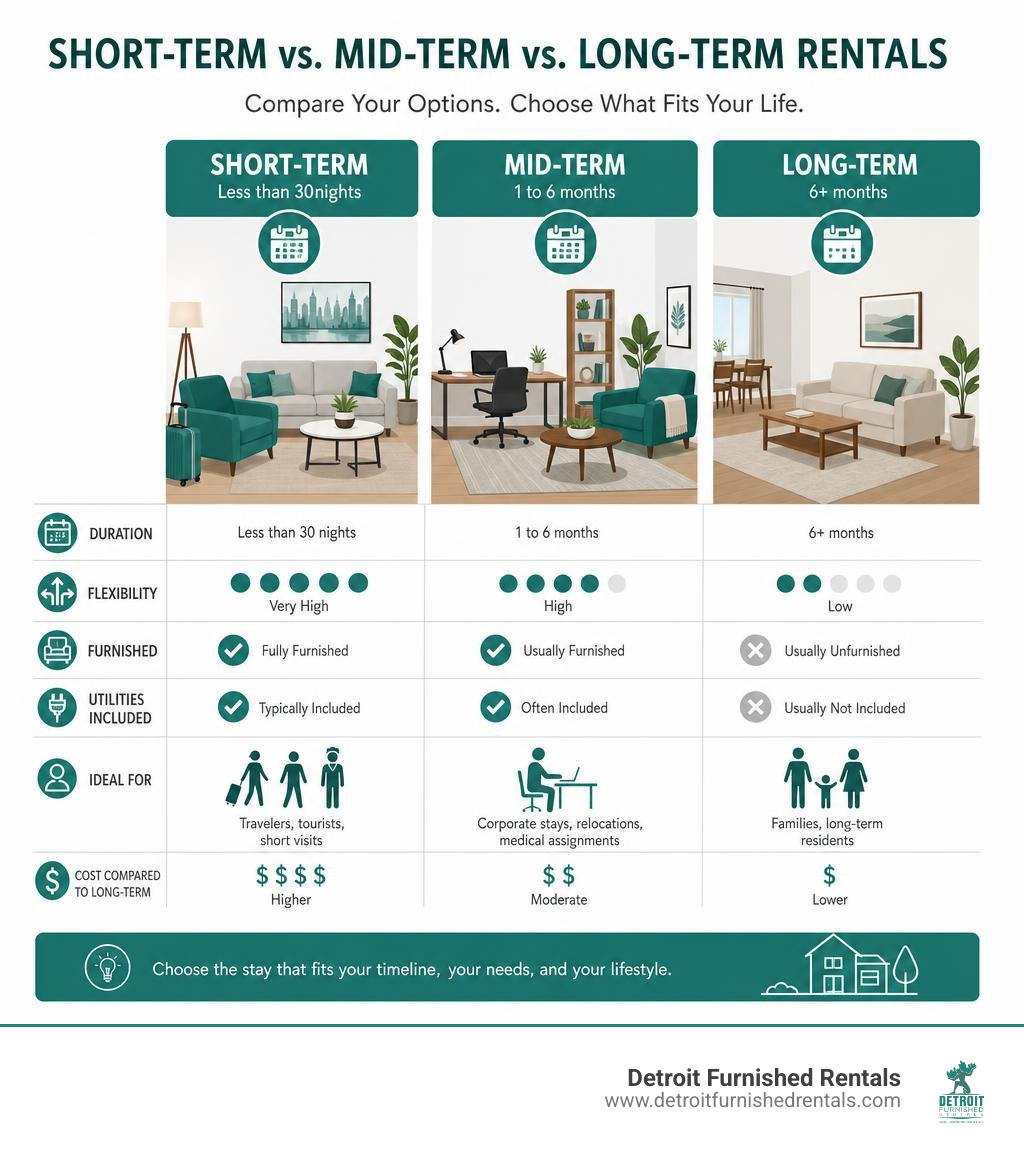
The primary differentiator between these rental types is the duration of the stay, which in turn dictates the legal agreements, pricing structures, and tenant rights. The “magic number” in the rental industry is 30 days. Once a stay crosses this 30-day threshold, the legal relationship between the host and guest typically transitions from a transient guest (like a hotel stayer) to a tenant with formal lease rights.
To help you visualize the differences, we have broken down the three main categories:
| Feature | Short-Term Rental (STR) | Mid-Term Rental (MTR) / Extended Stay | Long-Term Rental (LTR) |
|---|---|---|---|
| Typical Duration | 1 to 29 nights | 30 nights to 6 months | 6 months to 1 year+ |
| Lease Agreement | Terms of Service / Short Lodging Agreement | Month-to-month or fixed-term mid-term lease | Standard 12-month residential lease |
| Furnishings | Fully furnished, fully stocked kitchen | Fully furnished, utilities & Wi-Fi included | Unfurnished (usually) |
| Primary Audience | Vacationers, weekend travelers, quick business trips | Traveling nurses, corporate transfers, digital nomads | Local residents, long-term settlers |
| Utility Setup | Included in rate | Included in rate | Paid separately by tenant |
Understanding these distinctions is crucial because the laws governing short terms lets do not typically apply once you transition into mid-term or long-term territory. For an in-depth look at how to secure these mid-to-long-range stays, read our Short Term Apartment Complete Guide.
Why Professionals and Travelers Choose Short Terms Lets
The modern traveler demands more than just a place to sleep. They want a space that supports their lifestyle, health, and productivity. This is why professionals are increasingly turning away from hotels and choosing short terms lets.
- Fully Equipped Kitchens: Eating out three times a day gets old—and expensive—fast. Having a real kitchen with full-size appliances, pots, pans, and spices allows you to cook healthy meals and stick to your routine.
- Dedicated Workspaces: Working from a hotel bed or a tiny vanity desk is a recipe for back pain. Professional rentals feature dedicated desks, ergonomic chairs, and high-speed Wi-Fi to keep your productivity levels high.
- Pet-Friendly Options: For many of us, our pets are family. Leaving them behind during a multi-week assignment is not an option. Professional short-term lets often accommodate pets, providing a welcoming environment for your entire household.
If you are a corporate traveler or traveling nurse looking for accommodations that cater to your career needs, explore our resources on Short Term Rentals For Professionals and find pet-friendly spaces via our Short Stay Pet Friendly portal.
Navigating the Legal Landscape of Short Terms Lets

As the popularity of home-sharing platforms has exploded, municipal governments have stepped in to regulate the market. Cities must balance the economic benefits of tourism and flexible housing against the need to protect local housing stock, maintain neighborhood character, and ensure guest safety.
Consequently, the legal landscape for short terms lets has become a complex patchwork of municipal codes, zoning laws, and local ordinances. What is perfectly legal in one town could result in a thousands-of-dollars fine just one city over. If you are looking to host or rent in the Great Lakes State, staying informed is key—start by reviewing Short Term Rentals In Michigan.
Case Studies: Spokane, San Francisco, and Virginia Beach
To illustrate how wildly these rules can differ, let’s look at three distinct U.S. cities and how they regulate short-term rentals as of June 2026.
1. Spokane, Washington
In Spokane, a short-term rental is defined as renting all or a portion of a residential dwelling unit for less than 30 nights.
- Permitting & Fees: Spokane requires a short-term rental permit. The application fee is $200 in residential zones and $300 in other zones.
- Renewals: Permits must be renewed annually ($100 for residential, $150 for other zones). If you fail to pay the renewal fee, your permit automatically closes.
- Neighborhood Rules: Hosts in residential zones must mail or deliver physical notification letters to all abutting property owners and recognized neighborhood organizations. This letter must include emergency contact information.
- Eligibility: Following amendments in September 2023, permanent residents (both owners and tenants) are eligible to apply for permits.
2. San Francisco, California
San Francisco has some of the strictest short-term rental laws in the country, governed by the Office of Short-Term Rentals (OSTR).
- Permanent Residency Requirement: You can only host if you are the permanent resident of the unit, meaning you must reside there for at least 275 nights per calendar year.
- Permitting & Fees: The application fee is a steep $925, which is valid for two years.
- Hosted vs. Un-hosted Stays: If you are present in the unit during the stay (hosted), there is no limit on the number of nights you can rent. If you rent out the entire unit while you are away (un-hosted), you are strictly capped at 90 nights per calendar year.
- Platform Compliance: Hosts must maintain separate listings for hosted and un-hosted stays and display their valid registration number on all platforms.
3. Virginia Beach, Virginia
Virginia Beach divides transient properties into “home shares” (where the owner lives on-site) and standard short-term rentals (entire homes).
- Permitting & Fees: Zoning permits for entire-home short-term rentals cost $500 and must be renewed annually.
- Strict Requirements: Hosts must provide a detailed parking plan showing at least one 9×18-foot off-street parking space per bedroom. They must also maintain at least $1 million in liability insurance.
- Inspections: Properties must undergo a life safety inspection every 5 years and a structural safety inspection every 3 years.
These detailed regulatory environments highlight why many property owners prefer to transition their units into mid-term rentals (30+ days) to bypass these heavy administrative burdens. To learn more about navigating these properties, see our Short Term House Rentals Guide 2025.
Host Eligibility and Property Restrictions
Before you even think about applying for a permit, you must determine if your property is legally eligible. Many municipalities restrict certain types of housing from being used as short-term lets to prevent the displacement of long-term residents.
Generally, the following properties are ineligible for short-term rental use:
- Affordable Housing & Rent-Controlled Units: Units designated for low-income housing or subject to rent-stabilization laws are almost universally banned from short-term leasing.
- Accessory Dwelling Units (ADUs): In many cities, secondary backyard cottages, basement apartments, or carriage houses built under affordable housing initiatives cannot be rented for stays under 30 days.
- Commercial/Industrial Spaces: Non-residential buildings cannot be used for short-term lets unless they have been legally rezoned and brought up to residential safety codes.
- SROs and Residential Hotels: Single Room Occupancy buildings and designated residential hotels are protected to preserve housing for vulnerable populations.
If you are looking for compliant, legal ways to find or offer temporary housing without running into these municipal roadblocks, check out our Short Term Housing Solutions Guide.
Professional Entire-Unit Rentals vs. Shared Spaces
There is a massive operational and regulatory difference between renting out a spare bedroom while you make coffee in the kitchen (hosted/shared space) and handing over the keys to an entire apartment (un-hosted/entire-unit rental).
Municipalities look far more favorably on hosted stays because the primary resident is on-site to monitor noise, trash, and parking. This is why cities like San Francisco allow unlimited hosted stays but cap un-hosted stays at 90 days.
For travelers who value privacy, however, shared spaces are rarely ideal. This has led to the rise of professional property management companies. Unlike casual peer-to-peer hosts who may struggle to balance local occupancy caps and platform compliance, professional managers operate fully compliant, dedicated entire-unit rentals that offer hotel-grade consistency with home-like space.
Permits, Fees, and Financial Obligations
Operating a legal short-term rental requires treating it like the business it is. This means registering your business with the state, obtaining local zoning permits, and keeping meticulous financial records. Many cities now use online licensing portals like Accela Citizen Access to streamline applications, track compliance, and coordinate with major listing platforms to flag unregistered properties. For an overview of the business side of hosting, read our guide on Short Term Business.
Permitting Fees and Renewal Processes
As we saw in our case studies, the cost of entry varies wildly. To recap:
- San Francisco: $925 application fee, valid for two years.
- Virginia Beach: $500 zoning permit, renewed annually.
- Spokane: $200 (residential) or $300 (other zones) application fee, renewed annually for $100–$150.
It is critical to note that renewals are not automatic. If you miss your renewal deadline or fail to pay the fee, local systems will automatically close your permit. Once a permit is closed, API integrations between the city and platforms like Airbnb or VRBO will automatically deactivate your listings, canceling pending reservations and causing severe disruptions to your business.
Taxes and Insurance Requirements
If you operate a short-term let, you are responsible for paying transient lodging taxes. These are often referred to as Transient Occupancy Tax (TOT) or Tourism Improvement District (TID) assessments.
- Tax Rates: These taxes typically range from 5% to 15% of the rental rate and are designed to fund local tourism bureaus and infrastructure.
- Collection: While some platforms collect and remit these taxes on your behalf, hosts are ultimately responsible for ensuring full compliance.
- Insurance: A standard homeowners insurance policy will not cover commercial short-term rental activities. If a guest is injured on your property, your claim will likely be denied. Hosts must secure commercial business insurance or specialized landlord policies that carry at least $1 million in liability coverage specifically listing the short-term rental address.
Operational Best Practices and Private Restrictions
Running a successful short-term rental goes beyond paying your fees; it requires being a good neighbor and maintaining a safe property. If you are planning to rent or host in the Detroit area, familiarize yourself with our local operational tips in the Short Term Housing Detroit Mi Guide.
Safety, Parking, and Community Relations
To maintain your permit, you must adhere to strict operational standards:
- Life Safety Inspections: Properties must be equipped with working smoke detectors, carbon monoxide alarms, fire extinguishers, and clear emergency egress routes. Some cities require professional inspections every few years to verify these systems.
- Structural Safety: Railings, decks, stairs, and structural elements must meet local building codes to prevent accidents.
- Parking Plans: Parking is one of the most common sources of neighbor complaints. Many cities require hosts to provide designated, off-street parking spaces (such as a garage or driveway) and forbid guests from parking on residential streets.
- Community Notifications: Keep your neighbors happy. Providing nearby residents with a direct, 24/7 phone number to reach you or your property manager in case of noise or trash issues can resolve problems before they escalate to code enforcement.
Lease Agreements, HOAs, and Private Rules
Even if your city permits short-term rentals, private agreements can completely shut them down.
- Homeowners Associations (HOAs) and CC&Rs: HOA bylaws and Covenants, Conditions, and Restrictions (CC&Rs) frequently contain strict bans on leases shorter than 30, 90, or even 180 days. HOA fines can be incredibly punitive and can lead to liens against your property.
- Rental Lease Agreements: Standard residential leases almost always contain “no subletting” clauses. Renting out an apartment on a short-term platform without written landlord consent is a material breach of contract and a quick path to eviction.
- Leasebreaks and Assignments: If a tenant needs to move out early, they may look into a leasebreak (terminating the lease early with a penalty), a lease assignment (transferring the lease to a new tenant), or a sublet. However, none of these options legally allow the tenant to run a short-term rental business out of the unit.
For those looking to secure or offer fully authorized, beautifully decorated spaces that comply with all local and private rules, exploring professional Short Term Furnished Housing is the safest route.
Frequently Asked Questions about Short-Term Rentals
What happens if I operate a short-term rental without a permit?
Operating an unregistered short-term rental is a serious offense. Municipalities use automated software to scan listing platforms for unregistered properties. If caught, penalties can include:
- Daily fines ranging from $100 to over $480 per day, per unit.
- Immediate revocation of any existing business licenses.
- A permanent ban on applying for future short-term rental permits.
- Legal action and platform blacklisting.
To ensure you stay on the right side of local laws, review our Short Term Detroit Rentals Guide.
Can tenants sublet their apartments as short-term rentals?
In 99% of cases, no. Standard residential lease agreements strictly prohibit unauthorized subletting. If a tenant lists their rental on a short-term platform without the landlord’s explicit, written permission, they risk immediate eviction, financial penalties, and legal action. If you are a tenant looking for flexible lease terms that legally allow for shorter stays, it is best to look for a designated Short Term Lease Detroit agreement.
What are the typical property exclusions for short-term lets?
Most cities exclude properties built under affordable housing programs, Accessory Dwelling Units (ADUs) designed for long-term housing, commercial spaces, and non-residential properties. These exclusions protect the local housing market from being depleted of affordable, long-term options. If you are looking for compliant, medium-term options in residential areas, check out our selection of Short Term Apartments Detroit.
Conclusion
Navigating short terms lets can feel like walking through a regulatory minefield. Between municipal zoning permits, HOA rules, safety inspections, and tax obligations, managing a compliant property requires significant time, effort, and expertise.
That is where we come in. At Detroit Furnished Rentals, we take the stress out of temporary housing. We offer fully compliant, professionally managed short and mid-term furnished apartments throughout the Detroit metro area. Our properties are designed specifically for modern travelers, featuring:
- Fully equipped kitchens so you can cook healthy meals on your own schedule.
- Dedicated workspaces with high-speed Wi-Fi to keep you productive.
- Pet-friendly options because we know your four-legged companions are part of the family.
Whether you are looking for Short Term Rentals Detroit, exploring options across Short Term Rentals Detroit Michigan, or trying to find the perfect Short Term Housing Detroit solution, we have you covered.
For more information, browse our Short Term Furnished Apartments Detroit Guide, look through our Short Term Houses For Rent, or read our guide to Short Term Furnished Housing. If you are looking for other resources, check out our Short Term Detroit Rentals Guide, our directory of Short Term Apartment Rentals In Michigan, or plan a quick trip with Short Stay Detroit.
Ready to find your next home away from home? Book your next stay with Detroit Furnished Rentals today and experience the comfort of flexible, hassle-free living!