

What You Need to Know About Short-Term Leases (Before You Sign Anything)
Short term leases are rental agreements that typically last six months or less — including month-to-month, three-month, or other flexible arrangements agreed upon by the landlord and tenant.
Quick answer:
| Feature | Short-Term Lease |
|---|---|
| Duration | 3-6 months, or month-to-month |
| Furnished? | Usually yes |
| Utilities included? | Often yes |
| Cost vs. long-term | Higher monthly rate |
| Best for | Travelers, nurses, relocations, renovators |
| Flexibility | High — easier to move in and out |
Whether you’re a traveling nurse landing a 13-week contract in Detroit, a remote worker testing a new city, or a homeowner displaced during renovations — short-term leases offer a way to have a real home without a long commitment. But they come with trade-offs: higher monthly costs, less stability, and policies that vary widely by property and location.
This guide breaks down exactly how short-term leases work, what to expect, and how to find the right fit.
I’m Sean Swain, and over the past nine years I’ve built a 15-unit furnished rental portfolio across Detroit and Chicago — giving me experience navigating short term leases from both sides of the lease agreement. That experience shapes everything I’ll share here, so let’s get into it.
Handy short term leases terms:
What is a Short Term Lease?
When we talk about short term leases, we are generally referring to any rental agreement with a duration of six months or less. While the traditional “gold standard” in the rental world is the 12-month lease, the modern workforce and lifestyle demand more agility. According to Understanding short term leases, there is no universal legal definition for the exact number of days, but in the residential world, it typically covers stays ranging from a single month to half a year.
In many cases, these agreements are structured as month-to-month contracts. This means the lease automatically renews every 30 days unless one party provides notice to terminate. For those who need a bit more certainty, a fixed-term short lease (like a 3-month or 6-month term) provides a guaranteed “out” date.
To help you visualize the differences, we’ve put together a comparison of how these stack up against their long-term counterparts. For a deeper dive into the specifics of apartment living on a shorter timeline, check out our short-term-apartment-complete-guide.
Short-Term vs. Long-Term Leases
| Feature | Short-Term Lease | Long-Term Lease |
|---|---|---|
| Typical Duration | 1 to 6 months | 12 to 15 months |
| Notice Period | Usually 30 days | Usually 60 days |
| Furniture | Often fully furnished | Unfurnished |
| Utilities | Typically included in rent | Paid separately by tenant |
| Stability | Lower (landlord can change terms) | Higher (fixed rate for a year) |
| Price | Premium monthly rate | Market standard rate |
Benefits and Drawbacks of Short-Term Rentals

Choosing short term leases is often a decision driven by a need for speed and flexibility. If you’ve ever had to move across the country for a job that starts in two weeks, you know that the last thing you want to do is shop for a couch or wait for the electric company to turn on the lights.
The primary benefit is flexibility. You aren’t “locked in.” This is ideal if you are testing out a new neighborhood in Detroit before buying a house or if your job requires you to be mobile. Furthermore, these units are often “turnkey,” meaning you can literally move in with just your suitcase.
However, there are drawbacks. Because the landlord takes on more risk—such as higher turnover costs and potential vacancy—the monthly rent is almost always higher than a standard lease. You also have less long-term stability; a landlord could decide to sell the property or move in themselves once your short term is up. For a professional’s perspective on these trade-offs, see our guide on short-term-rentals-for-professionals.
Ideal Tenants for Short Term Leases
Who exactly is looking for these types of stays? In our experience in the Detroit market, we see a few specific groups:
- Traveling Professionals: Traveling nurses on 13-week assignments or consultants on three-month projects.
- Corporate Relocations: Employees moving for a new role who need a “home base” while they shop for permanent housing.
- Home Renovators: Local families whose primary residence is undergoing a major overhaul (nobody wants to live in a construction zone for four months!).
- Digital Nomads: Remote workers who want to spend a season experiencing the culture and food scene of a new city.
- Those on Short-Term Visas: International visitors on 90-day visas who need a stable place to stay that isn’t a hotel.
If you are a business owner looking into this, you might find our short-term-business resources helpful for understanding how these leases support commercial needs.
Flexibility in Short Term Leases
One of the biggest questions we get is: “What if I need to stay longer?” Most short term leases are quite accommodating when it comes to extensions, provided the unit hasn’t already been booked by someone else.
If you are on a month-to-month agreement, the process is seamless—you just keep paying rent! If you are on a fixed 3-month lease, you’ll want to discuss an extension at least 30 days before your move-out date. Some providers even offer transfer options, allowing you to move between different properties within their portfolio if your needs change. For more on the “hustle” of finding and managing these shorter terms, read about the-short-term-rental-hustle-uncovering-3-month-apartment-leases.
Essential Amenities and Costs to Expect
When you sign a short-term lease for a furnished unit, you aren’t just paying for the four walls. You are paying for a service. At Detroit Furnished Rentals, we believe a true short-term home should be “plug and play.”
Common amenities included in our short-term-furnished-housing include:
- Full Furniture Package: Bed, sofa, dining set, and workspace.
- Housewares & Linens: Everything from forks and pans to high-quality towels and bedsheets.
- All Utilities: Electricity, gas, water, and trash are usually kept in the owner’s name so you don’t have to deal with setup fees or credit checks with utility companies.
- High-Speed Wi-Fi: Essential for the modern remote worker.
- In-Unit Laundry: A major perk compared to laundromats or shared basement facilities.
Managing Costs in Short Term Leases
It is important to understand that the “sticker price” of a short-term rental covers more than just rent. Because these units have high turnover, landlords incur costs for professional cleaning, marketing, and administration every few months.
Factors that influence pricing include:
- Seasonality: In many cities, demand peaks in the summer.
- Length of Stay: Generally, the shorter the stay, the higher the monthly rate. A 6-month lease will usually have a lower monthly cost than a 1-month stay.
- Location: Proximity to downtown hubs or major employers like hospitals will drive prices up.
You can explore specific pricing for the Detroit area in our short-term-housing-detroit overview.
Pet Policies and Additional Fees
Don’t forget the four-legged family members! Many short term leases are pet-friendly, but they often come with specific rules. You might encounter:
- Pet Fees: Either a one-time non-refundable fee or monthly “pet rent.”
- Breed Restrictions: Some insurance policies for landlords restrict certain breeds (like Pit Bulls or Rottweilers).
- Documentation: You may need to provide vaccination records and a photo of your pet.
Other fees to watch out for include parking (especially in downtown Detroit), security deposits (though some membership-based platforms waive these), and cleaning fees. Learn more about our short-term-pet-friendly options to see how we accommodate pets.
Navigating the Application and Legal Process
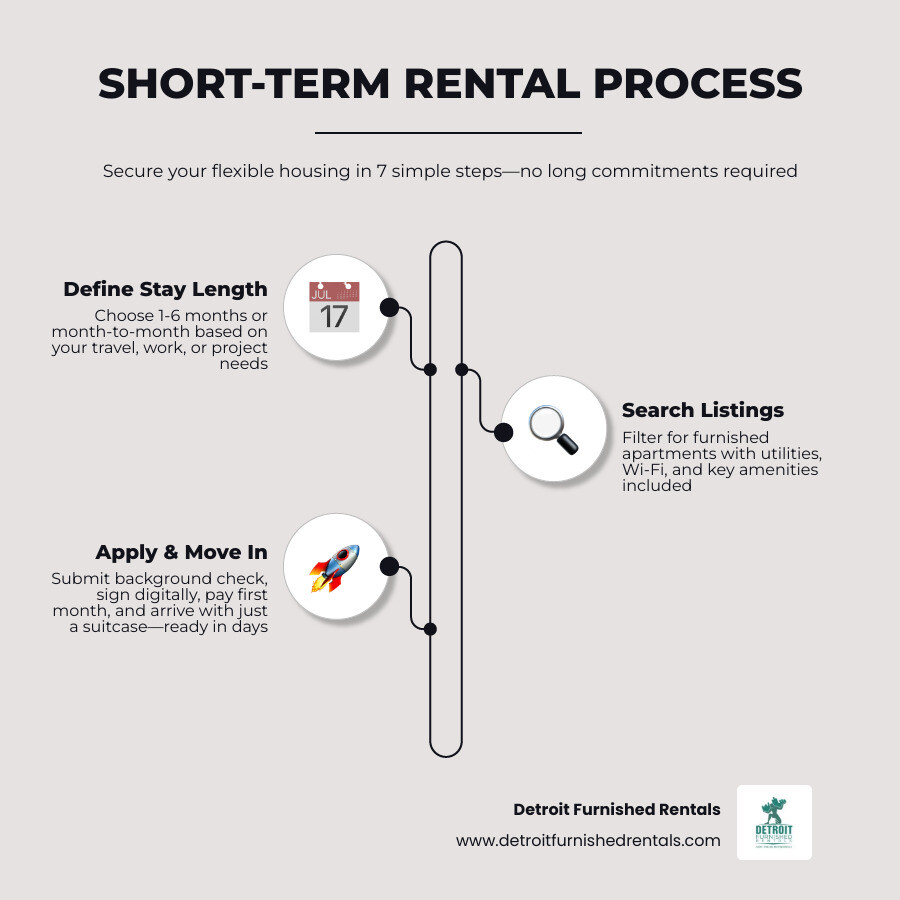
The move-in process for a short-term rental is usually much faster than a traditional apartment. Since many of these properties cater to people who are already on the move, the process is designed to be digital-first.
- Application: You’ll fill out a form online. Expect to provide ID and proof of income.
- Screening: Landlords will typically run a background and credit check. Don’t worry—reputable services often use “soft” credit pulls that won’t ding your credit score.
- Lease Signing: You will likely sign your short-term-lease-detroit electronically. Read it carefully! Ensure the move-out notice requirements (usually 30 days) are clearly stated.
- Payment: Most providers require the first month’s rent and any deposits/fees upfront before move-in instructions are released.
- Move-In: Many short-term rentals now offer contactless move-in via smart locks or lockboxes.
On the legal side, be aware that some areas have specific “occupancy taxes” for stays shorter than 30 days (similar to a hotel tax). However, for most short term leases lasting 31 days or longer, you are treated as a standard tenant with full tenant rights under Michigan law. For a look at what to expect in the coming years, check our short-term-house-rentals-guide-2025.
Frequently Asked Questions about Short-Term Rentals
How long does a short-term lease typically last?
A short-term lease typically lasts between three and six months. However, they can be as short as 30 days or even week-to-week in some corporate housing setups. Stays under 90 days are very common for international travelers and contract workers. You can find more details on Michigan-specific durations in our guide to short-term-rentals-in-michigan.
What is typically included in a furnished short-term rental?
Standard inclusions are “turnkey” items: a fully equipped kitchen (cookware, dishes, coffee maker), all furniture, bed linens, towels, and utilities (Wi-Fi, heat, water, electricity). Some luxury units also include access to building amenities like fitness centers or pools. See our short-term-furnished-apartments-detroit-guide for a full checklist.
How do short-term lease costs compare to long-term rentals?
Expect to pay a premium. Short-term rentals can cost 20% to 50% more per month than a 12-month unfurnished lease. This premium covers the cost of furniture, the convenience of included utilities, and the landlord’s increased risk of vacancy. For many, this cost is offset by the savings of not having to buy furniture or pay utility connection fees. We break down these costs further in our short-term-apartments-detroit analysis.
Conclusion
Navigating short term leases doesn’t have to be overwhelming. By focusing on flexibility, understanding the “all-in” cost of amenities, and knowing your rights as a tenant, you can find a temporary home that feels just as comfortable as a permanent one.
At Detroit Furnished Rentals, we specialize in making this transition seamless. Whether you are here for a three-month medical rotation or are relocating your family to the Motor City, we offer fully equipped, pet-friendly, and centrally located housing solutions.
Ready to find your next home in Detroit? Explore available properties in Detroit or read our short-term-housing-detroit-mi-guide for more local tips. Let us handle the furniture and the Wi-Fi—you just bring your suitcase!