Imagine stepping out of your comfortable furnished apartment – perhaps one provided by Detroit Furnished Rentals – at 7:45 AM, only to find yourself staring at a complex map of overlapping bus lines and streetcar stops. For many professionals arriving in a new city, mastering detroit public transportation feels like a daunting hurdle that stands between them and a productive day at their professional destination. It’s a common frustration to feel caught between the distinct schedules of various local transit systems, especially when you have an important morning presentation on a key city thoroughfare.
You probably believe that a car is a non-negotiable requirement for life in a major urban center, but the landscape has shifted since the local Regional Transit Authority implemented its 2026 service expansion. This guide promises to transform your daily commute into a stress-free experience by demystifying the network’s latest 15 percent increase in frequency across major corridors. We’ll show you how to use the unified payment system effectively and pinpoint exactly which neighborhoods offer the most reliable light rail access. From regional express buses to the sleek streetcars of the urban core, you’ll gain the local knowledge needed to move through the city with absolute poise and efficiency.
Key Takeaways
- Master the distinction between DDOT and SMART services to confidently navigate both the city core and the surrounding regional hubs.
- Identify the high-frequency Woodward corridors that make detroit public transportation a reliable choice for professionals commuting to the Detroit Medical Center.
- Streamline your journey with expert tips on using the Dart app and contactless payments for a modern, stress-free boarding experience.
- Solve the “last mile” challenge by integrating the QLINE streetcar with MoGo bike share for a truly multimodal and efficient commute.
- Learn how curated, transit-oriented housing can provide a turn-key lifestyle where a personal vehicle is no longer a necessity.
The 2026 Detroit Public Transportation Landscape
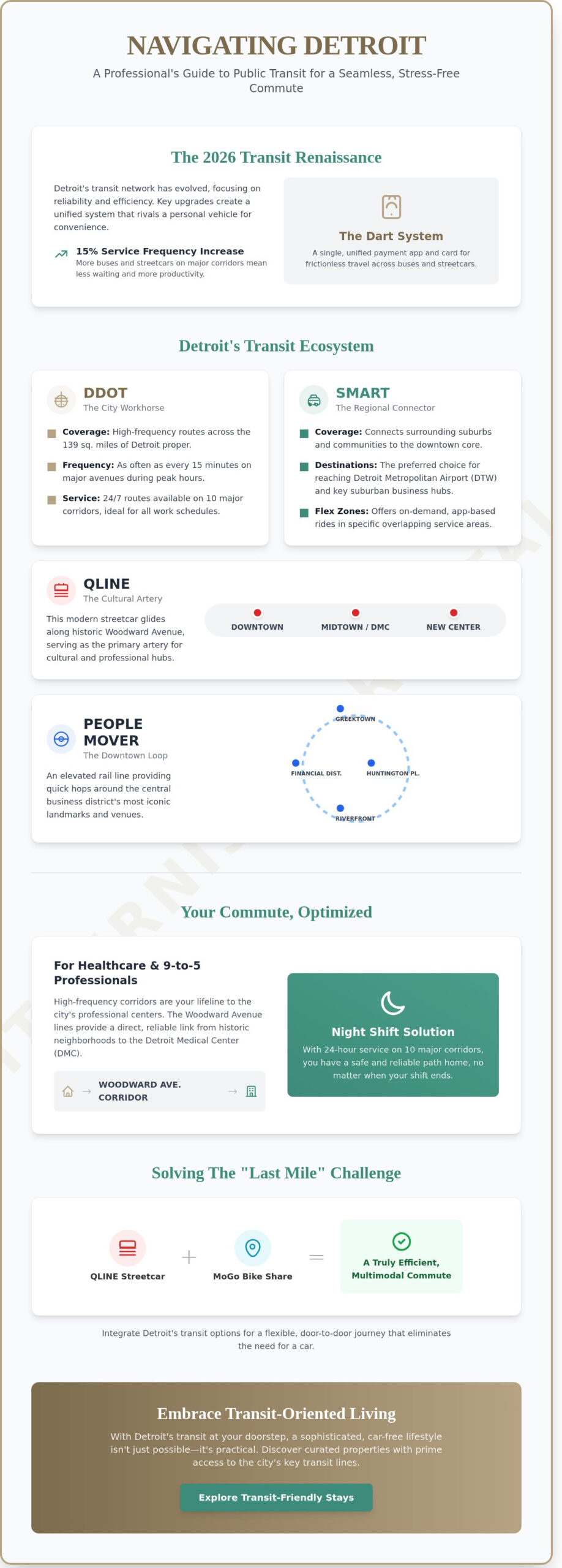
Detroit has reached a pivotal turning point in its urban evolution. By 2026, the city successfully transitioned from a car-centric history to a future defined by unified mobility. This transit renaissance provides a seamless experience for professionals who value efficiency as much as style. For those staying in our curated properties, detroit public transportation now functions as a reliable extension of your daily life. The system focuses on high-frequency corridors that ensure you spend less time waiting and more time enjoying the vibrant energy of the city.
The cornerstone of this modern era is the “Dart” system. This unified payment platform serves as the one pass to rule all buses and streetcars, eliminating the friction of multiple fares. It’s a turn-key solution for the modern traveler. You can find detailed historical context on how these systems evolved by exploring the records of Transportation in metropolitan Detroit. This integrated approach ensures that your journey from a historic neighborhood to a corporate headquarters is both rhythmic and stress-free.
Understanding DDOT vs. SMART
Navigating the city requires understanding the two primary pillars of the bus network. The Detroit Department of Transportation, known as DDOT, manages high-frequency routes across the 139 square miles of the city proper. It’s the workhorse of the urban core. Conversely, the Suburban Mobility Authority for Regional Transportation, or SMART, connects the surrounding suburbs to the city center. This is the preferred choice for regional professionals commuting from the outskirts into the downtown district.
- DDOT: Focuses on 24/7 service within city limits with 15-minute frequencies on major avenues.
- SMART: Provides critical links to Detroit Metropolitan Airport and key suburban business hubs.
- Flex Zones: Both agencies overlap in these specific zones to offer on-demand, app-based rides for the ultimate convenience.
These systems work in tandem to provide a comprehensive web of travel options. Whether you’re heading to a morning meeting or a late-night dinner in Corktown, the 2026 upgrades ensure reliability is no longer a question.
The Role of the QLINE and People Mover
For those living and working within the city’s most iconic districts, the rail options offer a sophisticated way to travel. The QLINE is the primary artery for cultural and professional hubs. This modern streetcar glides along Woodward Avenue, connecting the bustling Downtown area with the historic charm of New Center. It’s an ideal choice for visiting the Detroit Institute of Arts or attending a conference at one of the major tech centers.
The Detroit People Mover complements this by providing an elevated loop around the downtown core. It’s perfect for quick hops between the Financial District, Greektown, and the riverfront. Using these rails creates a stress-free environment where the city’s architecture becomes the backdrop of your commute. Every stop is thoughtfully designed to place you within steps of Detroit’s most celebrated landmarks and essential business destinations.
Strategic Routes for Professionals and Travel Nurses
For the modern professional or dedicated travel nurse, a commute shouldn’t be a source of stress. It should be a seamless transition between your curated home and your place of work. In Detroit, the most reliable way to navigate this is through high-frequency corridors. These routes, managed by the Detroit Department of Transportation (DDOT), offer 15-minute service intervals during peak hours on major arteries. If you’re heading to the Detroit Medical Center (DMC), the Woodward Avenue lines are your primary lifeline. These routes provide a direct link from historic neighborhoods like Boston-Edison straight to the heart of the medical district.
Night shifts are a reality for healthcare heroes. Because of this, Detroit expanded its 24-hour routes on ten major corridors in 2023. These “always-on” lines ensure that whether your shift ends at 2:00 AM or 7:00 AM, you have a reliable path back to your stress-free temporary home. Connecting the financial district to vibrant neighborhoods like Corktown or West Village has never been more straightforward, allowing you to trade the gridlock for a productive morning on the bus. Using detroit public transportation effectively means choosing these high-frequency paths to ensure your schedule remains predictable.
The DAX: Detroit Airport Express
The Detroit Airport Express (DAX) is a game-changer for corporate travelers arriving at DTW. This premium coach service runs 16 times daily between 6:00 AM and 11:00 PM. You’ll find amenities like high-speed Wi-Fi, spacious luggage racks, and USB charging ports at every seat. It’s a 35 to 45-minute trip from the airport to the city center, with the primary drop-off point located near Grand Circus Park. You can book tickets online via the Dart app, making your arrival into the city completely turn-key and professional.
Commuter Hubs: New Center and Downtown
New Center and Downtown serve as the “golden spikes” of the detroit public transportation network. These hubs allow you to transfer between the QLINE streetcar and regional SMART buses with ease. By 2026, major transit centers are scheduled to receive 40% more LED lighting and enhanced security monitoring to ensure rider comfort at all hours. These hubs connect the following key areas:
- New Center: Direct access to Henry Ford Hospital and the Amtrak station.
- Grand Circus Park: The central node for the QLINE and People Mover.
- Rosa Parks Transit Center: The primary terminal for downtown bus transfers.
This infrastructure makes living in a historic district while working in a modern skyscraper a practical reality for every guest.
Navigating Like a Local: Apps, Payments, and Safety
Getting around the city should feel as seamless as walking into one of our turn-key apartments. To master detroit public transportation, your first step is downloading the Dart mobile app. This digital tool transforms your smartphone into a personal ticket office and a real-time navigation hub. You can purchase passes in seconds and watch your bus move across the map with live GPS tracking. It is a vital resource for staying on schedule. Don’t stand at a stop wondering when your ride will arrive; check the app first to ensure your timing is perfect. For those who prefer a quicker approach, contactless payment options allow you to tap your phone or credit card directly at the reader for instant, stress-free boarding.
The Dart Pass Explained
The regional transit system uses a unified payment structure that works across DDOT, SMART, and the QLINE streetcar. As of 2026, a 4-hour pass costs $2.50, while a 24-hour unlimited pass is priced at $6.00. These options provide a flexible way to explore the city’s historic neighborhoods. For our professional guests staying in the city for a month or more, the $80 monthly pass offers the most significant cost benefit. It eliminates the need for daily transactions and provides a truly curated commuting experience for the duration of your stay. This pass is a practical solution for mid-term residents who want to integrate into the local rhythm without the burden of individual fares.
Safety and Comfort on the Move
Your peace of mind is a priority. Detroit’s transit infrastructure reflects this commitment through modern safety protocols and a dedicated transit police presence at major hubs. The city has expanded its “Refreshed” stop program, ensuring that waiting areas are well-lit and centrally located. In 2026, all fleet vehicles maintain high cleanliness standards and updated climate control systems to keep you comfortable during your journey. If you notice a maintenance issue at a shelter or a broken light, use the “Improve Detroit” app to report it directly to city officials. This proactive reporting tool helps maintain the quality of detroit public transportation for all residents.
- Real-time updates: Always verify bus locations via the Dart app before leaving your home.
- Late-night travel: Stick to well-lit “Refreshed” stops and utilize the front seats of the bus.
- Reporting: Use the “Improve Detroit” app for any non-emergency infrastructure concerns.
By utilizing these digital tools and understanding the fare structures, your transition into the Detroit lifestyle becomes much simpler. The system is designed to be reliable, letting you focus on your professional goals or your weekend adventures in the city.
The Multimodal Strategy: Beyond the Bus
Mastering the local landscape means looking past the traditional bus route. The most efficient way to use detroit public transportation involves solving the last mile problem. This is the specific gap between a transit station and your final destination. By adopting a multimodal mindset, you can transform a standard commute into a scenic, stress-free journey through the city’s most vibrant corridors. This approach ensures that your travel is as curated and reliable as your living space.
MoGo: Detroit’s Bike Share System
MoGo launched in 2017 and currently maintains 620 bikes at 75 stations throughout the metro area. You’ll find the highest density of these stations in Midtown, Downtown, and Corktown, making it an ideal choice for short hops between meetings. For professionals visiting on short-term assignments, the $18 Daily Pass provides unlimited 30-minute trips over a 24-hour period. Many savvy travelers find that docking a bike near a QLINE station allows for a rapid cross-town trip that avoids peak-hour traffic entirely. It’s a seamless way to bridge the distance between a streetcar stop and a turn-key apartment in a historic neighborhood.
Walkability and Transit-Oriented Neighborhoods
The Dequindre Cut serves as a premier example of the city’s revitalized pedestrian infrastructure. This 2-mile paved greenway occupies a former rail trench, offering a direct link between the East Riverfront and the historic Eastern Market. It functions as a pedestrian highway, allowing commuters to bypass street-level congestion while enjoying local street art. When paired with the 3.5-mile Detroit Riverwalk, these paths create a network that supports the 15-minute city model in the urban core. This urban planning concept ensures that work, high-end dining, and transit hubs are all within a brief, enjoyable walk from your front door.
While detroit public transportation provides the backbone of your travel, rideshare services like Uber and Lyft offer essential flexibility for the final leg of your trip. Using a bus for the long-haul portion of your journey and a quick rideshare for the final few blocks is a smart way to maintain a professional schedule. This synergy ensures you arrive at your destination feeling refreshed rather than exhausted. Whether you’re heading to a late-night event or returning from a long shift at the Medical Center, this hybrid approach offers the peace of mind you deserve. Once you’ve arrived, you’ll want to know the best restaurants downtown Detroit for a well-earned, sophisticated dining experience after a long day.
Experience the convenience of a perfectly positioned home base by exploring our move-in ready professional housing in Detroit’s most walkable neighborhoods.
Transit-Oriented Living with Detroit Furnished Rentals
Finding a home that aligns with your daily commute shouldn’t feel like a puzzle. We’ve curated our lofts to sit exactly where the city’s pulse is strongest, ensuring that your transition to Michigan is as seamless as possible. Detroit public transportation is evolving rapidly, and our properties are positioned to help you take advantage of every new connection. By choosing a residence situated near major transit nodes, you’re not just renting an apartment; you’re adopting a lifestyle that prioritizes your time and peace of mind.
Our “stress-free” promise is built on the idea that you don’t necessarily need a car to thrive here. For many professionals, the cost and logistics of maintaining a vehicle in a dense urban center can be a significant burden. We offer sanctuaries where high-end design meets practical urban accessibility. These mid-term rentals are the logical choice for transit-reliant newcomers who want to explore the city’s character without the immediate pressure of navigating local traffic or finding parking. It’s about providing a soft landing in a vibrant, historic environment. When you’re not commuting, discovering the best remote work spots Detroit has to offer ensures your productivity never skips a beat, whether you’re working from a Midtown café or a co-working space steps from your front door.
- Strategic Location: Properties are selected based on their “Walk Score” and proximity to transit hubs.
- Professional Design: Each unit features thoughtful layouts that accommodate remote work and relaxation.
- Simplified Living: Utilities, high-speed internet, and premium furnishings are included to eliminate move-in hurdles.
Proximity to the Woodward Corridor
Living along the Woodward Corridor means you’re never more than a few blocks from the QLINE’s 3.3-mile track. This connectivity is vital for those who need to reach the Detroit Medical Center (DMC), an institution that employs over 12,000 people, or the busy Financial District. Our furnished apartments Detroit provide a direct link to these economic hubs. You can enjoy a morning coffee in a quiet, historic loft and be at your desk in Midtown or Downtown within 15 minutes using detroit public transportation. It’s a level of convenience that defines modern urban living.
Your Turn-Key Home in the Heart of the City
We focus on reducing relocation friction by providing move-in ready lofts that celebrate Detroit’s architectural history. You’ll find soaring ceilings and original brickwork paired with contemporary amenities that meet the standards of a boutique hotelier. Beyond the physical space, we provide local guidance to help you master the bus routes and streetcar schedules like a native. Moving to a new city is a massive undertaking; we make it feel like a homecoming from the moment you turn the key. Explore our move-in ready lofts and apartments to find your next sanctuary in the city.
Master Your Seamless Detroit Commute
Navigating the Motor City in 2026 requires a smart blend of digital tools and local insight. You’ve learned how to leverage expanded QLine services and the convenience of the Dart app for a unified payment experience across the region. Mastering detroit public transportation means you can trade the frustration of morning traffic for a productive, peaceful commute to the Detroit Medical Center or the Financial District. It’s about choosing a lifestyle that prioritizes your time and your peace of mind.
Since 2015, Detroit Furnished Rentals has specialized in providing housing for travel nurses and corporate professionals who refuse to compromise on quality. Our properties are thoughtfully situated in the city’s most walkable and transit-rich neighborhoods. We offer move-in ready apartments that serve as true sanctuaries, complete with curated local guides to help you navigate your new surroundings. Our turn-key approach ensures your transition is entirely stress-free from day one.
Find your transit-accessible home away from home in Detroit and settle into a space designed for your professional success. The city’s vibrant future is right outside your door.
Frequently Asked Questions
Is public transportation in Detroit safe for professionals traveling alone?
Detroit’s transit systems are a secure and reliable choice for solo professionals, especially when utilizing the high-frequency corridors serving the Central Business District. DDOT and SMART buses feature onboard camera systems and integrate with the Dart app for real-time tracking, ensuring you aren’t waiting on dark corners. The QLINE streetcar maintains a consistent security presence across its 12 stations, providing a peaceful and sophisticated commute through the city’s most vibrant districts.
Do I need a car to live in Detroit for a 3-month assignment?
You can enjoy a seamless 90-day stay without a vehicle if you settle in centrally located neighborhoods like Midtown or Downtown. These areas boast high walkability scores, often reaching 85 out of 100, which allows for an effortless lifestyle. By leveraging detroit public transportation and the MoGo bike-share program, which offers 620 bicycles at 75 stations, your daily journey to the Medical Center or downtown offices becomes a stress-free experience.
How much does a monthly Detroit transit pass cost in 2026?
The regional Dart monthly pass is currently priced at $70.00, offering unlimited access to both DDOT and SMART bus lines. While official pricing for 2026 hasn’t been released by the City of Detroit Department of Transportation, the current rate remains one of the most competitive in the nation. This turn-key payment solution eliminates the need for daily cash transactions, helping you navigate from historic Corktown to the riverfront with professional ease.
Does Detroit public transportation run 24 hours a day?
Detroit provides 24-hour service on 10 primary bus routes, ensuring you can always find a way back to your sanctuary. Lines such as the #9 Jefferson and #16 Dexter operate around the clock to support the city’s diverse workforce and late-night hospitality scene. While the People Mover and QLINE have specific closing times, these core bus pillars maintain the city’s heartbeat and provide a dependable link to your move-in ready home at any hour.
What is the best way to get from Detroit Metro Airport (DTW) to Downtown?
The SMART FAST Michigan #261 bus is the most efficient and direct public link between DTW and the downtown transit hub. For a $2.00 fare, this express service departs approximately every 30 minutes, offering a curated alternative to the $50.00 average cost of a private rideshare. It’s a practical, sophisticated way to begin your Detroit stay, delivering you to the city center where your thoughtfully designed rental awaits.
How do I pay for the QLINE streetcar and the People Mover?
The QLINE streetcar is currently fare-free for all passengers, and the Detroit People Mover has extended its zero-fare pilot program through the end of 2024. This makes navigating the downtown core entirely seamless for residents and visitors alike. For other detroit public transportation needs, you should use the Dart app, which acts as a digital wallet for purchasing passes that work across multiple bus systems with a simple smartphone scan.
Can I bring my bike on Detroit buses and the QLINE?
You’re welcome to bring your bicycle on all DDOT and SMART buses, as well as the QLINE streetcar, to facilitate a truly flexible commute. Every city bus features a front-mounted rack designed to hold 2 bikes securely during transit. On the QLINE, you can simply walk your bike onto the car, allowing you to transition from the 27-mile Joe Louis Greenway to your historic apartment without any logistical friction.