Why Project-Based Housing Matters for Affordable Living
Project based housing is a federal program where rent subsidies are permanently attached to specific apartments. This helps low-income families pay only 30% of their income toward rent. Unlike portable housing vouchers, these subsidies stay with the property, meaning you receive assistance only while living in that particular unit.
Quick Facts About Project-Based Housing:
- Who it helps: Extremely low-income families, seniors, people with disabilities, and formerly homeless individuals
- How much you pay: 30% of your adjusted gross income for rent and utilities
- Who manages it: U.S. Department of Housing and Urban Development (HUD) through local housing agencies
- Current scale: Over 1.34 million active units nationwide
- Wait times: Can range from several years to over 20 years in high-demand areas
The housing affordability crisis affects millions, with one in four renter households paying more than half their income on rent. Project based housing addresses this by creating long-term affordable units. The program directs approximately 68% of its assistance to seniors, families with children, and individuals with disabilities—populations facing the greatest housing challenges.
I’m Sean Swain, and through my work with Detroit Furnished Rentals, I’ve seen how stable, affordable housing transforms lives and strengthens communities. My experience managing furnished rentals has given me deep insights into how project based housing programs create pathways to housing stability for our most vulnerable neighbors.
What Is Project-Based Housing? A Foundational Overview
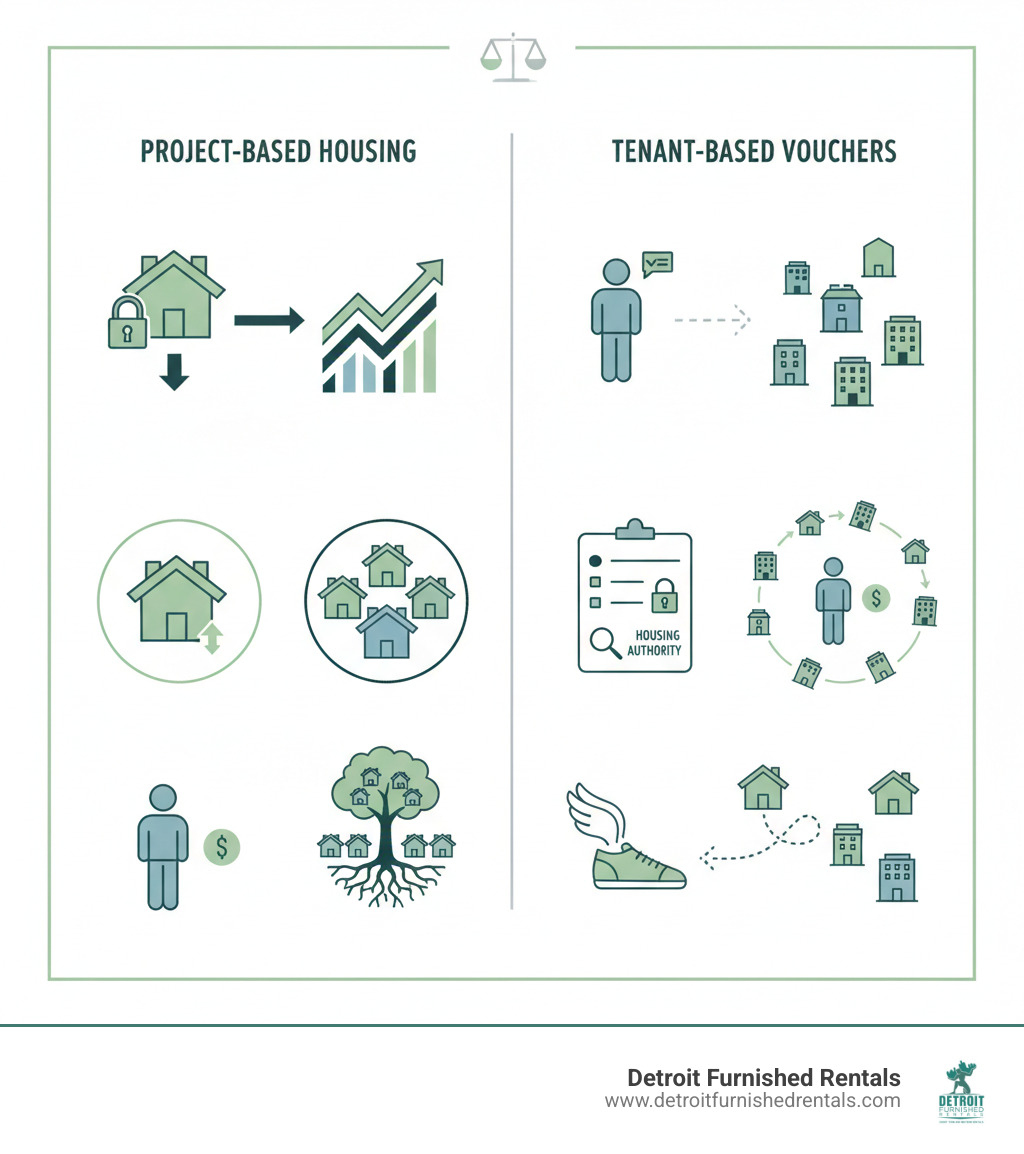
Project based housing is a key tool for affordable living, creating permanently affordable units through government and private property owner partnerships. Unlike portable vouchers, the subsidy is attached directly to the apartment. When you move out, the next qualifying family receives the same assistance.
The U.S. Department of Housing and Urban Development (HUD) works with private landlords and Public Housing Agencies (PHAs) to create these opportunities. The government provides funding and oversight through Housing Assistance Payments, making rent affordable while private landlords manage the properties. This approach ensures long-term affordability, keeping units accessible to low-income households even as market-rate rents climb.
The program’s roots trace to the Housing Act of 1937, with modern versions taking shape from the mid-1960s to mid-1980s through federal incentives. You can learn more in A brief history of federal housing assistance.
How the Program Works
The process centers on the Housing Assistance Payments (HAP) Contract, an agreement between HUD (or a local PHA) and the property owner. As a resident, you pay 30% of your adjusted income for rent and utilities. The HAP contract covers the rest, up to limits set by Fair Market Rents (FMRs).
Property owners must maintain their buildings to HUD standards, keep rents within program limits, and follow fair housing rules. In return, they receive reliable rental payments and long-term occupancy. This stability benefits tenants, as housing costs are tied to income; if your income decreases, your rent portion does too.
Types of Project-Based Section 8
Project-based housing comes in several forms, each with a different structure.
Project-Based Rental Assistance (PBRA) is the original and largest program, where HUD contracts directly with property owners. These are often larger developments built or renovated specifically for low-income families, many dating back to federal initiatives from the 1960s-1980s.
Project-Based Vouchers (PBV) are administered by local PHAs, which “attach” a portion of their housing vouchers to specific units. This strategy helps PHAs encourage new affordable housing development or preserve existing units. PHAs can typically use up to 20% of their vouchers for this purpose.
State and local programs often supplement federal efforts, creating their own project-based housing to address local needs or target specific populations.
Specialized programs serve seniors and people with disabilities. Programs like Section 202 (elderly) and Section 811 (disabilities) combine subsidies with supportive services, creating communities designed around specific needs.

The Mechanics: Eligibility, Application, and Costs
The process for project based housing involves specific eligibility rules, application procedures, and rent calculations. As the Center on Budget and Policy Priorities notes in its Policy Basics on Project-Based Vouchers, these programs are vital for housing stability. However, demand far exceeds supply, leading to long waitlists.
Who Qualifies for Assistance?
Eligibility primarily depends on income. HUD sets local income limits, and your household must fall within these ranges. The main categories are:
- Extremely low-income: 30% or less of the Area Median Income (AMI).
- Very low-income: Between 30% and 50% of AMI.
- Low-income: Up to 80% of AMI.
By law, 75% of new households admitted to voucher programs must be from the extremely low-income category. Other factors include:
- Household size: This affects income limits and the unit size you qualify for.
- Citizenship status: At least one household member must be a U.S. citizen or have eligible immigration status for full assistance. Mixed-status families may receive prorated aid.
- Screening criteria: Property managers screen applicants for factors like criminal history (especially serious offenses), past evictions, and poor rental history. It’s wise to ask about specific criteria before applying.
An older provision, the Earned Income Disallowance, helped disabled individuals by freezing their rent when they started working. While eliminated for new participants in 2023, some existing tenants still benefit.
How to Apply for Project-Based Housing
Unlike regular Section 8, you apply directly to specific buildings with project based housing.
Start by contacting your local Public Housing Agency (PHA) for a list of participating properties. The main challenge is finding properties with open waitlists, as many are closed due to high demand. Wait times can range from a few years to over two decades. Openings may be filled via lottery systems or on a first-come, first-served basis.
Once you find an open list, you’ll complete that property’s specific application. Waitlist management varies, with some properties giving preference to homeless individuals, seniors, disabled persons, or veterans.
Understanding the Costs and Rent Calculation
Rent is predictable: you typically pay 30% of your adjusted gross income for rent and utilities. This amount is determined through:
- Utility allowances: HUD sets standard allowances for utilities to ensure your total housing cost remains at 30% of your income.
- Annual recertification: Each year, the property manager reviews your income and family composition to adjust your rent portion. You must report any changes throughout the year.
- Fair Market Rents (FMRs): HUD establishes these rates by area and unit size to set the maximum subsidy the program will pay. A newer Small Area Fair Market Rents (SAFMR) program refines this by using ZIP codes, giving families access to more neighborhoods. You can see local rates in HUD’s SAFMR database.
Project-Based vs. Tenant-Based Vouchers: What’s the Difference?
Under the Section 8 umbrella, there are two main types of assistance: project based housing and tenant-based vouchers. Understanding their differences is key to your housing search.
The Core Distinction: Subsidy Portability
The biggest difference is whether the subsidy stays with the apartment or moves with you. With project based housing, the subsidy is attached to the unit. With tenant-based assistance (Housing Choice Vouchers), the subsidy is given to you, and you can take it to any qualifying rental.
| Feature | Project-Based Housing (PBRA/PBV) | Housing Choice Vouchers (HCVs) (Tenant-Based) |
|---|---|---|
| Subsidy Location | Attached to a specific housing unit or property. | Assigned to the eligible individual or family. |
| Tenant Choice | Limited to available units within participating properties. | Broader choice of private market rental units that meet program guidelines. |
| Waitlist | Applied for directly at participating properties; can be long or closed. | Managed by local PHAs; can be very long (10-20 years) and often closed. |
| Portability | Generally not portable; subsidy remains with the unit. | Highly portable; can be used in different jurisdictions (with some rules). |
| Stability | Provides long-term affordability for the specific unit. | Offers flexibility to move and retain assistance. |
Tenant-based vouchers offer more flexibility, allowing recipients to find housing in the private market. About 2.3 million households used these vouchers in 2022.
Understanding Project-Based Vouchers (PBVs)
Project-Based Vouchers are a hybrid. A local Public Housing Agency (PHA) “attaches” a portion of its voucher funding to specific apartments. PHAs use PBVs strategically to encourage the development of new affordable housing, preserve existing units, or create specialized housing for seniors, people with disabilities, or those experiencing homelessness. This is especially useful for providing on-site supportive services.
PHAs can use up to 20% of their voucher funds this way. To encourage mixed-income communities, assistance is usually limited to 25% of the units in a property. After living in a PBV unit for one year, you may be eligible for the next available tenant-based voucher, offering a path to future mobility.
Understanding Section 8 Project-Based Rental Assistance (PBRA)
PBRA is the original and larger form of project based housing, supporting about 1.34 million units nationwide. Unlike PBVs, these programs involve direct contracts between HUD and property owners, many established decades ago. Today, the main focus of PBRA is preservation—renewing these contracts to keep existing housing affordable for the vulnerable populations they serve, including seniors and people with disabilities. Without renewal, these units could be converted to market-rate housing, displacing long-term residents.
Impact, Challenges, and the Future of Project-Based Housing
Project based housing provides stable, affordable homes that benefit entire communities through increased economic activity and stronger neighborhood ties. The predictable rental income encourages developers to build or renovate affordable units, while residents gain the security to focus on health, education, and employment. However, the program also faces significant challenges.
Benefits and Criticisms of Project-based housing

Benefits:
- Economic Stability: Stable housing allows families to spend more on local goods and services, and children tend to perform better in school.
- Development Incentive: Guaranteed rent subsidies make affordable housing projects financially viable for developers.
- Efficient Service Delivery: It’s easier to provide on-site supportive services for seniors and people with disabilities.
Criticisms:
- Limited Tenant Choice: Residents are restricted to available units in participating properties, which may not be near jobs or schools.
- Concentration of Poverty: Clustering subsidized units can lead to segregated communities, though modern rules limit this by capping the percentage of assisted units in a building.
- Funding and Participation: Insufficient funding means only one in four eligible households receives assistance. Additionally, some landlords are hesitant to participate in federal programs.
The Future Outlook for Project-based housing
A crisis is looming. According to the National Housing Preservation Database, 446,000 of the 1.34 million active project-based units are at risk of losing their affordability status. Many are at immediate risk due to contract expirations within the next 24 months. Without renewal, owners can convert properties to market-rate housing, displacing tenants.
Advocacy groups like the National Low Income Housing Coalition (NLIHC) are pushing for full funding to renew contracts and protect tenants. The role of preservation is critical, as maintaining existing affordable units is often more cost-effective than building new ones.
Other Similar Housing Programs
Project based housing is part of a larger network of federal programs:
- Low-Income Housing Tax Credit (LIHTC): The largest source of new affordable housing, providing tax incentives to developers.
- Section 202 Supportive Housing for the Elderly: Combines affordable housing with services to help seniors age in place.
- Section 811 Supportive Housing for Persons with Disabilities: Provides housing and supportive services for adults with disabilities.
- Public Housing: Properties owned and operated directly by public housing agencies.
Together, these programs form a crucial safety net, though they still only reach a fraction of those in need.
Frequently Asked Questions about Project-Based Housing
Here are answers to some of the most common questions about project based housing.
Can I move and keep my assistance with project-based housing?
Generally, no. The subsidy is tied to the specific apartment, not the tenant. When you move out, the assistance remains for the next qualifying family.
However, there is an exception for those in a Project-Based Voucher (PBV) unit. After living in the unit for at least one year, you may request the next available tenant-based Housing Choice Voucher from your local housing authority. This provides a potential pathway to mobility, allowing you to move to another qualifying rental while keeping your assistance, though you may have to wait for a voucher to become available.
How long is the wait for project-based housing?
Wait times are notoriously long, ranging from a few years to over two decades in high-demand areas. Many property waitlists are closed entirely due to overwhelming demand.
Factors influencing your wait time include local demand, the number of available units, and property-specific preferences for groups like seniors, veterans, or people with disabilities. Because only one in four eligible families nationwide receives housing assistance, the scarcity creates long, frustrating waits. It is important to have realistic expectations.
Do I have to be a US citizen to qualify?
To receive full assistance, at least one member of the household must be a U.S. citizen or have eligible immigration status.
Families with mixed status (some eligible members, some not) can still receive help, but the assistance will be prorated. The subsidy is calculated based only on the number of eligible family members. You will need to provide documentation for all household members during the application process for verification.
Conclusion
Project based housing is more than a government program; it’s a lifeline that provides stability for families and strengthens communities. By attaching subsidies to properties, it creates a stock of permanently affordable homes for seniors, low-income families, and individuals with disabilities.
When housing is affordable, families have more resources for essentials like food and healthcare, and communities benefit from stable residents. However, the program faces challenges, including decade-long waitlists and the risk of losing hundreds of thousands of units to expiring contracts. Preservation is just as critical as new development.
Every family deserves a stable foundation. Project based housing empowers people to thrive, but the long waits require patience. For those needing immediate, flexible living solutions in Detroit, other options exist. Professionals and families in transition can find a stable home base with Detroit Furnished Rentals, which offers comfortable, move-in ready apartments featuring fully equipped kitchens and dedicated workspaces.
The fight for affordable housing is ongoing, but every preserved or new unit moves us toward a future where everyone has a safe place to call home.