Finding the Right Home for Both of You
Pet friendly temporary housing combines comfortable, fully-equipped living spaces with policies that welcome your pets, typically including options like furnished apartments, extended stay suites, and short-term rentals. These accommodations offer features such as in-unit kitchens, flexible lease terms, and workspace areas—while allowing you to keep your furry family member by your side.
Quick Answer: Best Pet-Friendly Temporary Housing Options
- Furnished Apartments – Full kitchens, more space, fewer restrictions, ideal for 30+ day stays
- Extended Stay Suites – Hotel-style amenities, housekeeping services, typical weight limits (40 lbs or less)
- Corporate Housing – Professional-grade Wi-Fi, workspace areas, monthly flexibility
- Short-Term Rentals – Home-like settings, often include pet amenities like water bowls and toys
Typical Costs: $20/day pet fee (capped at $200) plus $50 one-time fee, or monthly pet rent of $25-$75
With 53% of Canadians owning at least one household pet and Americans spending billions annually on pet care, our animals aren’t just companions—they’re family. Yet finding temporary housing that welcomes both you and your pet can feel like searching for a needle in a haystack. Whether you’re a traveling nurse on assignment, a corporate professional relocating for a project, or someone between homes, the challenge remains the same: Where can I stay that won’t make me choose between my career and my pet?
This guide walks you through everything you need to know about pet friendly temporary housing. You’ll learn about different accommodation types, understand the fees and policies you’ll encounter, find your responsibilities as a pet-owning tenant, and get practical tips for helping your furry friend adjust to temporary digs.
I’m Sean Swain, founder of Detroit Furnished Rentals, and I’ve spent years helping corporate travelers and medical professionals find comfortable, pet friendly temporary housing in the Detroit area. My experience managing multiple short-term rental properties has taught me exactly what pet owners need—and what property managers worry about—when it comes to temporary stays with animals.
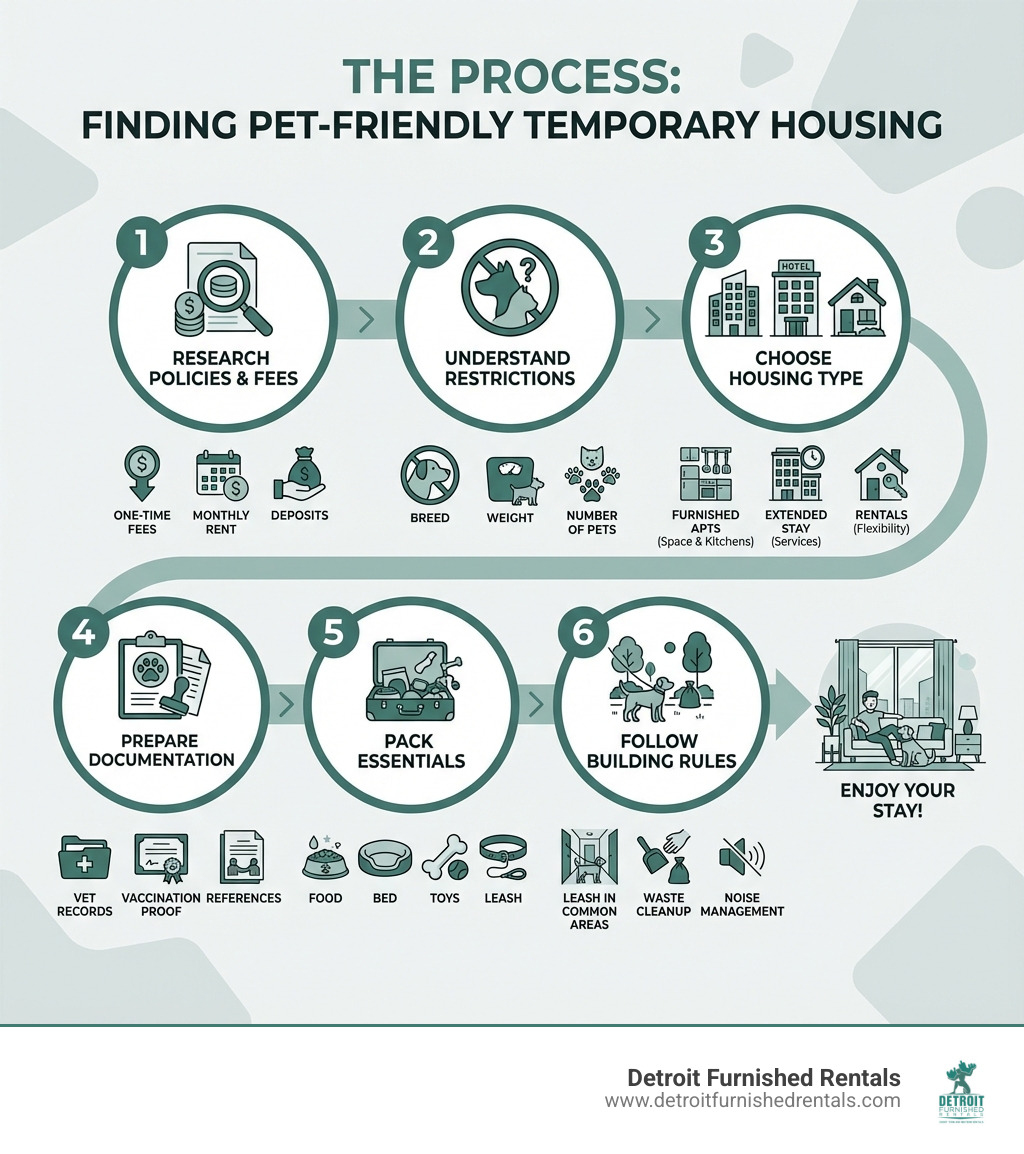
Why Choose Pet-Friendly Accommodations?
Bringing our pets along for a temporary stay isn’t just a convenience; it’s often a necessity for our well-being and theirs. The benefits of choosing pet friendly temporary housing extend far beyond simply avoiding kennel fees.

First and foremost, there are immense emotional benefits for us, the owners. Knowing our beloved companion is with us provides a profound sense of peace of mind. It reduces our stress and anxiety, allowing us to focus better on our work or transition without the constant worry about our pet’s welfare in an unfamiliar boarding situation. Pets are integral to our family, and keeping that family unit together, even temporarily, is invaluable.
For our pets, staying with us minimizes their stress. Animals thrive on routine and familiar surroundings. Being uprooted from home and placed in a kennel can be a traumatic experience, leading to anxiety, changes in behavior, and even health issues. In pet friendly temporary housing, we can maintain their feeding schedules, walking routines, and provide their favorite bed and toys, helping them settle in more quickly and comfortably. A lonely pet is more likely to chew on things they shouldn’t or bark and disrupt others, so keeping them close helps us manage their behavior and happiness.
Financially, avoiding kennel costs can lead to significant savings, especially for extended stays. While pet fees apply, they are often less than the cumulative cost of professional pet boarding. This allows us to allocate our budget to other important aspects of our temporary relocation or assignment.
Choosing pet friendly temporary housing increases the safety for our pets, ensures they receive direct supervision and care, and provides us with the peace of mind that we’re doing the best for our furry family members during a transitional period.
Exploring Types of Pet-Friendly Temporary Housing
When searching for temporary accommodations, we encounter several options, each with its own set of advantages and considerations for pet owners. Understanding these differences helps us make the best choice for our specific needs and the comfort of our pets.
| Feature | Furnished Apartments & Homes | Extended Stay Suites | Short-Term Rentals (e.g., vacation homes) |
|---|---|---|---|
| Space | Generally more spacious, separate living/sleeping areas | Studio or one-bedroom layouts, often compact | Varies widely, from cozy studios to multi-bedroom houses |
| Kitchen Type | Full-sized, fully equipped kitchens | Kitchenette with microwave, mini-fridge, limited cooktop | Varies, often full kitchens, but check specific listings |
| Pet Fees | Typically one-time non-refundable cleaning fee, potential pet rent | Daily fee capped at a certain amount, sometimes additional flat fee | Varies, can be flat fee, daily fee, or pet rent |
| Typical Stay Length | 30+ nights, ideal for mid-to-long term stays | Weekly to monthly, designed for business/relocation | Days to weeks, often for leisure or short transitions |
| Home-like Feel | High, designed for comfortable living | Moderate, functional for extended travel | High, depending on property type and owner’s decor |
| Services | Less frequent housekeeping, more independent living | Regular housekeeping (e.g., weekly/bi-weekly) | Self-catering, may offer add-on services |
| Pet Amenities | Varies, some providers offer welcome kits | Less common, basic pet relief areas | Varies, some owners provide bowls, beds, or fenced yards |
The Comforts of Furnished Apartments and Homes
For those seeking true comfort and a home-away-from-home experience, furnished apartments and homes are often the best choice for pet friendly temporary housing. This is where we at Detroit Furnished Rentals specialize. Our properties offer significantly more space than a typical hotel room, providing separate living, dining, and sleeping areas. This extra room is crucial for pets, allowing them space to play, roam, and relax without feeling confined. It also means we can set up a dedicated corner for their bed, food, and water bowls, creating a familiar “den” that helps them settle in.
Our furnished apartments in Detroit come with full-sized, fully equipped kitchens. This isn’t just a convenience for us; it’s a game-changer for pet owners. We can prepare our own meals, store pet food properly, and avoid the hassle and expense of dining out for every meal. For pets with specific dietary needs or those who prefer their own food, a full kitchen is indispensable.
Many of our units also include dedicated workspaces, which means we can work comfortably while keeping an eye on our furry friends. This setup is ideal for professionals, traveling nurses, or anyone on an extended assignment, offering the perfect blend of professional functionality and personal comfort. Furnished apartments are particularly well-suited for longer stays, typically 30 nights or more, providing stability for both us and our pets during significant life transitions. While some restrictions may apply, the overall environment is often more accommodating and less restrictive than traditional hotel settings.
The Convenience of Extended Stay Suites
Extended stay suites offer another viable option for pet friendly temporary housing, particularly for shorter to mid-length stays. These accommodations are designed to provide apartment-style lodging within a hotel framework, often featuring kitchenettes with basic appliances. They typically include in-room amenities and often offer housekeeping services, though the frequency can vary. For instance, some extended stay brands might offer weekly full-service housekeeping for longer stays, while others might provide it bi-weekly, or offer fresh towels and linens upon request for shorter stays.
While convenient, extended stay suites usually come with stricter pet policies than furnished apartments. Common restrictions include weight limits, such as dogs weighing 40 lbs. or less, and a limit of one pet per suite. These properties are generally more accommodating than traditional hotels, but the space can be more compact, which might be a consideration for larger dogs or multiple pets.
Community and Emergency Support Options
While our focus at Detroit Furnished Rentals is on providing comfortable, private pet friendly temporary housing, we recognize that sometimes individuals face extreme circumstances, such as homelessness, where finding any shelter with a pet becomes a critical challenge. The inability to keep a pet can be a significant barrier for people seeking assistance, with some choosing to stay on the streets rather than separate from their animals.
In many communities, local initiatives and shelters are working to address this gap, understanding that for many, pets are truly family members whose companionship is vital during hardship. While we don’t operate shelters, we believe that providing accessible, private pet friendly temporary housing options helps alleviate the overall strain on community support systems by offering a dignified and comfortable alternative for those who can afford it. For those interested in understanding the broader landscape of support, including local shelter initiatives that may accommodate pets, we encourage exploring resources relevant to your area. Learn about local shelter initiatives.
Understanding Pet Policies, Fees, and Regulations
Navigating pet friendly temporary housing requires a clear understanding of the various policies, fees, and regulations that come with bringing our furry companions along. These aspects can vary significantly between different types of accommodations and providers, so it’s crucial to do our homework.
Decoding Pet Fees vs. Pet Rent
One of the most common points of confusion for pet owners is the difference between pet fees, pet rent, and pet deposits.
- Pet Fee: This is typically a one-time, non-refundable charge paid at the beginning of your stay. It’s often intended to cover additional wear and tear or the cost of special cleaning after a pet has occupied the unit. For example, some providers might charge a $20 per day pet fee, capped at $200 for an extended stay, with an additional one-time $50 fee applying after the cap is reached for the remainder of the stay. Other properties might have a non-refundable pet cleaning fee, such as $350 + tax.
- Pet Rent: Unlike a one-time fee, pet rent is a recurring monthly charge added to your regular rental payment. This covers the ongoing privilege of having a pet in the unit. It’s common in longer-term rentals and can range from $25 to $75 per month.
- Pet Deposit: This is a refundable amount paid upfront, similar to a security deposit for humans. It’s held by the property manager and is returned to us at the end of our stay, provided there’s no pet-related damage beyond normal wear and tear. While not always common in very short-term temporary housing, it’s a standard practice in many longer-term pet-friendly rentals.
It’s essential to clarify whether a charge is a fee (one-time, non-refundable), rent (monthly), or a deposit (refundable) before booking any pet friendly temporary housing.
Common Restrictions in Pet-Friendly Temporary Housing
Even in accommodations that are advertised as pet-friendly, certain restrictions are common. These are put in place to ensure the safety and comfort of all residents and to protect the property.
- Breed Restrictions: Some properties have specific breed restrictions, often excluding breeds traditionally perceived as “guard” or “attack” dogs, such as Pitbulls, Dobermans, Mastiffs, and Rottweilers. While we understand the concerns, we also know that responsible ownership is key, regardless of breed.
- Weight Limits: It’s very common to find weight restrictions. For instance, some temporary housing options may only allow dogs weighing 40 lbs. or less, or even as low as 25 lbs. or less for both dogs and cats.
- Number of Pets Allowed: Most properties will have a limit on the number of pets per unit, typically a maximum of two.
- Types of Pets: While dogs and cats are the most commonly accepted pets, some places may also allow small birds, small rodents (like hamsters or gerbils), fish aquariums, or turtles. If we have a less common pet, confirm their acceptance beforehand.
Always refer to the specific building’s pet policy or contact the provider directly to confirm these details before making a reservation.
Legal Considerations and Building Rules
Beyond fees and restrictions, there are important legal considerations and building-specific rules that we, as responsible pet owners, must adhere to in pet friendly temporary housing.
- Service Animal Laws: Service animals are not considered pets and are protected by law. In the United States, the Americans with Disabilities Act (ADA) ensures that individuals with disabilities can bring their service animals to public accommodations. This typically means service animals are exempt from pet fees, breed restrictions, and weight limits, provided proper documentation can be supplied.
- Nuisance Pet Clauses: To ensure harmony within shared living spaces, properties often have “nuisance pet” clauses. These define behaviors that are unacceptable, such as aggressive actions, excessive barking, physical harm to others or service animals, or interference with other residents. Repeated violations can lead to formal warnings and even a requirement to remove the pet from the property.
- ‘Petiquette’ in Shared Spaces: Living in a community, especially in an apartment building, requires what we call ‘Petiquette’—a blend of common sense, courtesy, and adherence to rules. This includes:
- Leash Rules: Pets must always be on a leash or adequately restrained when in common areas (hallways, lobbies, elevators, outdoor spaces).
- Waste Disposal: We are responsible for immediately cleaning up after our pets. This usually means “poop and scoop” policies and properly disposing of waste, often double-bagged, in designated receptacles. For indoor pets, litter boxes should be kept clean and waste double-bagged before disposal.
- Noise Management: We must manage our pets’ barking or other noises to avoid disturbing neighbors, especially during quiet hours.
- Elevator Etiquette: If another resident appears uncomfortable with our pet, it’s courteous to offer to take the next elevator.
- Guest Pet Policies: If friends or family visit with their pets, we must ensure their animals are on the allowable list, registered with property management, and adhere to all community rules.
At Detroit Furnished Rentals, we provide clear guidelines to ensure a harmonious environment for all our guests, both two-legged and four-legged. We believe that responsible pet ownership is the cornerstone of a successful pet friendly temporary housing experience.
A Guide to a Smooth and Happy Stay
Ensuring a smooth and comfortable stay for ourselves and our pets in pet friendly temporary housing involves preparation, responsibility, and a little extra care to help our animals adjust.
Preparing for Your Stay in Pet-Friendly Temporary Housing
Preparation is key to reducing stress for both you and your pet.
- Veterinarian Check-up and Records: Before we travel, a visit to the vet ensures our pet is healthy and up-to-date on vaccinations. We should carry their vaccination records, as some properties may require them.
- Update Microchip Information: If our pet has a microchip, double-check that the registered contact information is current, including our temporary address or a reliable contact number.
- Packing List: Beyond our own belongings, we need a dedicated packing list for our pet. This should include:
- Sufficient food and treats for the entire stay.
- Their favorite bed, blankets, and toys to provide familiar comfort.
- Leash, collar/harness, and ID tags.
- Food and water bowls (a portable one for outings can be very handy).
- Waste bags and any necessary cleaning supplies.
- Any medications.
- A carrier or crate, especially if our pet is crate-trained.
- Crate Training: If our pet isn’t already crate-trained, now might be a good time to start. A crate can provide a safe, familiar den for them in a new environment and can be essential for their safety if we need to leave them alone.
Responsibilities of a Great Pet-Owning Tenant
Being a great pet-owning tenant in pet friendly temporary housing means going above and beyond to ensure our pet doesn’t cause any issues for the property or other residents.
- Following Leash Rules: Always keep our pets on a leash or in a carrier when in common areas of the building or on the property grounds.
- Immediate Waste Cleanup: Carry waste bags at all times and immediately clean up after our pet outdoors. Dispose of waste properly in designated bins.
- Managing Noise and Barking: Be mindful of our pet’s noise levels. Excessive barking can disturb neighbors. If our pet is prone to barking, we should work on training or seek solutions to keep them calm when we’re away.
- Securing Pet During Housekeeping: If our temporary housing includes housekeeping services, we must ensure our pet is safely contained in a crate or removed from the unit during cleaning visits. This protects both our pet and the housekeeping staff.
- Reporting Damage: If our pet accidentally causes any damage to the unit or common areas, we must report it to property management immediately. Transparency helps resolve issues quickly and maintains our reputation as responsible tenants.
Helping Your Pet Settle In
Moving to a new place can be unsettling for pets, even when we’re right there with them. We can take steps to make their transition smoother.
- Create a Familiar Space: As soon as we arrive, set up our pet’s bed, food, and water bowls in a consistent location. Having their familiar items and a designated “spot” helps them feel secure.
- Maintain Routine: Stick to their regular feeding, walking, and playtime schedules as much as possible. Predictability is comforting.
- Explore the Neighborhood: Take our dog for long walks to explore the new surroundings and find suitable potty spots. For cats, provide stimulating toys and vertical spaces if available.
- Find Local Resources: Research local dog parks, pet supply stores, and a veterinarian in Detroit for any emergencies.
Here’s a quick list of essential items to pack for your pet:
- Food and water (with bowls)
- Favorite bed and blankets
- Comfort toys and chew items
- Leash, collar/harness, and ID tags
- Waste bags
- Any medications
- Copy of vaccination records
- Portable water bottle for walks
For more comprehensive advice on making your pet’s temporary stay as comfortable as possible, check out our detailed guide. More tips for a positive stay.
Frequently Asked Questions about Pet-Friendly Stays
We understand that you might have more specific questions about bringing your pet along for a temporary stay. Here are answers to some common inquiries:
What’s the difference between a ‘pet-friendly’ and ‘pets allowed’ policy?
While these terms might seem similar, there’s often a subtle but important distinction. A property that is “pet-friendly” typically means they not only allow pets but also actively welcome them. This might include providing pet amenities like welcome kits (e.g., a chew toy and water bowl), having designated pet relief areas, or even organizing pet-related events. They accept pets as part of the family.
On the other hand, “pets allowed” might simply mean they won’t deny your pet, but with potentially stricter rules, limitations, and perhaps fewer amenities catering to animals. It’s more of an acceptance than an accept. When we see “pet-friendly,” it often implies a more accommodating and understanding environment for our furry friends.
Are service animals subject to pet fees and restrictions?
Generally, no. In the United States, laws such as the Americans with Disabilities Act (ADA) protect individuals with disabilities who use service animals. This means that service animals are typically exempt from pet fees, breed restrictions, and weight limits that apply to companion pets. However, the owner is usually required to provide appropriate documentation and registration for the service animal. Service animals are trained to perform specific tasks directly related to a person’s disability and are not considered pets. We always accommodate service animals without additional charges, provided the necessary documentation is supplied.
How can I prove my pet is well-behaved to a potential landlord?
Demonstrating that your pet is well-behaved can significantly ease the process of securing pet friendly temporary housing. Here are a few ways we can provide assurance to a potential landlord or property manager:
- Veterinarian Records: Provide up-to-date vaccination records and a letter from your vet confirming your pet’s good health.
- Previous Landlord References: Offer contact information for previous landlords who can attest to your pet’s good behavior and your responsibility as an owner.
- Training Certificates: If your dog has completed obedience training, providing a certificate can show they are well-managed.
- Pet Resume: Create a “pet resume” detailing your pet’s age, breed, weight, temperament, training, and habits, along with a cute photo.
- Meet-and-Greet: If feasible, offer to bring your pet for a brief meet-and-greet with the property manager to demonstrate their calm demeanor.
- Pet Insurance: Showing proof of pet liability insurance can reassure landlords about potential damages.
Being proactive and transparent about our pet’s behavior can go a long way in building trust and securing the perfect temporary home.
Conclusion
Finding pet friendly temporary housing doesn’t have to be a daunting task. As we’ve explored, planning is crucial, from understanding the different types of accommodations available to decoding pet policies and preparing our furry companions for the move. The key is to be informed, responsible, and proactive in our search and during our stay.
For many, furnished apartments offer the ideal blend of comfort, space, and a home-like environment, making them an excellent choice for both pets and their owners during transitional periods. With full kitchens, dedicated workspaces, and flexible lease terms, they provide the stability and amenities needed for a smooth and comfortable experience.
For those seeking pet friendly temporary housing in Detroit, we at Detroit Furnished Rentals are dedicated to providing fully-equipped, comfortable options that welcome you and your furry family members. We understand that your pets are family, and we’re committed to making your temporary stay in Detroit as stress-free and enjoyable as possible.
Find your perfect pet-friendly furnished apartment in Detroit