What “Corporation Rental” Really Means (And Why It Matters in 2026)
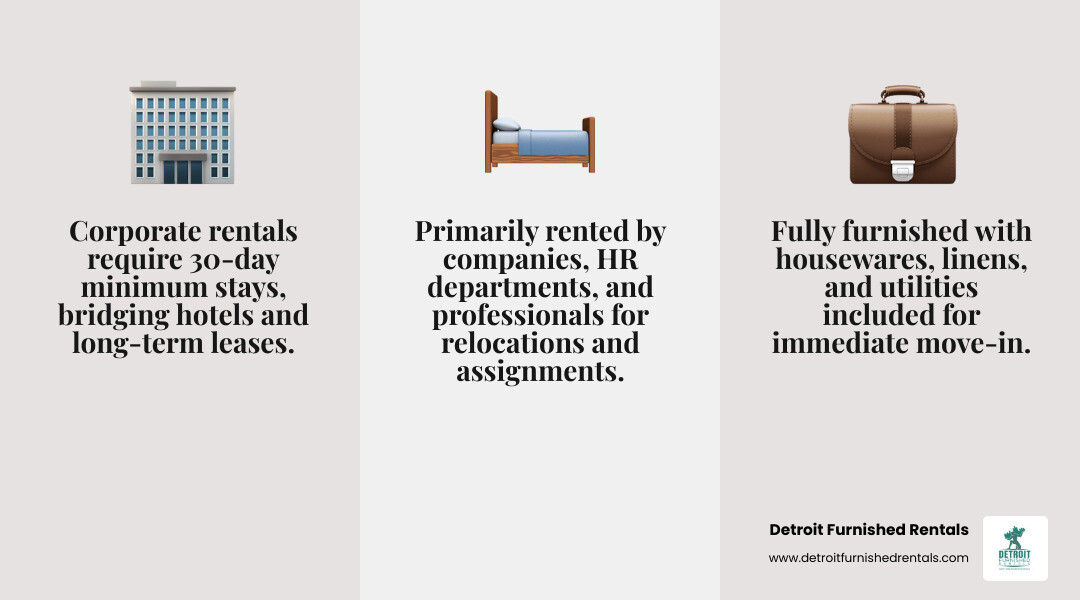
A corporation rental is a fully furnished, professionally managed property leased for temporary stays — typically 30 days or longer — to business travelers, relocating employees, and other professionals who need a move-in-ready home away from home.
Quick answer:
| Feature | Corporation Rental |
|---|---|
| Lease length | 30 days to 6 months (typical) |
| Furnished | Yes — fully, including housewares and linens |
| Utilities included | Usually yes |
| Who rents | Companies, HR departments, or individual professionals |
| Cost vs. hotel | More space, lower cost per night on extended stays |
| Managed by | Professional housing providers or independent landlords |
Corporate rentals sit in a sweet spot between a hotel and a traditional apartment lease. You get the flexibility of a short stay and the comfort of a real home.
This type of housing has been around for over 50 years. But in April 2026, demand is surging — driven by travel nursing, remote work assignments, insurance displacements, and corporate relocations. More professionals than ever need furnished, flexible housing that a standard lease or hotel simply can’t provide.
I’m Sean Swain, co-owner of Detroit Furnished Rentals, and over the past nine years I’ve grown a 15-unit furnished rental portfolio across Detroit and Chicago — giving me experience with every aspect of the corporation rental market, from pricing and furnishing to lease structuring and tenant relations. In this guide, I’ll walk you through everything you need to know, whether you’re a renter looking for your next temporary home or a landlord exploring this strategy.
Explore more about corporation rental:
What is a Corporation Rental?

At its core, a corporation rental (often used interchangeably with “corporate housing”) is a turnkey residential solution. Unlike a standard apartment where you’d need to call the power company and haul a mattress up three flights of stairs, these units are ready for you the moment you turn the key.
In the industry, we call these “mid-term stays.” They aren’t nightly like a hotel, but they aren’t year-long commitments either. Most company housing explained resources will tell you that the magic number is 30 days. This duration is significant because it often moves the rental out of the “transient” or “hotel tax” category and into a standard residential lease territory, which is often easier for landlords to manage from a regulatory standpoint.
These properties are specifically designed for:
- Business travelers on extended assignments.
- Relocating employees who need a home base while they shop for a permanent house.
- Healthcare professionals, like travel nurses, who usually work 13-week contracts.
To help you visualize where this fits in the market, here is a comparison table:
| Feature | Corporate Housing | Hotel | Vacation Rental (Airbnb) | Traditional Lease |
|---|---|---|---|---|
| Typical Stay | 30 – 180 Days | 1 – 7 Days | 2 – 14 Days | 12+ Months |
| Furnishings | Full (High Quality) | Minimal | Eclectic/Personal | None |
| Kitchen | Full & Equipped | Kitchenette/None | Full | Full (Unequipped) |
| Utilities | Included | Included | Included | Tenant Pays |
| Primary Goal | Work/Relocation | Travel/Leisure | Vacation | Long-term Living |
Typical Clients for a Corporation Rental
While “corporate” is in the name, the client base is incredibly diverse. We see a wide range of professionals seeking who is who in the world of corporate apartment rentals.
- Healthcare Staffing: Travel nurses and doctors are the backbone of the mid-term market. They need safe, quiet, and fully equipped spaces near major hospitals.
- Digital Nomads: In 2026, the “work from anywhere” culture is still going strong. These renters look for high-speed internet and a vibe that feels more like a home than a sterile hotel room.
- Insurance Claimants: If a family’s home is damaged by fire or flood, their insurance company will often foot the bill for a corporation rental for 3 to 6 months while repairs are made.
- Government and Military: Contractors and personnel on temporary duty assignments often prefer the privacy of an apartment over base housing or hotels.
- Project Consultants: Audit teams, IT implementation specialists, and engineers often move to a city for a specific 4-month project.
How Corporate Housing Differs from Traditional Leases
The biggest difference is the “frictionless” nature of the stay. In a traditional lease, you are responsible for everything—furniture, water, electricity, internet, and even lightbulbs. In understanding corporate serviced apartments, all of those costs are bundled into one monthly payment.
Furthermore, traditional leases are rigid. If you break a 12-month lease at month four, you’re usually hit with massive penalties. A corporation rental offers flexible lease terms. At Detroit Furnished Rentals, we often work with month-to-month extensions because we know that a “three-month project” can easily turn into five months.
Key Features and Amenities of a Successful Property
What makes a corporation rental successful? It’s not just about having a bed; it’s about providing an environment where a professional can actually live and work.
The baseline expectation in 2026 includes:
- Blazing Fast WiFi: This is non-negotiable. If the internet lags during a Zoom call, the tenant will leave.
- Dedicated Workstations: A kitchen table isn’t enough. A successful unit needs a desk and an ergonomic chair.
- In-Unit Laundry: For a 30-day stay, nobody wants to hunt for quarters or visit a laundromat.
- Fully Equipped Kitchen: This means more than just a stove. We provide pots, pans, a blender, a toaster, and a high-quality coffee maker.
- Pet-Friendly Options: Many relocating families won’t move without their furry friends. Offering pet-friendly units is one of our biggest competitive advantages at Detroit Furnished Rentals.
If you are a landlord setting up a unit, you might consider furniture rental services to get your property market-ready quickly. Professional providers can often furnish an entire home in as little as 48 hours, which is vital if you have a corporate client ready to sign immediately. Our furnished rentals for professionals guide emphasizes that quality matters—cheap furniture wears out fast under the high turnover of corporate stays.
Essential Furnishings for a Corporation Rental
When asking what is a corporate apartment?, the answer lies in the details. You are selling “convenience.”
- The Sleep Experience: Invest in high-quality mattresses and high-thread-count linens. A business traveler who doesn’t sleep well won’t renew.
- Smart Entertainment: Large Smart TVs with streaming capabilities are standard.
- Kitchen Essentials: Don’t forget the small things—corkscrews, measuring spoons, and Tupperware for leftovers.
- Aesthetic Decor: The unit should feel curated and modern, not like a dorm room. Many owners use professional furniture packages to ensure a cohesive, high-end look that commands premium rates.
Financial Benefits and Startup Costs
From an investment standpoint, a corporation rental can be significantly more profitable than a traditional long-term rental. While a standard apartment in Detroit might rent for $1,500 unfurnished, that same unit as a corporate rental could command $2,800 to $3,500 per month.
The trade-off is higher startup costs and more active management.
The Startup Budget: Landlords should expect to spend between $12,000 and $15,000 to launch a professional-grade corporate unit. This includes:
- Furnishings: $8,000 – $10,000 (roughly $1,500 to $4,000 per room).
- Housewares & Linens: $1,500 – $2,000.
- Tech & Utilities Setup: $500.
- Initial Deep Clean & Photography: $600.
While these costs are high, the ROI is often superior. Some landlords even explore advanced tax strategies, such as using C Corporations for rental properties, to manage the 21% flat tax rate on profits while aggressively paying down property debt. However, this requires “super duper” careful planning with a CPA.
For those just getting started, we recommend checking out corporate leasing 101 to understand the nuances of the business model.
Pricing Strategies for Your Corporation Rental
Pricing isn’t “set it and forget it.” It’s dynamic.
- Tiered Pricing: You should charge more for a 30-day stay than a 6-month stay. The shorter the stay, the higher the administrative and cleaning burden.
- All-Inclusive Billing: Your price should include rent, utilities, internet, and parking. Corporate HR departments hate “nickel and diming.” They want one invoice they can easily approve.
- Negotiation Tactics: Be prepared to offer a 10-20% discount during off-peak seasons (like Detroit winters) to keep your occupancy high.
- Occupancy Optimization: It is better to have a unit occupied at a slightly lower rate than sitting empty for a month.
When managing corporate leasing apartments, we always look at the “RevPAR” (Revenue Per Available Room) rather than just the monthly rent. If you can cover your annual expenses in just 6 months of corporate occupancy, the rest is pure profit.
Legal Considerations and Marketing Strategies
Renting to an individual is one thing; renting to a company is another. In a corporation rental scenario, the “tenant” on the lease is often a legal entity (an LLC or Corp), while the “occupant” is the employee.
Legal Checklist:
- Entity Screening: Standard credit checks don’t work for corporations. You may need to verify their standing with the Secretary of State or ask for a personal guarantee from a company officer.
- Lease Addendums: Ensure your lease has a “corporate addendum” that specifies who is allowed to stay in the unit and holds the company liable for any damages caused by their employees.
- Zoning & Regulations: Many cities have strict rules against stays shorter than 30 days (Airbnb style). Because corporate housing is typically 30+ days, it often bypasses these “transient lodging” taxes and restrictions. However, always check local Detroit ordinances.
Marketing Your Property: To find the best tenants, you need to go where they are looking.
- Specialized Platforms: List on sites like CorporateHousing.com or CHBO (Corporate Housing By Owner).
- HR Partnerships: Reach out to the HR departments of local hospitals and large Detroit employers (like the Big Three automakers).
- SEO & Content: Use a furnished corporate housing complete guide approach on your own website to attract organic traffic.
- Relocation Management Companies (RMCs): These firms handle the logistics for Fortune 500 employee moves. Getting on their “vetted vendor” list is the holy grail of corporate housing.
For a deeper dive into the local market, our Detroit corporate rentals guide provides specific insights into which neighborhoods are currently seeing the highest demand from business travelers.
Frequently Asked Questions about Corporate Housing
How long is a typical stay in a corporate rental?
While the industry standard is a 30-day minimum, the average stay typically ranges from 3 to 6 months. Many of our clients at Detroit Furnished Rentals start with a 90-day lease and then transition to a month-to-month arrangement if their project or home search is extended. You can find more details in our corporate housing Detroit guide.
Is corporate housing more expensive than a hotel?
If you look at the nightly rate, corporate housing is almost always cheaper than a high-end hotel for stays over 30 days. Furthermore, because you have a full kitchen, you save significantly on food costs. When you factor in the extra square footage and the “home-like” feel, the value proposition for business visitor housing is much higher than a cramped hotel room.
Who typically signs the lease for a corporate unit?
It varies. Sometimes a Fortune 500 company signs the lease directly. Other times, a third-party relocation management firm acts as the leaseholder. In some cases, the individual professional signs the lease but is reimbursed by their employer. Understanding these company housing benefits helps landlords know who to hold accountable for rent and damages.
Conclusion
The world of the corporation rental is , professional, and highly rewarding for both tenants and landlords. In 2026, as the workforce becomes more mobile and the demand for flexible living continues to climb, this niche of the real estate market is more vital than ever.
At Detroit Furnished Rentals, we pride ourselves on bridging the gap between “temporary” and “home.” Whether you are a traveling nurse looking for a quiet sanctuary near the Medical Center or a property owner looking to maximize your ROI, understanding the nuances of corporate housing is the first step toward success.
If you’re looking for a place to stay or want to see how a professionally managed unit looks, we invite you to discover top corporate housing options in Detroit. We’ve spent years perfecting the “just bring your suitcase” experience, and we’re here to help you do the same.