

Why Historic Detroit Restaurants Are Worth Seeking Out
Historic Detroit restaurants represent some of the most authentic, character-rich dining experiences in the Midwest. Here are the most iconic ones you should know about:
| Restaurant | Founded | Known For |
|---|---|---|
| Amore da Roma (Roma Café) | 1888 | Detroit’s oldest Italian restaurant, Eastern Market |
| American Coney Island | 1917 | Classic coney dogs |
| Lafayette Coney Island | 1924 | Coney rivalry landmark |
| Buddy’s Pizza | 1946 | Inventor of Detroit-style square pizza |
| Baker’s Keyboard Lounge | 1933 | World’s oldest jazz club |
| Jacoby’s German Biergarten | 1904 | 120+ years of German cuisine |
| Cadieux Cafe | Est. early 20th c. | Only feather bowling venue in the U.S. |
| Dakota Inn Rathskeller | 1933 | Pre-WWII German decor, live sing-alongs |
| Cliff Bell’s | 1935 | Art Deco jazz club, Prohibition roots |
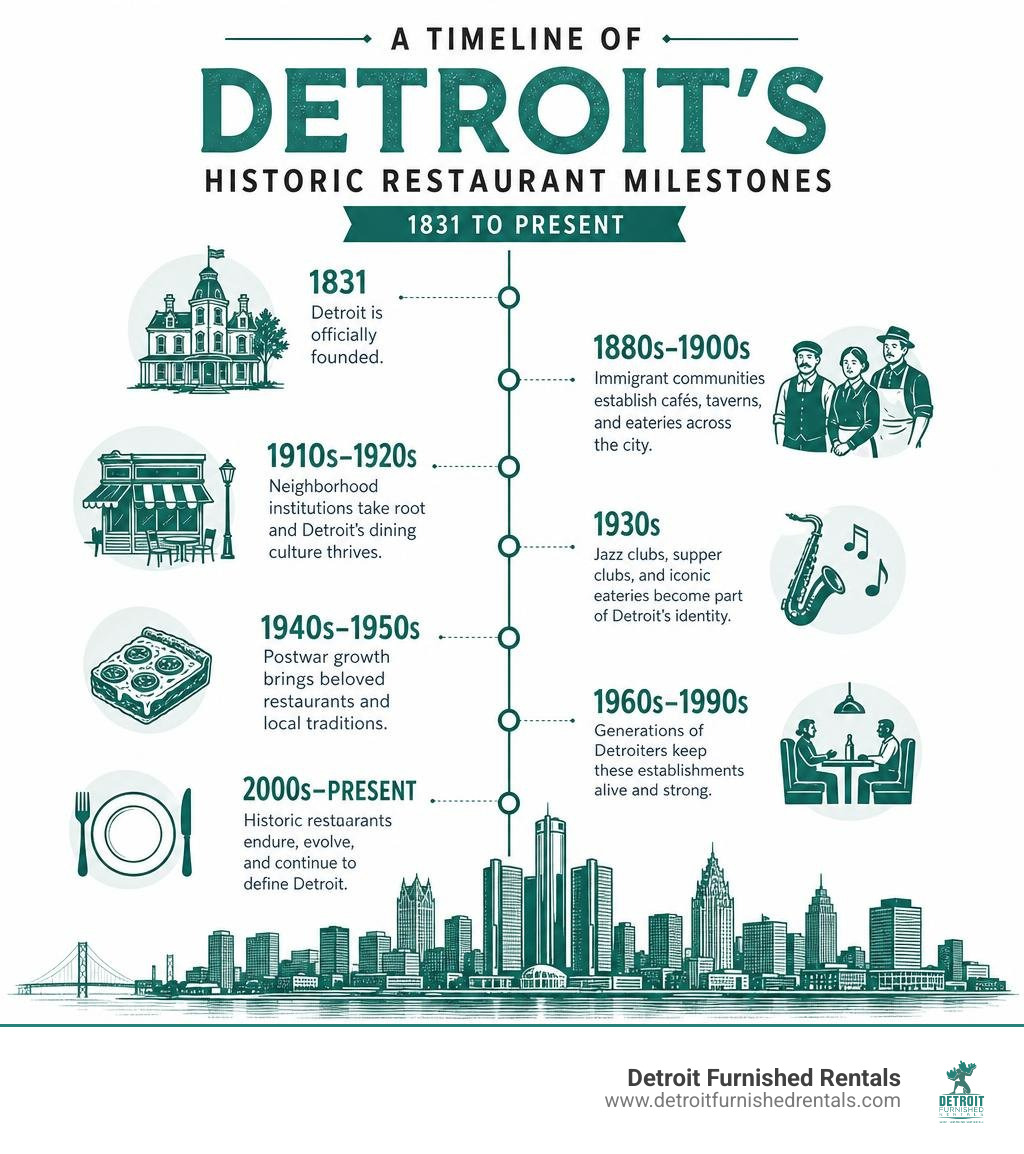
Detroit’s food scene didn’t happen by accident. It was built — dish by dish — by waves of German, Italian, Greek, Polish, Belgian, and Lebanese immigrants who turned their family recipes into neighborhood institutions.
Some of these places have been feeding Detroiters for over a century. A few have been lost to demolition and redevelopment. Others nearly vanished before being restored to their former glory.
What they all share is something you can’t manufacture: real history on the walls, in the recipes, and behind the bar.
I’m Sean Swain, a Detroit-based hospitality operator with a deep connection to the city’s neighborhoods, architecture, and culinary heritage — and historic Detroit restaurants are one of the first things I recommend to every guest who stays in one of our furnished rentals. Whether you’re here for a week or a few months, this guide will point you to the places worth making time for.
Similar topics to Historic Detroit restaurants:
A Guide to Historic Detroit Restaurants and Their Century-Old Legacies
To step into a historic Detroit restaurant is to step back in time. These establishments are not dusty museum relics; they are living, breathing cathedrals built to keep traditions alive. Amid decades of economic shifts, neighborhood transformations, and shifting culinary trends, these dining rooms have remained remarkably unchanged. They serve as anchors of comfort, offering a sensory bridge to the Detroit of yesteryear.
Amore da Roma (Formerly Roma Café)
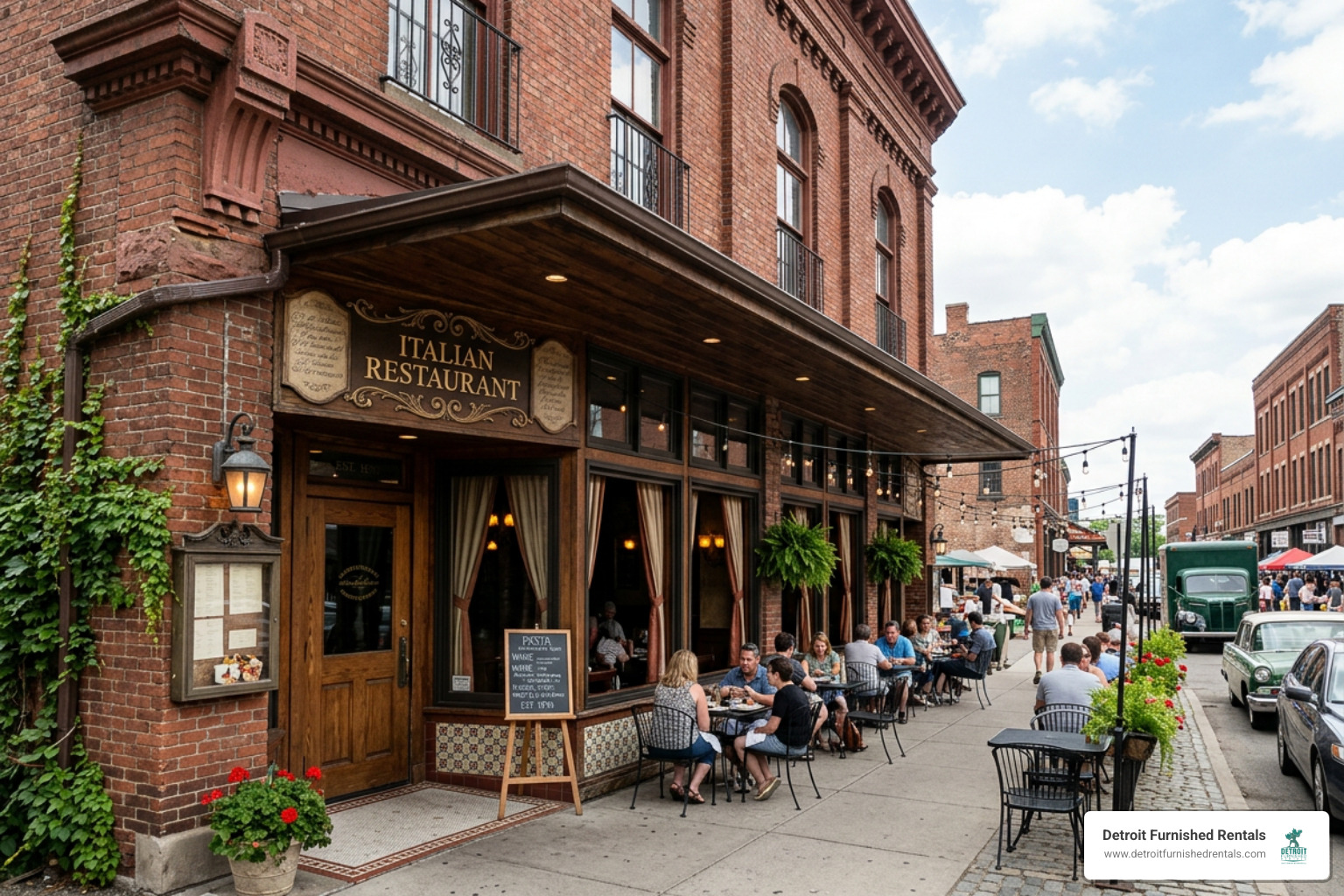
Located in the heart of Eastern Market, Amore da Roma (originally founded as Roma Café in 1888) stands proud as Detroit’s oldest continuously operating Italian restaurant. It was originally built to serve the vendors, farmers, and patrons of the bustling market. Walking through its doors feels like stepping into a warm, festive, dimly lit Italian-American family gathering.
The restaurant has survived the turn of two centuries by maintaining a deep commitment to its roots. When the legendary Roma Café closed its doors in 2017, the culinary community held its collective breath. Thankfully, it was rebranded and revived as Amore da Roma, preserving the classic Midtown Italian-American ambiance, the dark wood, the white tablecloths, and the traditional menu. Diners still flock here for exceptional veal selections, classic pasta dishes, and a unique regional crossover: “Italian saganaki,” a flaming cheese dish that nods to Detroit’s nearby Greek community. To learn more about how these legendary spots fit into our city’s narrative, check out our guide on A Taste of History: Unearthing Detroit’s Classic Dining Gems.
Jacoby’s German Biergarten
Tucked away on Brush Street downtown, Jacoby’s German Biergarten has been pouring cold drafts and serving hearty German fare since 1904. For over 120 years, Jacoby’s has stood as a testament to the city’s early German immigrant community. It survived the dark days of Prohibition by operating quietly, and it remains a beloved sanctuary for those seeking a pint of imported German lager and a plate of traditional rindfleisch rouladen (beef roll-ups) or spaetzle. In a downtown filled with sleek, modern glass towers, Jacoby’s dark wood interior and vintage beer steins remind us of a more neighborly, leisurely Detroit.
The Birth of Detroit-Style Pizza at Historic Detroit Restaurants
No conversation about Detroit’s culinary identity is complete without discussing Detroit-style pizza, a global phenomenon that was born out of the city’s mid-century industrial ingenuity.
In 1946, Gus Guerra, the owner of a neighborhood tavern called Buddy’s Rendezvous on Conant Street, decided to add pizza to the menu. However, he didn’t want to make just any round pie. His wife, Anna, shared a traditional Sicilian thick-crust dough recipe, but they needed the right pans to bake it. Gus looked to Detroit’s booming automotive industry for inspiration. He sourced blue steel utility pans originally designed as oil drip trays and parts bins from local auto plants.
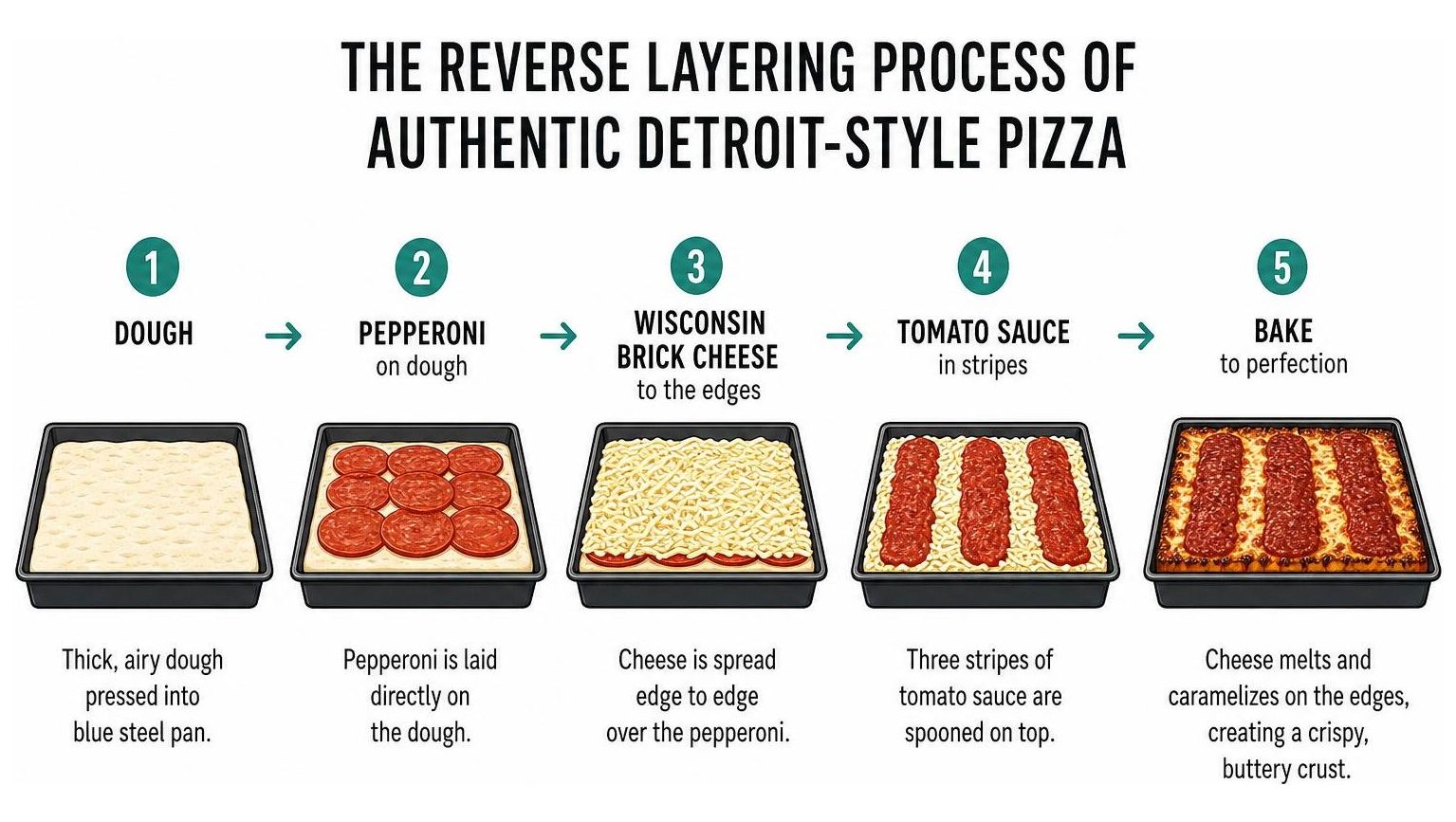
These heavy, square steel pans proved to be the magic ingredient. They distributed heat incredibly evenly, baking the thick, airy dough to a perfect golden crisp. The cooking process is defined by a reverse layering technique: first, the pepperoni is laid directly onto the dough; next, a generous layer of Wisconsin brick cheese is spread all the way to the edges of the pan; finally, three racing stripes of thick tomato sauce are spooned over the top. As the pizza bakes, the brick cheese melts down the sides, caramelizing against the hot blue steel to create a crispy, buttery, dark cheese crust that is the hallmark of the style.
Today, the original Buddy’s Pizza location on Conant Street still serves up these legendary square pies in a dining room filled with community-built decor, historic photos, and nostalgic charm. To explore more about Buddy’s and other local spots that have stood the test of time, see the list of 30 Detroit-area restaurants that have been around over 50 … .
Jazz, Steaks, and Historic Detroit Restaurants of the Mid-Century
During the mid-20th century, Detroit was a global powerhouse of manufacturing, music, and wealth. The restaurants of this era reflected that confidence, combining high-end dining with world-class entertainment and sophisticated cocktails.
Baker’s Keyboard Lounge
Opened originally as a simple sandwich joint in 1933, Baker’s Keyboard Lounge began booking jazz musicians in 1934 and quickly transformed into the “World’s Oldest Continuous Jazz Club.” This historic spot on Livernois Avenue became a legendary performance hub, hosting giants like Ella Fitzgerald, Miles Davis, Nat “King” Cole, and Sarah Vaughan. Stepping into Baker’s is an incredible sensory experience. The intimate room features a famous piano-shaped bar, Art Deco lighting, and a soul food menu that has comforted music lovers for generations.
London Chop House and the Caucus Club
For the ultimate in mid-century power dining, the elite of Detroit headed to the London Chop House (founded in 1938) and its sister establishment across the street, the Caucus Club (founded in 1952). These subterranean sanctuaries were the preferred gathering spots for auto executives, politicians, and celebrities.
The London Chop House was legendary for its impeccable service, prime steaks, and the invention of the “Bullshot” cocktail—a savory, beefy relative of the Bloody Mary made by mixing vodka with beef consommé, Worcestershire sauce, and lemon. Meanwhile, the Caucus Club offered a sophisticated club-like atmosphere where a young Barbra Streisand famously performed early in her career.
Both venues have been meticulously restored, allowing modern diners to experience old-school tableside Caesar salad preparations, vintage leather booths, and classic steakhouse hospitality. You can read more about these legendary institutions in our deep dives: London Chop House: Detroit’s Legendary Fine Dining Steakhouse and the historic Caucus Club Detroit.
Immigrant Flavors and Neighborhood Traditions
The story of Detroit’s culinary landscape is fundamentally a story of global migration. Wave after wave of immigrants arrived in the Motor City to work in the factories, bringing with them the rich culinary traditions of their homelands. These communities established neighborhoods that revolved around their churches, social halls, and family-run restaurants.
| Immigrant Group | Core Neighborhood | Iconic Dish / Tradition | Famous Historic Venue |
|---|---|---|---|
| Greek | Greektown | Saganaki (Flaming Cheese), Coney Dogs | Lafayette & American Coney Island, Pegasus |
| Polish | Hamtramck | City Chicken, Pierogi, Dill Pickle Soup | Polonia, Ivanhoe Cafe (Polish Yacht Club) |
| German | Harmonie Park / Downtown | Sauerbraten, Rouladen, Cold Lager | Jacoby’s, Dakota Inn Rathskeller |
| Belgian | East Side | Mussels & Frites, Feather Bowling | Cadieux Cafe |
| Italian | Eastern Market / Midtown | Veal Marsala, Handmade Pasta | Amore da Roma, Mario’s |
| Lebanese | Dearborn / Metro Detroit | Shawarma, Hummus, Falafel | Al Ameer |
Coney Island Rivalries and Greektown Sparks
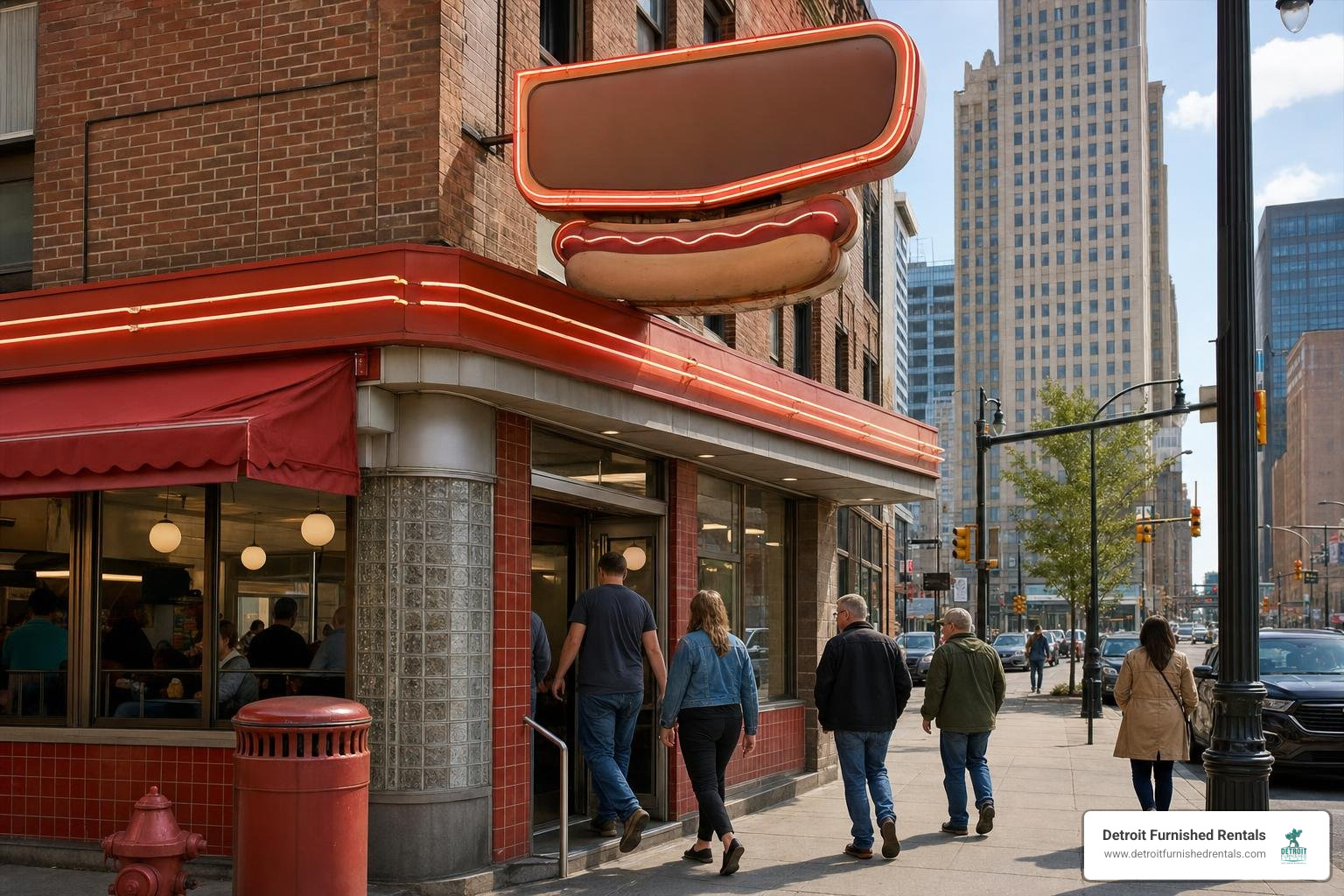
Perhaps no food is more synonymous with Detroit than the Coney Island hot dog. Despite the name referencing New York, the Coney Island hot dog as we know it—a natural-casing beef frankfurter topped with a savory, beanless beef chili, yellow mustard, and freshly diced white onions—was perfected by Greek immigrants in Detroit.
This culinary tradition sparked one of the most famous sibling rivalries in American restaurant history. In 1917, Greek immigrant Gust Keros opened American Coney Island on Lafayette Boulevard downtown. A few years later, in 1924, Gust brought his brother William over from Greece to help. Following a family dispute, William decided to open his own joint, Lafayette Coney Island, right next door.
For over a century, these two legendary spots have operated side-by-side, dividing Detroiters into passionate camps. American features a bright, spacious, neon-lit dining room, while Lafayette offers a narrow, no-frills, incredibly atmosphere where veteran servers shout orders down the counter. To understand the magic behind this legendary rivalry, read our article on American Coney Island Chili Dogs.
Just a short walk away lies Greektown, where the festive energy of Greek dining remains on full display. It was here, at establishments like Pegasus Taverna, that the modern tableside presentation of saganaki was popularized. Diners watch in delight as a thick slice of Kasseri cheese is pan-fried, doused in brandy, lit aflame right at the table, and extinguished with a squeeze of fresh lemon juice as the entire staff shouts a hearty “Opa!”
Polish Comforts in Hamtramck and Beyond
Just north of downtown lies Hamtramck, an enclave that became the epicenter of Polish-American life in Michigan. Here, the line between social life, faith, and food was beautifully blurred.
At Polonia, a beloved neighborhood staple that was famously featured on national food television in 2009, diners are treated to authentic, budget-friendly comfort food. Two dishes perfectly capture this heritage:
- City Chicken: Despite its name, this classic Polish-American dish contains no chicken at all. Born out of the Great Depression when chicken was expensive and pork was cheap, it consists of cubed pork on a wooden skewer, breaded, browned, and baked until incredibly tender.
- Dill Pickle Soup: A creamy, tangy, and deeply warming soup loaded with potatoes, carrots, and sour pickles—a perfect remedy for cold Michigan winters.
For a broader look at how these neighborhood staples shape our local food culture, explore the insights in Discovering Metro Detroit’s Iconic Restaurants .
Unique Dining Customs and Speakeasy Secrets
Detroit’s historic restaurants are beloved not just for their food, but for the unique customs, entertainment, and subcultures they have preserved.
Feather Bowling at the Cadieux Cafe
On the city’s east side, the Cadieux Cafe stands as a proud monument to Detroit’s Belgian immigrant community. Originally operating as a quiet, Prohibition-era speakeasy where patrons had to tip a loose fence slat to gain entry, the Cadieux Cafe is now famous as the undisputed home of feather bowling in the United States.
Feather bowling is a traditional Belgian pastime similar to bocce ball or horseshoes. Players roll heavy, cheese-wheel-shaped wooden balls down a curved, dirt lane toward a single pigeon feather stuck in the ground at the far end. Between September and April, the lanes are packed with leagues and curious visitors. The best way to experience it? Rent a lane, order a bucket of traditional Belgian-style steamed mussels with pommes frites, and pair it with a cold Belgian dubbel or tripel.
To discover more hidden watering holes with fascinating backstories, check out Cheers to the Past: Exploring Detroit’s Historic Bar Scene and A Toast to the Past with Detroit’s Most Historic Bars.
The Soundtrack of Detroit: Jazz Clubs and Piano Bars
Music and dining have always gone hand-in-hand in Detroit, and several historic venues have preserved the luxurious, sensory experience of live performances.
Cliff Bell’s
If you are looking for pure, unadulterated Art Deco luxury, Cliff Bell’s on Park Avenue is unmatched. The building itself was designed by legendary architect Albert Kahn, though it was originally capped at just two stories instead of the planned eleven. The interior was designed by Charles Agree and featured domed ceilings adorned with 12,000 sheets of gold leaf, warm mahogany trim, and brass accents.
Founder Cliff Bell was a colorful character who viewed Prohibition as an unwarranted infringement on personal liberty. He operated several successful speakeasies, including the Grand Circus Chop House (affectionately known as the “DAC Annex” because members of the dry Detroit Athletic Club would sneak out the back door to get a drink there). Cliff Bell’s is also historically credited with introducing stools to the bar industry at his Erskine Bridge Club in 1930.
After sitting vacant and water-damaged for 20 years starting in 1985, the venue was lovingly restored and reopened in 2006. Today, it stands as a premier global jazz venue where guests can enjoy live music and fine dining in a stunning, historic room. Discover the full story behind this legendary venue in Cliff Bell’s: Detroit’s Iconic Jazz Club & Cocktail Lounge and read their official narrative at Our Story – Cliff Bell’s .
For another historic jazz experience, don’t forget to visit Baker’s Keyboard Lounge: Detroit’s Historic Home of Jazz.
Parish Bars and Neighborhood Watering Holes
In Detroit’s historic immigrant neighborhoods, the local tavern was often a direct social extension of the neighborhood church. These “parish bars” served as meeting places, community centers, and places of comfort.
Michno’s Cafe
A prime example was Michno’s Cafe, originally located on Central Street in Southwest Detroit. Established in a building constructed in 1922 and purchased by the Michno family in 1939, the bar sat directly across the street from St. Stephen Catholic Church.
The connection between the church and the bar was incredibly close. It was common practice for church ushers to quietly sneak out of the sanctuary during the priest’s Sunday homily, slip across the street to Michno’s for a quick shot of whiskey, and return in time to pass the collection baskets. To comply with strict Sunday liquor laws, the bartender would simply cover the liquor bottles with a clean sheet, removing it only when trusted regulars walked through the door.
Though the original Detroit location was sold in 1990 after more than 50 years of family operation, the legacy lives on at their relocated spot in Redford, where the original 1939 orange neon sign still glows warmly behind the bar. You can read a beautiful, detailed account of this neighborhood institution in A History of Michno’s Cafe .
Another legendary watering hole is the Two Way Inn on the city’s northeast side. Opened in 1876, it claims the title of Detroit’s oldest operating bar, having served as a jail, a general store, a brothel, and a neighborhood sanctuary over its long history.
Lost Landmarks, Modern Revivals, and the Battle for Preservation
While Detroit has done an admirable job of preserving many of its historic dining rooms, the march of redevelopment has not been without its casualties. The loss of several architectural and culinary gems serves as a poignant reminder of the ongoing struggle to balance progress with historical preservation.
Lost Detroit Dining Landmarks
- Little Harry’s (Alexander Chene House): Demolished in 1991 to clear land for an IHOP restaurant.
- Edelweiss Cafe: Demolished in 1950 to make way for a parking garage serving the Detroit Opera House.
- Alt Heidelberg Cafe (1307 Broadway): Closed in 1918 due to the onset of statewide Prohibition and rising anti-German sentiment during WWI.
The Tragic Demolition of Little Harry’s
The loss of Little Harry’s remains one of the most controversial chapters in Detroit’s preservation history. The restaurant was housed in the historic Alexander Chene House, built around 1850 in the Federalist style on land that was originally part of a French colonial land grant from 1707. It was one of the oldest surviving brick homes in Detroit.
During Prohibition, the house operated as a high-class speakeasy. In the mid-20th century, under the stewardship of Harry Bianchini (nicknamed “Little Harry” because of his short stature), it became an elite restaurant hosting Hollywood stars and politicians. Walt Disney sat at the bar, Carol Channing sang on top of the piano, and Henry Ford II was a regular.
In 1990, the property was purchased by singer Anita Baker and her husband, who argued that restoring the historic structure was economically unfeasible. Despite passionate protests from local preservationists and a pending court restraining order taped to the property’s fence, a bulldozer tore the historic home down under the cover of darkness in 1991. Today, an IHOP occupies the site. Read the detailed history of this lost treasure at Little Harry’s (Alexander Chene House) — Historic Detroit .
From German Cafes to Modern Parking Garages
Another early casualty was the Edelweiss Cafe, which opened on September 10, 1913, at the corner of John R and Broadway. Built at a cost of $150,000, it was a massive, beautiful German restaurant featuring a main dining hall that could hold 500 people, a “Stammtisch” (round table) for regulars, and a basement rathskeller called the “Old Hickory Beefsteak Dungeon” where steaks were broiled over a open hickory fire.
The Edelweiss was highly significant; it was the formal birthplace of the Kiwanis Club in November 1914 and hosted legendary figures like baseball star Ty Cobb. However, changing tastes and urban development led to its closure, and the building was demolished in 1950 to construct a parking garage. You can explore the architectural legacy of the cafe at Edelweiss Cafe (Edelweiss Building, John R. Broadway Building) — Historic Detroit .
Just down the street at 1307 Broadway stood the Alt Heidelberg Cafe, which opened in 1908. Designed in a gorgeous North German Renaissance style, it featured a basement rathskeller and a grand dining hall. Unfortunately, the onset of statewide Prohibition in Michigan on May 1, 1918, combined with anti-German sentiment during World War I, forced the restaurant into bankruptcy.
The building’s facade was stripped in 1925 for a classical limestone bank design, and it later became the long-term home of Henry the Hatter, America’s oldest hat retailer, which occupied the space for 65 years before relocating to Eastern Market in 2017. For a look at the history of this adaptive structure, visit 1307 Broadway (Henry the Hatter, Alt Heidelberg Cafe, Standard Trust Co. Building, Continental Bank) — Historic Detroit .
Modern Revivals and Adaptive Reuse
Thankfully, Detroit’s modern culinary renaissance has embraced adaptive reuse, breathing new life into historic spaces while honoring their architectural bones.
The Apparatus Room
Located inside the Detroit Foundation Hotel downtown, The Apparatus Room is a stunning example of modern hospitality meeting historic preservation. The restaurant occupies the ground-floor space of a beautifully restored 1929 fire station—the very spot where Detroit’s historic horse-drawn and early motorized firetruck cavalry once stood ready.
The design preserves the original firehouse doors, brickwork, and brass accents, creating an atmosphere that feels distinctly Detroit. The culinary program features refined New American cuisine with a strong emphasis on hyper-local sourcing, partnering with local purveyors like “Bees in the D” for urban honey.
Stanley Hong’s Mannia Cafe
On East Baltimore, Stanley Hong’s Mannia Cafe represents a unique intersection of mid-century Googie architecture, Chinese-American history, and musical heritage. Designed by Nathan Johnson, a pioneering Black architect, the building opened in 1971 and features futuristic concrete parabolas and a wave-like roof.
It was highly progressive, welcoming a diverse clientele during eras of racial tension. In the 1990s, the venue transitioned into a music club called the Rhythm Kitchen, becoming the epicenter of Detroit’s underground hip-hop scene and hosting early rap battles for a young Eminem. Though currently vacant, the building was designated a historic district in 2018, protecting it for future restoration. Read more about this architectural marvel at Stanley Hong’s Mannia Cafe (Rhythm Kitchen, Grace Fellowship Church, God’s Way Church) — Historic Detroit .
Frequently Asked Questions
What is the oldest continuously operating restaurant in Detroit?
The oldest continuously operating Italian restaurant in Detroit is Amore da Roma (originally founded as Roma Café) in Eastern Market, which has been serving hungry Detroiters since 1888.
Why is Detroit-style pizza square?
Detroit-style pizza is square because its creator, Gus Guerra, used rectangular blue steel utility pans borrowed from local automotive plants in 1946 to bake a thick, Sicilian-style dough. The pans distributed heat exceptionally well, creating the signature caramelized cheese crust.
What unique sport can you play at Cadieux Cafe?
At the historic Cadieux Cafe, you can play feather bowling, a traditional Belgian sport similar to bocce ball where players roll cheese-wheel-shaped wooden balls down a dirt lane toward a pigeon feather.
Conclusion
Detroit’s historic dining scene is a testament to the city’s resilience, diversity, and rich cultural heritage. From the caramelized edges of a square pizza to the historic jazz notes echoing off gold-leafed ceilings, these establishments offer far more than just a meal—they offer a direct connection to the soul of the Motor City.
At Detroit Furnished Rentals, we are proud to help travelers, corporate professionals, and relocating families feel at home in this incredible city. Our comfortable, centrally located, and fully equipped furnished apartments place you just minutes away from these legendary culinary landmarks. Whether you are here for a short-term project or settling in for a few months, we invite you to pull up a chair, order a classic dish, and savor the taste of Detroit’s history. Ready to begin your culinary adventure? Explore Detroit’s Culinary Scene and find your perfect home away from home today.

