Historical Context of the Eroica Symphony Beethoven Created
To understand why the eroica symphony beethoven wrote sounded so radical in 1805, we have to step into Beethoven’s world between 1802 and 1804. Europe was undergoing massive political reshaping following the French Revolution, and Beethoven was experiencing an equally terrifying personal crisis. His story during these years is documented in historical records, such as those cataloged by the Beethoven Music Research Center.
When comparing Beethoven’s symphonies ranked from 1 to 9, Symphony No. 3 clearly marks the moment he stepped away from the shadow of Haydn and Mozart into uncharted territory.
Napoleon Bonaparte Dedication and Disillusionment
Beethoven initially admired Napoleon Bonaparte, viewing the young French general as a champion of republican ideals, liberty, and equality. He decided to name his new symphony Bonaparte. However, that political idealism crumbled in May 1804.
Beethoven’s student and secretary, Ferdinand Ries, recounted the exact moment he delivered the news to his teacher that Napoleon had crowned himself Emperor of the French. Ries recalled that Beethoven flew into a rage, exclaiming that Napoleon was “nothing more than an ordinary man” who would now trample human rights to satisfy his ambition. Beethoven grabbed the title page of his manuscript, ripped it in half, and threw it to the floor. When the parts were published in 1806, the title page read Sinfonia Eroica—a heroic symphony written “to celebrate the memory of a great man.”
Heiligenstadt Testament and the New Path
The political drama was matched by a internal struggle. In the autumn of 1802, while staying in the quiet Viennese suburb of Heiligenstadt, Beethoven penned a heartbreaking letter to his brothers. Known today as the Heiligenstadt Testament, it was part last will and part confession of suicidal despair caused by his rapidly worsening deafness.
Beethoven resolved to survive for the sake of his art, declaring to his friend Wenzel Krumpholz that he was taking a “new path” in composition. The eroica symphony beethoven penned immediately after this crisis was the first major result of that promise. Instead of surrendering to tragedy, he converted his personal battle into a musical narrative of heroism and spiritual rebirth.
Breaking Classical Traditions in Symphonic Structure
Before 1804, a classical symphony was an elegant, balanced affair, typically lasting 20 to 30 minutes. The Eroica smashed those boundaries, stretching performance times between 45 and 55 minutes and requiring a far larger dynamic range from musicians.
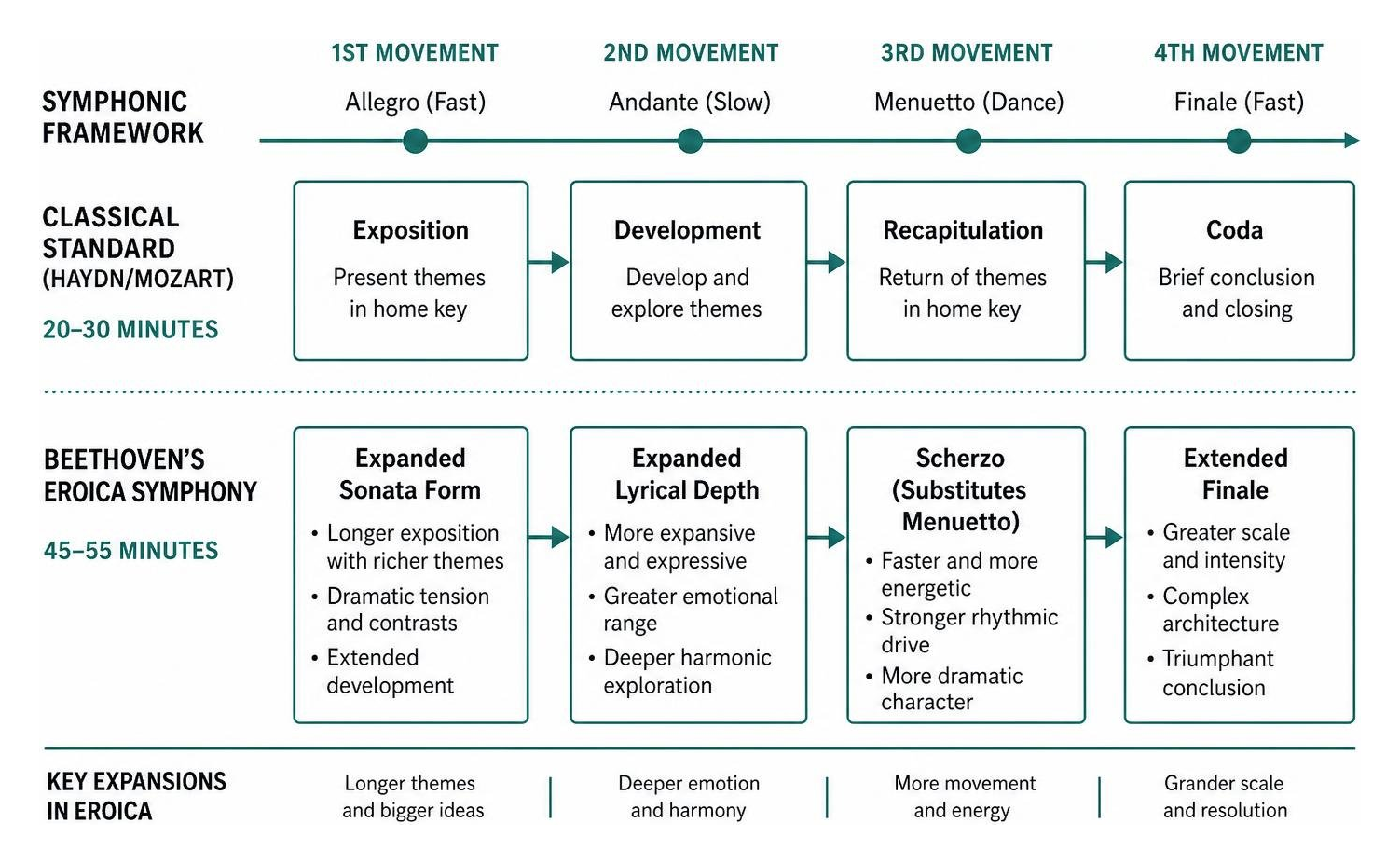
Beethoven also expanded the orchestra itself by adding a third French horn to the woodwind and brass sections, allowing for rich fanfares and complex chromatic harmonies never before attempted in symphonic music.
| Feature | Classical Standard (Haydn/Mozart) | Beethoven’s Eroica Symphony |
|---|---|---|
| Average Duration | 20 to 30 minutes | 45 to 55 minutes |
| Horn Scoring | 2 French Horns | 3 French Horns |
| First Movement Scale | 8 to 10 minutes | 12 to 19 minutes |
| Dynamic Contrast | Moderate, clear boundaries | Extreme accents, disruptive syncopations |
| Slow Movement Type | Lyrische/Andante melody | Massive C minor Funeral March (Marcia funebre) |
Duration and Scale Innovations
The sheer physical scale of the Eroica shocked early 19th-century concertgoers. The opening movement alone lasts between 12 and 19 minutes—nearly as long as an entire standard classical symphony by Haydn. Rather than serving as light entertainment for aristocratic parlors, the music demanded intense, continuous concentration from listeners.
Harmonic and Orchestral Breakthroughs
Right from bar one, Beethoven rejects standard introductions. The symphony opens with two thunderous E-flat major chords—often described as hammerblows or cannon shots—followed immediately by a cello theme that lands on an unexpected, dissonant C-sharp. This small chromatic twist creates harmonic instability that propels the entire movement forward.
Another famous innovation occurs right before the first movement’s recapitulation: the first horn enters prematurely with the main theme while the strings are still holding a dissonant chord. During early rehearsals, Ferdinand Ries famously shouted that the horn player had miscounted his rests, nearly getting his ears boxed by an angry Beethoven for failing to recognize the deliberate compositional stroke!
Detailed Analysis of the Four Movements
To appreciate how unified this piece is, it helps to explore the four distinct movements. As noted in uDiscover Music’s feature on the Eroica, the work unfolds like a continuous dramatic narrative across its four movements.
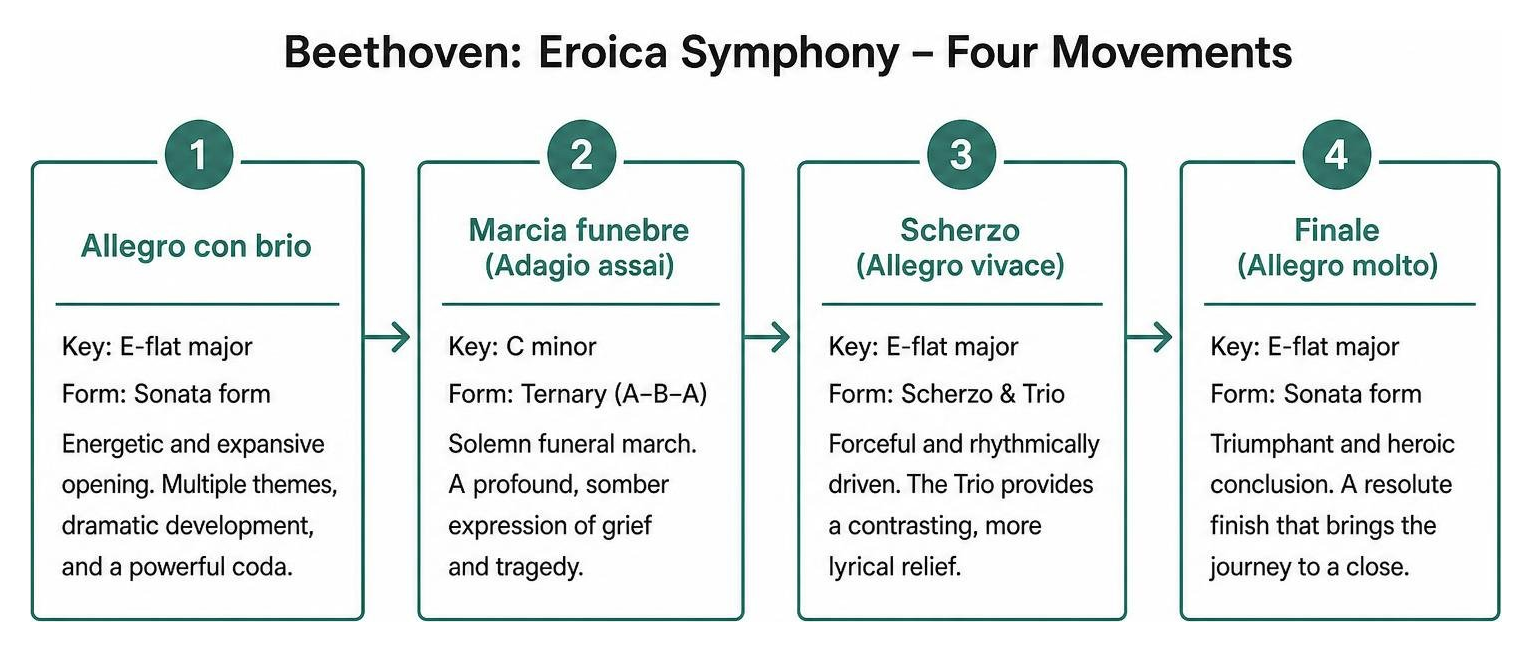
Movement I: Allegro con brio
Set in E-flat major, the first movement (Allegro con brio) operates in sonata form, but expanded to unprecedented proportions. By measure 85, Beethoven has already introduced four distinct thematic ideas. The development section is vast, featuring jarring syncopations and off-beat accents that create physical tension before resolving into an unusually long coda that acts like a second development section.
Movement II: Marcia funebre (Adagio assai)
The second movement is a solemn Funeral March (Marcia funebre) in C minor lasting between 12 and 18 minutes. An oboe sings a heartbreaking melody over muffled strings, mimicking a public state funeral procession.
As explored in Eastman School of Music’s Eroica study, the movement contrasts deep grief with a comforting C major middle section before the opening march theme returns and disintegrates into halting, sobbing fragments at its conclusion.
Movement III: Scherzo (Allegro vivace)
Following the dark despair of the march, the third movement Scherzo leaps to life with bubbling energy. The star attraction here is the central Trio section, which features a fanfare written for three French horns. This display took advantage of the natural horns of the era, pushing brass players to their absolute technical limits.
Movement IV: Finale (Allegro molto)
The fourth movement (Finale) is a masterclass in double variation form. Instead of starting with a full melody, Beethoven begins with a bare bass line, builds complex fugal counterpoint over it, and only then reveals the sweeping main theme. The movement builds through fast and slow variations before exploding into a triumphant Presto coda that celebrates heroic achievement.
Thematic Origins and Cultural Legacy
The Eroica did not emerge out of thin air; Beethoven had been experimenting with its main thematic material for years before combining it into Symphony No. 3.
How Eroica Symphony Beethoven Themes Evolved from Opus 35
The famous melody driving the symphony’s fourth movement appeared in at least three of Beethoven’s earlier compositions:
- The 12 Contredanses for Orchestra (WoO 14, No. 7)
- The finale of his 1801 ballet The Creatures of Prometheus (Op. 43)
- The Variations and Fugue for Piano in E-flat Major (Op. 35), commonly known today as the Eroica Variations.
Music scholars, examining the comprehensive archives on Wikipedia’s Eroica entry), note that Beethoven likely built the symphony from the back forward, using the variations technique to link the thematic arc of all four movements. Readers interested in playing Beethoven’s piano arrangements can also read our guide on how to play Beethoven’s 5th Symphony on piano.
Premiere and Reception of Eroica Symphony Beethoven Masterpiece
Following private rehearsals at the palace of his patron, Prince Lobkowitz, in 1804, Beethoven conducted the first public performance at the Theater an der Wien in Vienna on April 7, 1805.
Initial reactions were divided. Some critics complained the work was unacceptably long, chaotic, and filled with “bizarrerie.” Others recognized its genius immediately. By 1807, orchestra musicians in Leipzig were holding voluntary, unpaid extra rehearsals just to master its complex rhythms. Fast-forward to a 2016 survey of 151 international conductors conducted by BBC Music Magazine, and the Eroica was voted the greatest symphony of all time.
If you are planning a trip to experience live symphonic music yourself, check out our deep dive into the Detroit Symphony Orchestra at Orchestra Hall.
Legacy in Cultural Commemorations
Beyond the concert hall, the second movement Marcia funebre has become a global musical symbol for national mourning. It has been performed at memorial ceremonies and state funerals for figures such as:
- President Franklin D. Roosevelt (1945)
- President John F. Kennedy (1963)
- The 11 Israeli athletes murdered at the 1972 Munich Summer Olympics
Frequently Asked Questions About Beethoven’s Third Symphony
Why did Beethoven scratch out Napoleon’s name from the Third Symphony?
Beethoven erased Napoleon’s name in a fit of rage after learning the French general had crowned himself Emperor in May 1804. Beethoven felt Bonaparte had betrayed the republican principles of human liberty to become a tyrant. The erasure on the surviving manuscript was so violent that it tore physical holes through the paper.
How long is Beethoven’s Eroica Symphony compared to earlier symphonies?
The Eroica typically runs between 45 and 55 minutes, depending on tempo choices and whether exposition repeats are observed. This made it nearly twice as long as standard classical symphonies by Haydn or Mozart, which generally lasted between 20 and 30 minutes.
What makes the Eroica Symphony a bridge to the Romantic era?
The Eroica introduced subjective emotion, personal psychological narrative, massive formal scale, and adventurous harmonic dissonance into orchestral music. Instead of following strict Classical rules of symmetry, Beethoven used music to express human struggle, triumph, and drama, laying the groundwork for Romantic composers like Brahms, Tchaikovsky, and Mahler.
Conclusion
The eroica symphony beethoven constructed remains a turning point in Western art—a piece born from personal deafness and political disappointment that ultimately redefined what music could express.
When visiting Michigan to attend live classical concerts, having a comfortable home base makes all the difference. We at Detroit Furnished Rentals provide premium, fully equipped apartments located near the city’s top cultural venues. You can explore upcoming concert schedules and book your stay through our guide on how to experience live orchestral performances at Detroit Symphony Orchestra. Whether you are here for a weekend performance or an extended seasonal stay, our pet-friendly, centrally located units ensure you can enjoy Detroit’s vibrant arts scene in comfort.