Why Housing Matters When Your Child Needs Medical Care
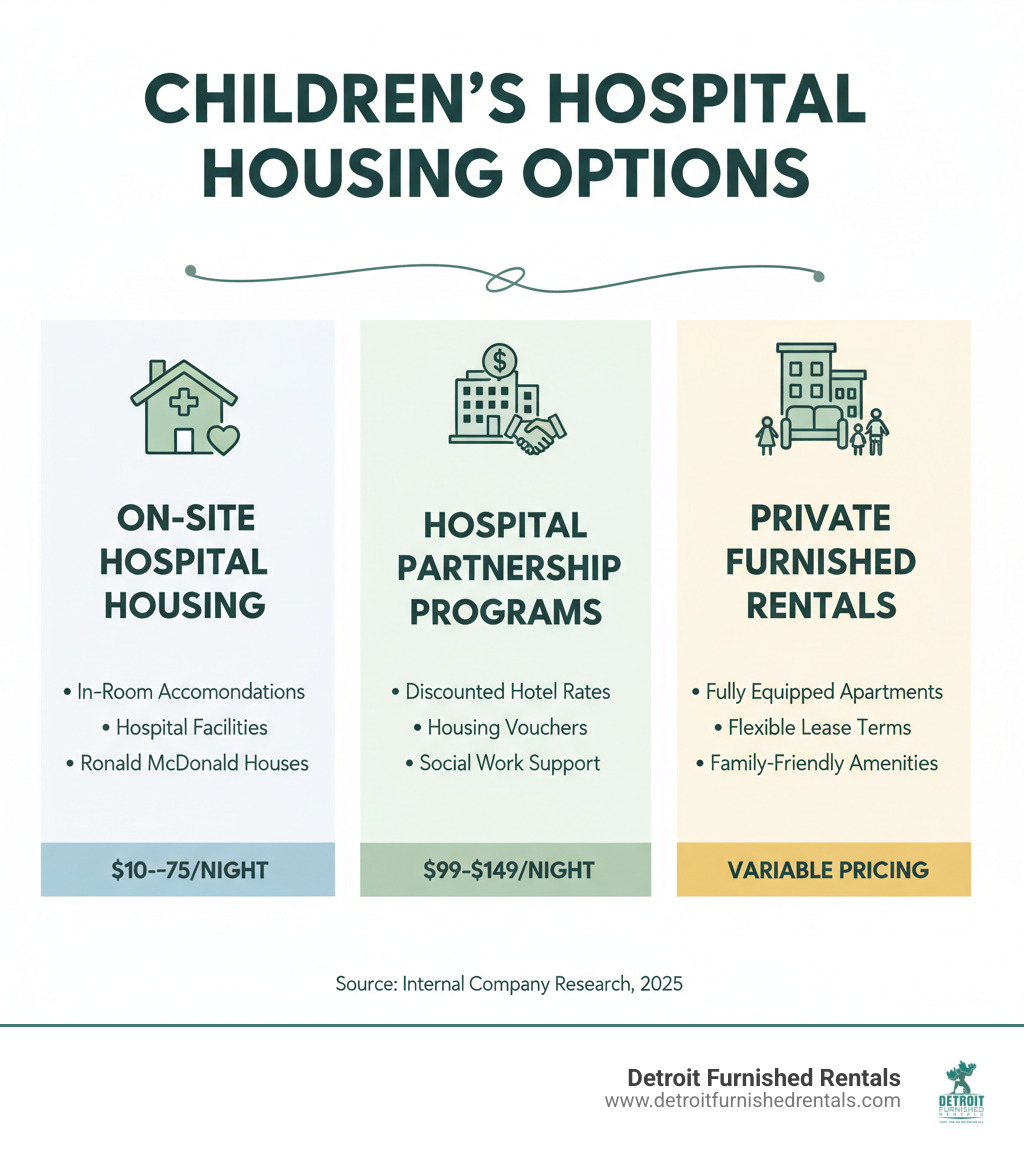
Children’s Hospital housing refers to temporary accommodation options available to families whose children are receiving medical treatment, ranging from on-site hospital facilities to private furnished rentals. Here’s what you need to know:
Main Housing Options:
- Hospital-Affiliated Programs – On-site or nearby facilities like Ronald McDonald Houses, often $10-$75/night
- Hotel Partnerships – Discounted rates at nearby hotels, typically $99-$149/night
- Private Furnished Rentals – Fully equipped apartments with flexible terms and home-like amenities
- Housing Voucher Programs – State-funded assistance through hospital partnerships with local housing authorities
When a child needs specialized medical care, a family’s world shifts completely. As Kelly Galloway of Children’s Hospital Colorado puts it: “Housing insecurity is one of the most challenging social needs affecting patient health outcomes. It’s impossible for families to address complex medical needs without safe and stable housing.”
The connection is clear. Stable housing isn’t just about having a roof overhead—it’s a critical factor in a child’s recovery. Families facing housing insecurity struggle to keep appointments, manage medications, and focus on their child’s healing.
This guide walks you through the various housing options available near children’s hospitals. We’ll cover hospital-run programs, partnership initiatives, and private rental solutions. You’ll learn about eligibility requirements, costs, and how to access support services. Whether you’re facing a short hospital stay or extended treatment, understanding your options helps you find a comfortable, stable place to call home during a difficult time.
The Critical Link Between Housing and Health
Picture this: You’re trying to manage your child’s complex medical treatments, keep track of multiple appointments, and help them rest and recover. Now add the constant worry of not knowing where your family will sleep tonight or whether your current living situation is safe. This is the daily reality for families facing housing insecurity—and it directly impacts a child’s ability to heal.
The connection between housing and health isn’t just intuitive—it’s proven. As Kelly Galloway of Children’s Hospital Colorado noted, housing insecurity is “one of the most challenging social needs affecting patient health outcomes.” When families don’t have a stable place to stay, everything else becomes harder.

The quality of where a family stays matters tremendously. Environmental hazards like mold, tobacco smoke, or unsafe conditions can make existing health problems worse or create new ones. Dr. Megan Sandel, a pediatric expert, points out that mental health is just as important to consider when looking at housing quality. An unstable or unhealthy living situation creates stress and anxiety for both children and their parents.
Think of stable Children’s Hospital housing as a form of medicine itself. When families have a safe, comfortable place to stay, they can focus entirely on their child’s recovery. They’re more likely to make it to appointments on time. They can follow complex medication schedules without distraction. They have space to rest and regroup between treatments.
The impact of housing on health outcomes extends beyond just the physical environment. A stable home reduces family stress, which in turn helps with treatment adherence and improves overall health outcomes. Children heal better when their parents aren’t overwhelmed with worry about basic needs.
Children’s hospitals across the country are recognizing this truth. They’re increasingly treating housing security as a critical social determinant of health—not just a nice-to-have, but an essential component of care. Many hospitals now have programs that proactively screen families for housing needs and connect them with resources.
This shift reflects an important understanding: a child’s well-being doesn’t stop at the hospital doors. It extends into every aspect of their living situation. By addressing housing needs alongside medical treatment, healthcare providers can help families build resilience and optimize health outcomes—especially for vulnerable youth facing homelessness or housing instability.
Types of Children’s Hospital Housing Support
When your child needs medical care, finding the right place to stay can feel overwhelming. But you have options—and understanding them helps you make the best choice for your family during this challenging time.
The type of Children’s Hospital housing you choose depends on your family’s unique needs. Are you looking for the convenience of staying steps from the hospital? Do you need the privacy and space of a full apartment? Or would you prefer the familiar comfort of a hotel? Each option offers something different, and there’s no one-size-fits-all answer.
A welcoming, clean room can make a world of difference when you’re far from home. It’s not just about having a place to sleep—it’s about creating a small sanctuary where your family can regroup, rest, and find moments of normalcy.
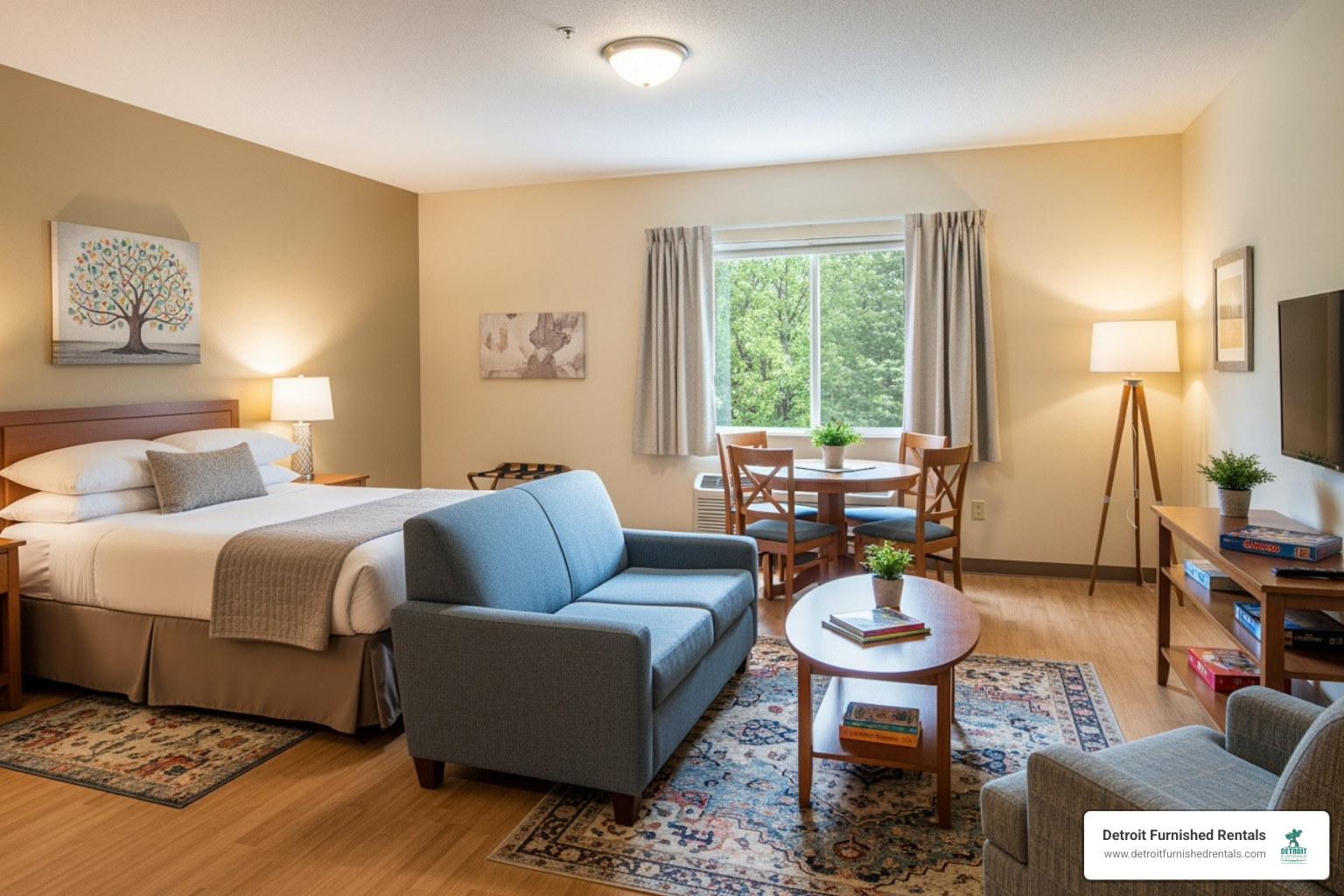
When choosing temporary housing, consider what matters most to your family:
- Proximity to the hospital: Less travel time means less stress and more time with your child.
- Private bedrooms and bathrooms: Essential for comfort and privacy during an already difficult time.
- Fully equipped kitchens: Home-cooked meals save money and accommodate special diets.
- Laundry facilities: A must-have for extended stays.
- Internet access: Keep connected with work, school, and loved ones back home.
- Child-friendly spaces: Play areas help siblings cope with the situation.
- Pet-friendly options: Sometimes your furry family member is part of the healing process.
- Flexible lease terms: Treatment schedules can be unpredictable.
- Supportive community: Connecting with other families facing similar challenges can be surprisingly comforting.
On-Site and Hospital-Affiliated Housing
Many hospitals offer lodging right on campus or just steps away. These options prioritize convenience and are often the most affordable choice, creating a supportive community of families in similar situations.
Bedside accommodations are the closest you can get. For example, UPMC Children’s Hospital of Pittsburgh provides in-room accommodations for parents, though siblings usually cannot stay overnight. For families with children in Intensive Care, separate sleeping rooms may be available.
Ronald McDonald Houses have become synonymous with family-centered care. Facilities at hospitals like Nationwide Children’s and BC Children’s are just steps away, offering private apartments with kitchens and common areas for a nominal fee (around $15/night), with financial aid available. Their proximity and community feel are invaluable, and many ensure no family is turned away due to inability to pay.
Hospital-owned facilities offer another option. Boston Children’s Hospital, for instance, runs a family inn and an apartment building with subsidized rates ($30-$75 per night), including amenities and shuttle service. Similarly, UC Davis Children’s Hospital partners with the Kiwanis Family House to offer inexpensive accommodations.
Most of these programs have eligibility requirements, usually based on distance from the hospital. Your hospital’s social work department is the best starting point for the application process. For families seeking Short-Term Housing Detroit while their child undergoes treatment, these affiliated programs can be a lifeline.
Hotel Partnerships and Discounted Rates
When hospital-affiliated housing isn’t available—or doesn’t quite fit your family’s needs—many children’s hospitals have partnerships with local hotels offering discounted rates. These arrangements give you a more traditional lodging experience with amenities like daily housekeeping and on-site dining.
For example, UPMC Children’s Hospital of Pittsburgh partners with numerous hotels that offer rates from $109-$149 per night, plus perks like free shuttles. Many hotel chains provide specific hospital patient rates that can significantly reduce costs. Similarly, Boston Children’s and UC Davis Children’s Hospital provide lists of partner hotels with booking codes for easy reservations.
These hotel partnerships often include perks that make life a little easier: complimentary breakfast, free Wi-Fi, and sometimes shuttle services to and from the hospital. Always mention your affiliation with the Children’s Hospital when booking to ensure you receive the special medical rate.
For families needing Furnished Apartments Detroit Michigan for a slightly longer stay, some extended-stay hotels also participate in these discount programs, offering a middle ground between traditional hotels and apartment rentals.
Private Furnished Rentals
Sometimes what a family needs most is simply a place that feels like home. Private furnished rentals offer that—along with privacy, flexibility, and space to breathe during an extended medical stay.
Unlike a hotel room or shared hospital housing, a furnished rental gives your family room to spread out and maintain some sense of normalcy. You get a complete kitchen for preparing meals (crucial for special diets or just saving money on dining out), in-unit laundry facilities, separate living and sleeping areas, and often multiple bedrooms. This setup lets you maintain family routines, reduces the stress of living out of a suitcase, and provides much-needed stability when everything else feels uncertain.
Space and comfort matter more than you might think. Having room for siblings to play, a quiet spot for parents to decompress, and a dining table where the family can share a meal together—these simple things become incredibly important during a difficult time.
Cost-effectiveness is another advantage, especially for extended stays. When you factor in the ability to cook meals instead of eating out for every meal, furnished rentals often prove more affordable than hotels. Plus, you’re not paying hotel prices for multiple rooms if your family needs more space.
Privacy gives your family breathing room. After long days at the hospital, having your own space—away from the medical environment—allows for quiet family time and genuine rest.
Flexibility is perhaps the biggest benefit. Treatment plans change. What you thought would be a two-week stay might extend to two months. Furnished rentals typically offer flexible lease terms that adapt to your child’s needs without locking you into rigid contracts.
Many furnished rental companies also offer family-friendly amenities like pet-friendly policies (because sometimes your furry companion is part of the family’s emotional support system), dedicated workspaces for parents who need to work remotely, and access to building amenities like gyms or play areas.
For families seeking Furnished Apartments Detroit while their child receives care at local hospitals, comfortable options exist that combine convenience with modern amenities. At Detroit Furnished Rentals, we understand the unique needs of families during such times. Our focus is on providing comfortable, centrally located accommodations that feel like a true home away from home—because that’s exactly what you need when you’re focused on what matters most: your child’s recovery.
Navigating Children’s Hospital Housing: Key Programs and Partnerships
Children’s hospitals understand that medical care alone isn’t enough if a family doesn’t have a safe place to sleep. That’s why they’re increasingly partnering with community organizations and launching innovative programs to address housing needs directly. These initiatives recognize a simple truth: stable housing is part of the healing process.
The partnership between Children’s Hospital Colorado and the Aurora Housing Authority shows what’s possible when hospitals think beyond traditional medicine. They secured 20 state housing vouchers specifically for families of pediatric patients. Kelly Galloway from Children’s Hospital Colorado puts it plainly: housing insecurity makes it impossible for families to manage complex medical needs. But these vouchers aren’t just about covering rent. They come with long-term social work support and connections to community resources, creating a foundation families can build on even after their child’s treatment ends.
Nationwide Children’s Hospital takes a different but equally powerful approach through their Healthy Homes program. Since 2008, they’ve partnered with Community Development for All People to renovate over 730 homes in their surrounding neighborhoods. They’ve done full-gut renovations, built new energy-efficient homes, and provided repair grants. They even developed The Residences at Career Gateway, offering 58 apartments and townhomes alongside on-site job training. It’s a model that connects stable housing to economic opportunity, recognizing that family health extends far beyond the hospital walls.
These programs reflect a growing understanding: when hospitals invest in housing solutions, they’re investing in better health outcomes. Local housing authorities, state voucher programs, and community partnerships are becoming essential parts of pediatric care. For families seeking Children’s Hospital housing, these initiatives offer hope and practical support during an incredibly difficult time.

Hospital initiatives; Social work support; Community partnerships; Local housing authorities; State housing vouchers; Long-term rental assistance
The Role of Social Work and Support Staff
When your child is seriously ill, the last thing you need is to figure out housing logistics on your own. That’s where hospital social workers become lifelines. These professionals do far more than hand you a list of nearby hotels. They guide families through every step of finding and securing appropriate housing, connecting them with financial assistance, and ensuring no family falls through the cracks.
Social workers provide comprehensive case management that addresses the whole picture. They’ll help you understand eligibility requirements for various programs, whether that’s a Ronald McDonald House, a discounted hotel room, or a state housing voucher. They know which programs have availability and which might be the best fit for your specific situation. If financial help is available, they’ll make sure you know about it and help with applications.
The partnership between Children’s Hospital Colorado and the Aurora Housing Authority specifically includes housing case managers who stick with families long-term. These case managers connect families to employment assistance, education support, job training, daycare, transportation, and food assistance. It’s about creating sustainable stability, not just a temporary fix.
At UPMC Children’s Hospital of Pittsburgh, social workers can be paged for emergency overnight accommodation needs. Boston Children’s Hospital has dedicated staff for their Patient Family Housing Program who assist with applications and provide ongoing support. There’s also a concierge service to help families find local hotels and short-term rentals when needed.
For families at Children’s Hospital of Michigan, social workers are typically the first people to ask about housing. They understand the local landscape and can tailor solutions to your family’s unique needs. Beyond the practical help, they offer something equally valuable: emotional support from someone who understands what you’re going through.
Innovative Screening and Support Tools
Hospitals are getting better at identifying housing needs before they become crises. Healthcare providers now recognize that asking about a family’s housing situation is as important as checking vital signs. After all, how can a child heal properly if their family doesn’t have a safe, stable place to stay?
Tools like the PRAPARE Assessment Tool help healthcare teams screen for housing instability and related social needs during routine care. These standardized questions identify families at risk, whether due to homelessness, unsafe living conditions, or unaffordable rent. The Hunger Vital Sign screening tool also helps providers understand the full scope of a family’s social challenges.
Once housing issues are identified, some hospitals are trying truly innovative approaches. Boston Medical Center, for example, has implemented “housing prescriptions,” where doctors literally prescribe stable housing as part of a patient’s treatment plan. Think about that for a moment: a prescription for a safe home, just like you’d get a prescription for medication. These prescriptions can connect families with housing navigators, provide direct referrals to programs, or include physician letters advocating for housing accommodations.
This proactive screening allows hospitals to provide timely support before housing problems interfere with medical care. Medical-legal partnerships are also emerging, where lawyers work alongside healthcare teams to address housing discrimination, eviction prevention, and accessing housing assistance programs.
These tools and programs represent a fundamental shift in healthcare thinking. Hospitals are recognizing that their responsibility extends beyond treating illness to addressing the social factors that affect health. For families navigating Children’s Hospital housing needs, this means more comprehensive support and earlier intervention when problems arise.
Frequently Asked Questions about Children’s Hospital Housing
What are the biggest challenges families face when seeking housing?
Families seeking housing during a medical crisis face several significant challenges.
Financial strain is a primary concern. Medical bills, lost income from unpaid work leave, and daily expenses for travel, parking, and food add up quickly, creating a burden many families are unprepared for.
Long waiting lists for affordable options like Ronald McDonald Houses are common. The immediate need for housing often forces families to scramble for last-minute, stressful alternatives.
Proximity and logistics are also major problems. Finding affordable housing close to the hospital is difficult, and daily travel adds stress. Furthermore, many on-site options cannot accommodate siblings, which can split up the family.
The emotional toll of being far from home, community, and support networks is immense, all while trying to stay strong for a sick child.
Finally, navigating the complex application processes for various housing programs, each with its own rules and paperwork, can be overwhelming for exhausted parents.
How much do these housing options typically cost?
The price for Children’s Hospital housing varies widely, offering choices for different budgets.
Hospital-affiliated programs like Ronald McDonald Houses are the most affordable, typically charging between $10 and $75 per night. Many offer financial aid and will not turn families away for inability to pay. For example, a Ronald McDonald House may ask for $15 per night, while a hospital-owned inn might range from $30 to $75 per night.
Hotel partnerships offer a middle ground. Through hospital discounts, rates are typically between $99 and $149 per night and often include perks like free breakfast or shuttle service.
Private furnished rentals can be more cost-effective for longer stays. While the nightly rate may seem higher, having a full kitchen to cook meals, in-unit laundry, and more space for the family provides significant value and savings over time.
Don’t forget to ask about potential hidden costs and always check with the hospital’s social work department about financial assistance programs.
How are the success of these housing programs measured?
Hospitals and their partners measure success by looking at how these programs genuinely help families heal. Key metrics include:
- Number of families housed and their length of stay, which shows if they have stable housing throughout treatment.
- A reduction in missed appointments. Stable housing makes it easier for families to attend all necessary treatments, directly impacting a child’s recovery.
- Improved patient health outcomes. Children in stable housing tend to have fewer emergency visits, smoother recoveries, and better adherence to care plans.
- Feedback from families themselves on reduced stress and financial burden. This qualitative data confirms that secure housing allows parents to focus on their child’s recovery.
For broader community initiatives, success also includes measures like community revitalization and improved housing quality. These varied metrics help hospitals refine their programs to better serve families.
Conclusion
When your child needs medical care, finding a place that feels like home becomes part of the healing process. Children’s Hospital housing isn’t just about having somewhere to sleep—it’s about creating a stable foundation that allows your family to focus entirely on what matters most: your child’s recovery.
Throughout this guide, we’ve explored the many options available to families, from the convenience of hospital-affiliated programs like Ronald McDonald Houses to the flexibility of hotel partnerships and the home-like comfort of private furnished rentals. Each option serves a unique purpose, and the right choice depends on your family’s specific needs, the length of your stay, and what will bring you the most peace of mind during this challenging time.
The connection between stable housing and health outcomes is clear. When families don’t have to worry about where they’ll sleep or how they’ll afford their next night’s stay, they can keep appointments, follow treatment plans, and provide the emotional support their child needs. Hospitals understand this, which is why they’re partnering with local organizations, securing housing vouchers, and employing dedicated social workers to help families steer their options.
For families seeking Children’s Hospital housing in the Detroit area, you have choices. Whether you need the immediate support of an on-site facility or prefer the privacy and space of a furnished apartment, resources exist to support you. Private furnished rentals offer the comforts that make an extended stay bearable—a full kitchen to prepare your child’s favorite meals, a washer and dryer so you don’t have to worry about laundry, and separate spaces where siblings can play or you can simply take a breath.
At Detroit Furnished Rentals, we’ve seen how much difference a comfortable, reliable home base makes for families during medical journeys. Our fully equipped apartments near Detroit-area hospitals provide the stability and normalcy that helps families cope with uncertainty. You can cook familiar meals, maintain bedtime routines, and have space for the whole family to be together.
Don’t hesitate to reach out to your hospital’s social work department—they’re there to help you explore all available options and connect you with financial assistance if needed. By taking advantage of these resources and finding the right housing solution for your family, you’re not just finding a place to stay. You’re creating a safe harbor where your family can rest, regroup, and focus completely on your child’s healing.
Explore housing options near Detroit-area hospitals and find how the right accommodation can provide the peace of mind you need during this journey. Your family’s well-being matters, and having a true home away from home is an essential part of the path to recovery.