

Why Detroit Was the Doorway to Freedom
The underground railroad detroit michigan played a pivotal role in American history as one of the most critical gateways to freedom for enslaved people seeking liberation. If you’re looking to explore this powerful history, here are the key sites and experiences you should know about:
Top Underground Railroad Sites in Detroit:
- Second Baptist Church – Michigan’s oldest Black congregation that sheltered approximately 5,000 freedom seekers
- Gateway to Freedom Monument – International memorial at Hart Plaza overlooking the Detroit River crossing
- First Congregational Church – Offers immersive “Flight to Freedom” reenactment tours
- Detroit Historical Museum – Features the “Doorway to Freedom” permanent exhibit
- Charles H. Wright Museum – Houses the extensive “And Still We Rise” exhibit on African American history
Detroit earned the code name “Midnight” among Underground Railroad conductors because it represented the final stop before dawn—the crossing into Canada where true freedom awaited. The city’s unique geography, sitting just one mile across the Detroit River from Canada, made it an essential last station on the journey to liberation.
Between the 1820s and 1865, an estimated 50,000 freedom seekers passed through Detroit on their path to Canada. This wasn’t just geography—it was the city’s diverse community of free Black residents and white abolitionists who risked everything to defy the Fugitive Slave Act of 1850 and help people reach safety.
After that law passed, even free states weren’t safe anymore. Canada became the only true destination for freedom, and Detroit became the doorway to get there.
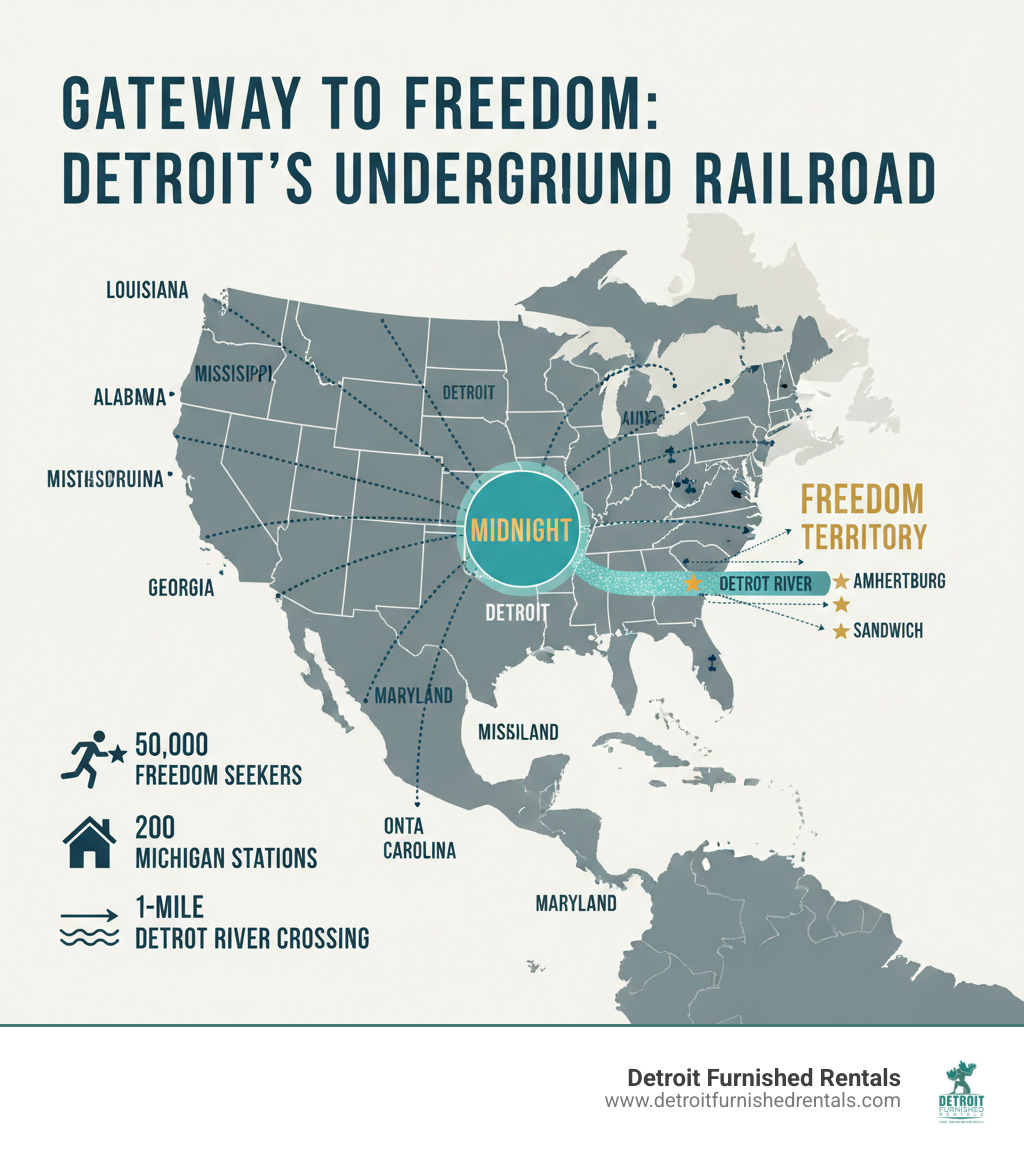
Detroit’s Pivotal Role: The ‘Midnight’ Station
Before we dive deeper into Detroit’s story, let’s clarify what the Underground Railroad actually was. Despite its name, there were no tracks, no trains, and no tunnels (well, maybe a few tunnels). Instead, it was a secret network of brave people, safe routes, and hidden places that helped enslaved African Americans escape to freedom from the 1800s until slavery ended in 1865.
The network operated like a spy mission, complete with coded language to protect everyone involved. Safe houses were called “stations,” the guides who led people to freedom were “conductors,” and the freedom seekers themselves were “passengers” or “baggage.” This clever system of code words helped them communicate without arousing suspicion from slave catchers and bounty hunters.
Now, here’s where Detroit’s story gets really important. The city’s geographical advantage was extraordinary—sitting just one mile across the Detroit River from Canada. That short stretch of water represented the difference between captivity and freedom. Canada had abolished slavery in 1834, achieving full emancipation by 1838. Once freedom seekers crossed that river, they were legally free and protected from recapture.
Everything changed with the Fugitive Slave Act of 1850. This harsh federal law declared that escaped enslaved people had to be returned to their owners, even if they’d made it to free Northern states. Suddenly, nowhere in America was truly safe. The increased risk meant that Canada became true freedom—not just safer, but the only place where freedom was guaranteed by law.
This is why Detroit earned its code name “Midnight” on the underground railroad detroit michigan network. It represented the darkest hour before dawn—the final, most dangerous stop before reaching Canada (known as “Dawn” or “Canaan”). For those helping freedom seekers, the risks were immense. Conductors and station masters faced heavy fines and imprisonment if caught.
Michigan had an estimated 200 stations operating between the 1820s and 1865, with towns across the state hiding freedom seekers in homes, barns, attics, and cellars. But Detroit held a unique position as the gateway—the last step before crossing into Canada. By 1861, historians believe around 75,000 people found freedom through the Underground Railroad, with Detroit facilitating a remarkable portion of those escapes.
For a deeper dive into the city’s rich past, including its role in this and other historical events, explore more info about Detroit’s history and landmarks.
Key Historical Sites on the Underground Railroad Detroit Michigan
Walking through Detroit today, you’re tracing paths that once led to freedom. These aren’t just buildings and monuments—they’re places where real people risked everything for liberation. Let’s explore the physical locations that made Detroit’s underground railroad detroit michigan network possible.
Second Baptist Church: A Central Station on the Underground Railroad in Detroit, Michigan
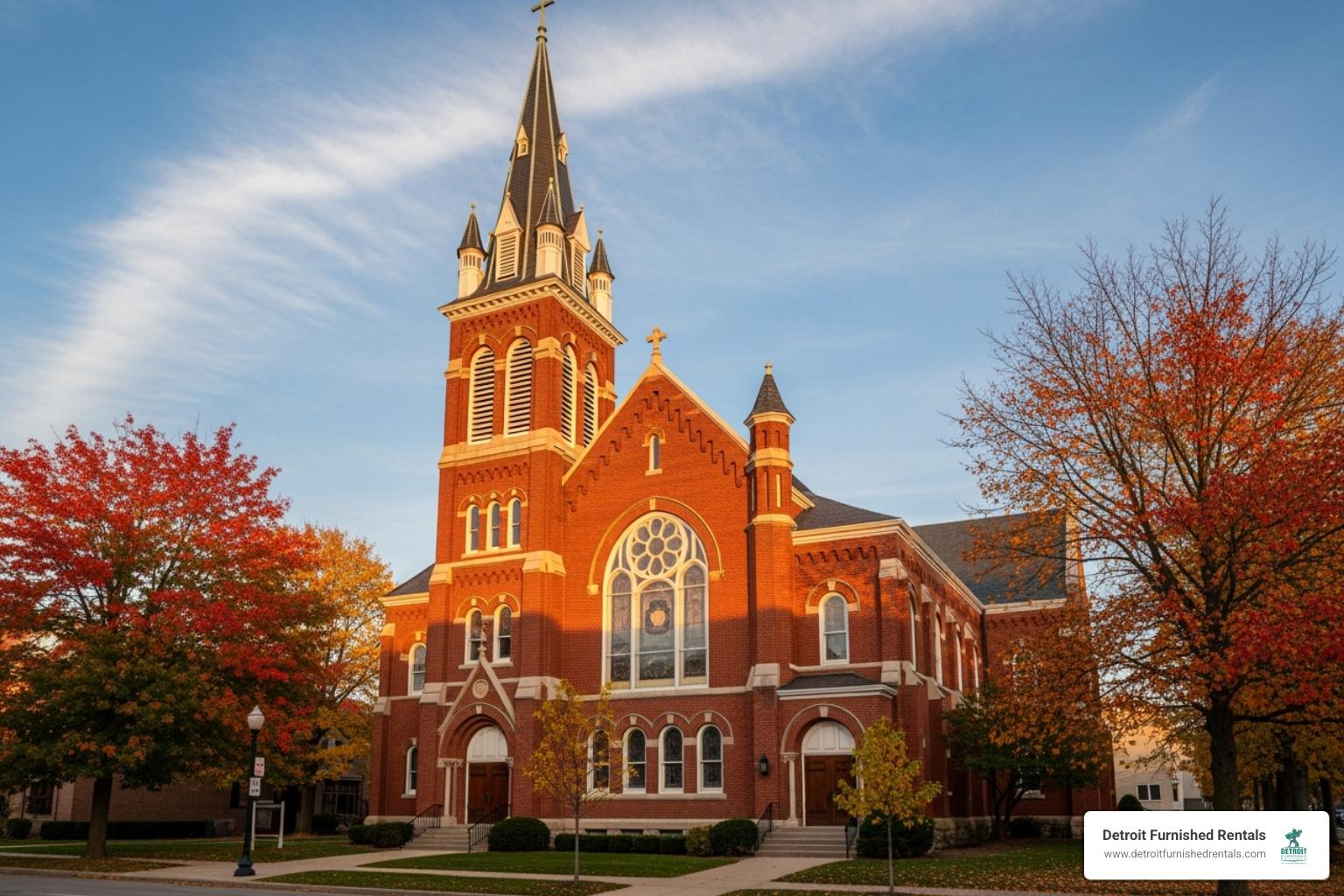
When you stand before the Second Baptist Church, you’re looking at Michigan’s oldest Black congregation—and one of the most important stops on the entire Underground Railroad network. Founded in 1836, this church became far more than a place of worship. It became a guide of hope.
For more than three decades, the church’s basement served as the Croghan Street Station, sheltering an estimated 5,000 freedom seekers as they prepared for their final crossing into Canada. Think about that number for a moment. Five thousand people found refuge, food, and rest within these walls before making the dangerous journey across the Detroit River.
The church community didn’t just open their doors—they openly defied federal law to do what they knew was right. Leaders like Frederick Douglass, Sojourner Truth, and John Brown all worked alongside this congregation in their abolitionist efforts. The courage it took to operate this station, knowing the risks of imprisonment and heavy fines under the Fugitive Slave Act, is almost impossible to comprehend.
Today, you can tour the church and see where this history unfolded. The basement where thousands waited and prayed is now an underground museum, preserving these stories for future generations. Tours typically require advance reservations, so it’s best to call ahead and plan your visit.
You can find this powerful landmark and walk in the footsteps of those who sought freedom here: Get Directions to the church. To learn more about visiting, check out Detroit’s monuments and landmarks.
First Congregational Church of Detroit
The First Congregational Church took a different but equally vital role in Detroit’s freedom network. As another critical station house, this church didn’t just shelter freedom seekers—it helped them prepare mentally and spiritually for the harrowing journey ahead.
What makes this site especially remarkable today is how it brings history to life. The church hosts the Underground Railroad Living Museum, featuring the “Flight to Freedom” tour—and this isn’t your typical museum experience. You become a “passenger” on the Underground Railroad, following a “conductor” through a powerful reenactment of the escape journey.
During the tour, you’ll experience what freedom seekers faced: hiding from bounty hunters, symbolically crossing the Ohio “Deep” River, finding temporary refuge in safe houses like Levi Coffin’s famous Indiana station, and finally reaching “Midnight”—Detroit itself—before the final push to Canada. It’s an emotional, immersive experience that connects you to the fear, hope, and incredible bravery of those who made this journey.
This reenactment helps us understand not just the facts, but the feelings—the constant danger, the moments of kindness from strangers, the resilience required to keep moving forward. To experience this powerful journey yourself, visit the Station House Tour at First Congregational Church.
The Gateway to Freedom Monument
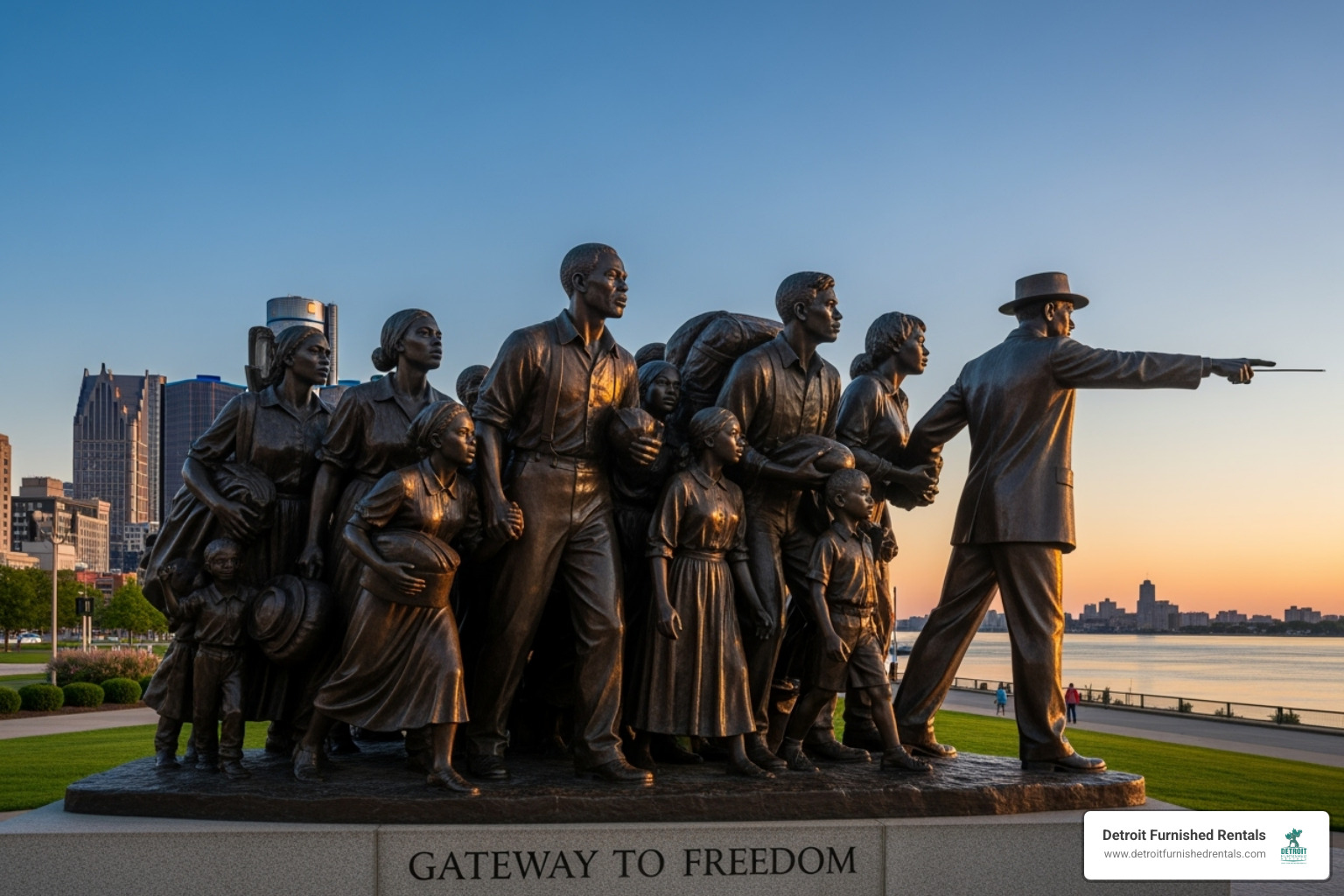
Down at Hart Plaza, overlooking the Detroit River, stands one of the most moving tributes to freedom you’ll ever encounter. The Gateway to Freedom Monument, sculpted by Ed Dwight, captures a moment frozen in time—a conductor guiding a group of freedom seekers, beckoning others to join them as they prepare to cross that final stretch of water to Canada.
The bronze figures seem to move with purpose and hope, their faces showing both the weight of what they’ve endured and the anticipation of freedom just across the river. The monument’s location is no accident. It sits exactly where it should—overlooking the very waters that represented the last barrier between bondage and liberty.
This international symbol of freedom has a sister monument in Windsor, Ontario, creating a visual link between the two shores and honoring the shared history of this crossing. Standing here, you can see Canada in the distance, just as those freedom seekers did over 150 years ago. It’s a powerful reminder that freedom was literally within sight, yet still required one more dangerous crossing.
For a deeper understanding of the symbolism and stories behind this iconic landmark, read our dedicated article: Gateway to Freedom Monument Honoring Detroit’s Role in the Underground Railroad.
Other Significant Locations
Detroit’s Underground Railroad history extends beyond these major sites. Throughout the city, you’ll find places that played quieter but equally important roles in the freedom network.
Mariner’s Church, located just steps from the Detroit River, served as a spiritual refuge for sailors and freedom seekers alike. In 1955, when the church was relocated, construction workers finded something extraordinary—a tunnel beneath the church extending under the river toward Canada. This hidden passage had undoubtedly helped countless people reach freedom.
The Finney Hotel Barn, once standing at Woodward and Griswold, was owned by Seymour Finney, a tailor turned hotelier and dedicated abolitionist. Finney courageously housed freedom seekers in his hotel’s stable, providing them with shelter right in the heart of the city. Historical plaques now mark the site, honoring his brave contributions.
George DeBaptiste’s home once stood near East Larned and Beaubien. DeBaptiste was a free Black entrepreneur who became one of Detroit’s most important conductors. He used his steamship, the “T. Whitney,” disguised as a regular commercial vessel, to transport freedom seekers across the Detroit River. He also formed a secret organization called the “African-American Mysteries or Order of the Men of Oppression” to coordinate escape efforts. You can pay respects at his grave in Elmwood Cemetery, where his legacy is preserved.
Bethel African Methodist Episcopal Church, founded in 1839 as the Colored Methodist Society, provided crucial aid and sanctuary at its early locations. The church stands today as a testament to its founders’ courage and commitment to freedom.
Even Tommy’s Detroit Bar & Grill has Underground Railroad connections—the building is rumored to have a tunnel beneath it that served as an escape route during both the Underground Railroad era and later during Prohibition. These hidden passages throughout the city speak to the ingenuity and secrecy required to operate this network.
To explore the full scope of Michigan’s freedom network, including sites throughout the state, View the interactive map Take a virtual tour of the Underground Railroad in Michigan. This map highlights 24 notable people and places that formed Michigan’s extensive Underground Railroad network.
The People and Museums Preserving the Story
The underground railroad detroit michigan wouldn’t have existed without the extraordinary courage of everyday people who risked everything to help others reach freedom. These weren’t just names in history books—they were real people who made impossible choices every single day.
Key Conductors and Abolitionists
George DeBaptiste was one of Detroit’s most remarkable freedom fighters. Born free, he could have lived a comfortable life as a successful entrepreneur. Instead, he dedicated himself to the abolitionist cause with fierce determination. His steamship, the “T. Whitney,” looked like any other commercial vessel on the Detroit River, but it carried precious cargo—people seeking freedom. DeBaptiste didn’t work alone; he organized the secret “Order of the Men of Oppression,” a network of abolitionists who coordinated escapes with military precision.
William Lambert was another crucial figure in Detroit’s freedom network. This free Black entrepreneur and community leader didn’t just talk about justice—he lived it. He co-founded Detroit’s third Black church, opened his home as a safe house, and used his own money to fund escape routes. Lambert often worked alongside DeBaptiste, and together they formed the backbone of Detroit’s Underground Railroad operations.
Not all conductors were Black. Seymour Finney, a white tailor turned hotelier, used his Finney Hotel as cover for his abolitionist work. While guests slept upstairs, freedom seekers hid in his stable, waiting for the right moment to cross the river. His story reminds us that the fight for freedom brought together people from all backgrounds.
The Detroit Vigilant Committee represented this beautiful collaboration between the free Black community and white abolitionists. They didn’t just help people escape—they actively protected freedom seekers from slave catchers, sometimes through dramatic confrontations.
One of the most powerful stories of community resistance was the Blackburn Uprising of 1833. When Thornton and Lucie Blackburn, who had escaped slavery in Kentucky, were recaptured in Detroit, something remarkable happened. Four hundred people—mostly from Detroit’s Black community—rallied together and freed them from jail. This wasn’t a quiet rescue; it was Detroit’s first racial civil uprising. The Blackburns eventually made it to Canada, where they started a successful taxi business in Toronto.
Similar courage erupted in Marshall, Michigan, in 1843 when slave catchers tried to reclaim Adam Crosswhite. The entire town rose up to protect him, showing that resistance to slavery had spread throughout Michigan.
Even famous abolitionists found their way to Detroit. Frederick Douglass and John Brown met at William Webb’s Detroit home to discuss strategies for ending slavery. These weren’t just philosophical discussions—they were planning sessions for freedom.
To find more about George DeBaptiste’s incredible contributions, visit: Learn about George DeBaptiste’s life.
Museums and Immersive Tours
Detroit’s Underground Railroad history isn’t locked away in dusty archives. The city has worked hard to bring these stories to life in ways that let us truly understand what freedom seekers experienced.
The Detroit Historical Museum features the powerful “Doorway to Freedom” exhibit, which does something special—it lets you walk an experiential trail that mirrors the actual journey to freedom. You’ll hear personal stories from families who made it to Canada and those who chose to build new lives right here in Detroit. It’s not just about facts and dates; it’s about real people making impossible choices.
The Charles H. Wright Museum of African American History takes an even broader view with its massive “And Still We Rise” exhibit. This 22,000-square-foot journey through 400 years of African American history includes compelling sections on the Underground Railroad, helping us understand how Detroit’s role fit into the larger struggle for freedom.
If you want to literally walk in the footsteps of freedom seekers, City Tour Detroit offers the “Incredible Journey to Midnight” walking tour. This isn’t your typical historical tour—actors bring the past to life with reenactments inside actual Underground Railroad sites like the Croghan Street Station at Second Baptist Church. You’ll feel the tension, the hope, and the triumph of those final moments before crossing into Canada.
The Michigan Freedom Trail Commission works tirelessly across the entire state to preserve these stories, ensuring that future generations understand the courage it took to fight for freedom. Their efforts mean that this crucial chapter of American history stays alive and accessible.
These museums and tours don’t just teach history—they help us feel it. And that makes all the difference in understanding why Detroit’s role in the Underground Railroad matters so much, even today.
Frequently Asked Questions about Detroit’s Underground Railroad
As we’ve explored Detroit’s profound role in the journey to freedom, you might have some questions about the specifics. Let’s address the most common ones we hear from visitors and history enthusiasts.
What was Detroit’s code name on the Underground Railroad?
Detroit’s code name was ‘Midnight’, and the symbolism is both beautiful and powerful. This name signified Detroit as the final stop in the United States before crossing the Detroit River into Canada. Just as midnight represents the darkest hour before dawn, Detroit represented that last, often most dangerous moment before freedom.
Canada was often referred to as ‘Dawn’ or ‘Canaan’ – the promised land of freedom. The journey from Midnight to Dawn wasn’t just a physical crossing of a one-mile stretch of water; it was a change from bondage to liberty, from fear to hope.
How many slaves escaped through Detroit?
This is one of those questions where the true answer reveals the nature of the underground railroad detroit michigan itself. Because the network operated in absolute secrecy – with coded language, hidden passages, and constant fear of findy – keeping records would have been impossibly dangerous.
That said, historians have pieced together estimates based on accounts, letters, and records that survived. They believe that between 40,000 and 50,000 freedom seekers passed through Detroit on their way to Canada over the course of more than 40 years. Some estimates go even higher, suggesting up to 75,000 people found freedom through Michigan’s Underground Railroad network by 1861.
These staggering numbers make Detroit one of the most significant gateways to freedom on the entire Underground Railroad. Each number represents a person – someone with a name, a story, a family, and dreams of a life lived in freedom.
Was the Underground Railroad an actual railroad?
This is perhaps the most common misconception about the Underground Railroad, and it’s an understandable one given the name. No, the Underground Railroad was not a physical railroad with tracks, trains, or even underground tunnels (though a few tunnels did exist, like the one finded beneath Mariner’s Church).
Instead, it was a secret, complex network of people, safe houses called ‘stations’, and routes organized by abolitionists to help enslaved African Americans escape to freedom. The entire “railroad” terminology was actually part of an elaborate coded metaphor designed to maintain secrecy and confuse anyone who might be listening or trying to capture freedom seekers.
The people who guided escapees were ‘conductors’, the freedom seekers themselves were ‘passengers’ or ‘baggage’, and the safe houses where they hid were ‘stations’. Even the routes had railroad-inspired names. This clever use of everyday language allowed abolitionists to discuss their dangerous work in plain sight without arousing suspicion.
It was a network built on courage, trust, and an unwavering belief in human dignity and freedom.
Conclusion: The Enduring Legacy of Freedom
Standing at the riverfront today, looking across that narrow stretch of water to Canada, it’s impossible not to feel the weight of what happened here. The underground railroad detroit michigan story isn’t just about dates and places—it’s about thousands of individual moments of courage that changed the course of history.
Detroit earned its code name “Midnight” for a reason. It was the darkest hour before dawn, the most dangerous moment in the journey, when freedom was so close you could almost touch it across that one-mile expanse of water. And yet, it was also where hope burned brightest, fueled by ordinary people doing extraordinary things.
What makes this story so powerful is the collaboration at its heart. Free Black entrepreneurs like George DeBaptiste risked their lives and livelihoods. White abolitionists like Seymour Finney opened their businesses as sanctuaries. Churches became stations. Homes became hiding places. An entire community—diverse, determined, and defiant—came together to say that some things matter more than safety or profit or following unjust laws.
The bravery wasn’t just in the dramatic rescues or dangerous river crossings. It was in the daily acts of resistance, in the meals prepared for strangers, in the secret knocks on doors in the middle of the night, in the willingness to face prison or worse for people they’d never met. That’s the Detroit spirit—then and now.
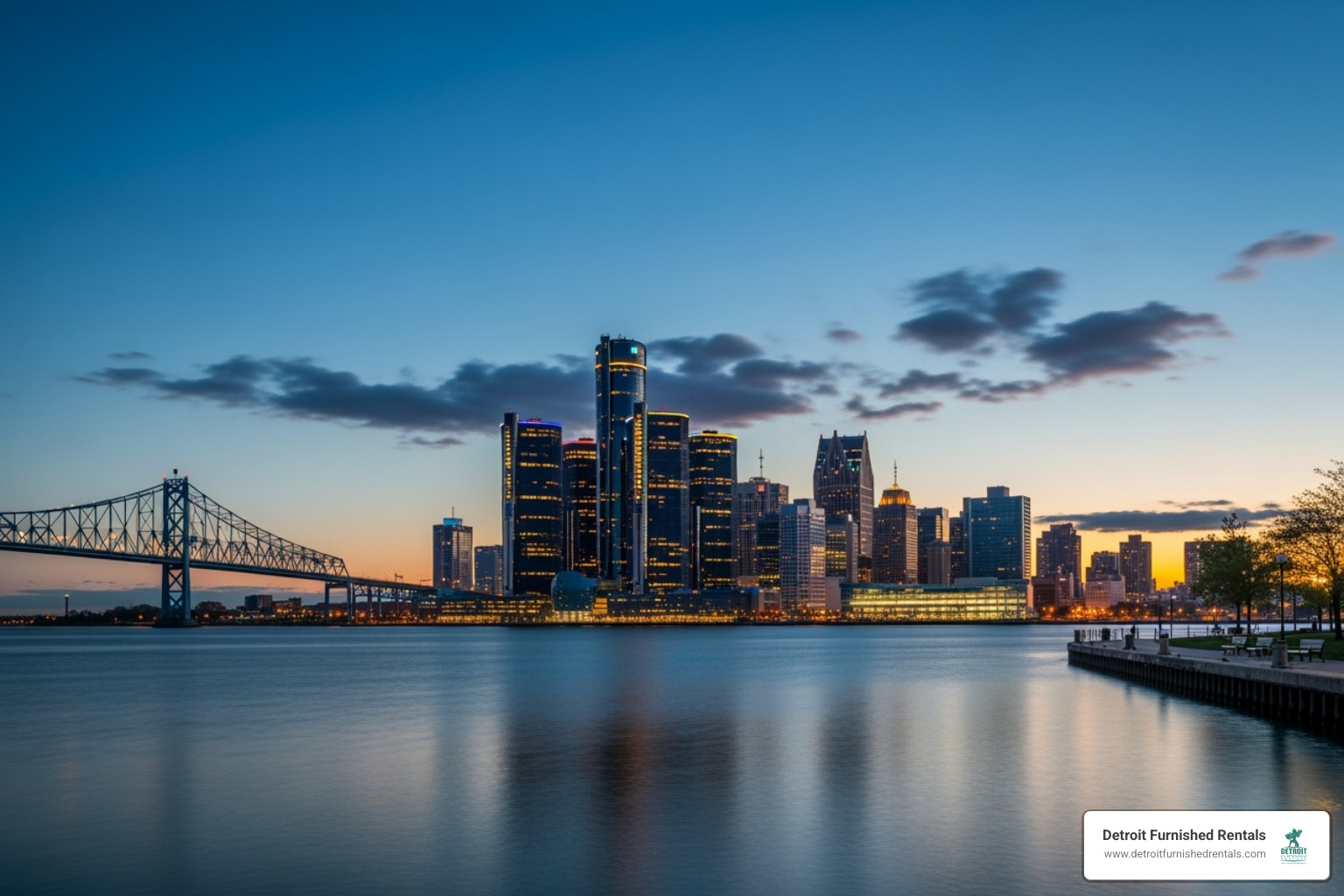
Remembering this past matters deeply. These stories remind us what’s possible when people refuse to accept injustice. They show us that freedom isn’t just given—it’s fought for, protected, and passed forward. Walking through Second Baptist Church, standing before the Gateway to Freedom Monument, or experiencing the immersive exhibits at the Detroit Historical Museum, you’re not just learning history. You’re connecting with something that still resonates today.
If you’re planning to explore these powerful sites, you’ll want to stay somewhere that puts you close to the action. Detroit Furnished Rentals offers comfortable, fully equipped apartments in central locations, making it easy to visit the museums, monuments, and churches that tell this incredible story. Our pet-friendly units give you a welcoming home base while you explore the city’s rich heritage.
Whether you’re here for a few days or a few weeks, Detroit’s Underground Railroad history will stay with you long after you leave. To begin planning your journey through Detroit’s historical landmarks and find the perfect place to stay, visit: Explore Detroit’s Monuments and Landmarks.
The view from Windsor looking back at Detroit—the same view those freedom seekers saw when they finally reached Canada—reminds us that some journeys change everything. This is one of those stories. Come experience it for yourself.

