Why Short-Term Business Goals Matter Right Now
Short term business goals are the actionable steps that drive immediate progress while building toward your bigger vision. Here’s what you need to know:
What are short-term business goals?
- Timeline: Typically 1-6 months, with quarterly planning being most common
- Purpose: Address immediate needs, improve cash flow, and create quick wins
- Focus: Tactical actions like boosting customer retention, documenting processes, or launching a new marketing campaign
- Measurement: Specific, quantifiable results (increase revenue by X%, gain Y new customers)
Why they matter:
- They provide a roadmap when you’re too busy growing to plan far ahead
- They help bridge cash flow gaps and seasonal fluctuations
- They create momentum through achievable wins
- They allow you to test strategies before committing long-term resources
It’s hard to focus on growing your business when, well, it’s growing. The day-to-day demands of running operations, serving customers, and managing your team can consume every waking hour. But here’s the reality: without clear short-term goals, you’re running blind.
Short-term goals aren’t just about quick wins. They’re about creating a structured path forward that balances immediate survival with future growth. Whether you’re a traveling professional managing projects across different cities or a small business owner trying to scale, setting the right short-term goals means you can adapt quickly, measure what matters, and build sustainable momentum.
The challenge? Most businesses either focus too heavily on short-term profits at the expense of long-term health, or they get so caught up in their five-year vision that they miss critical opportunities right in front of them. This guide will show you how to set short-term business goals that create immediate impact while laying the groundwork for lasting success.
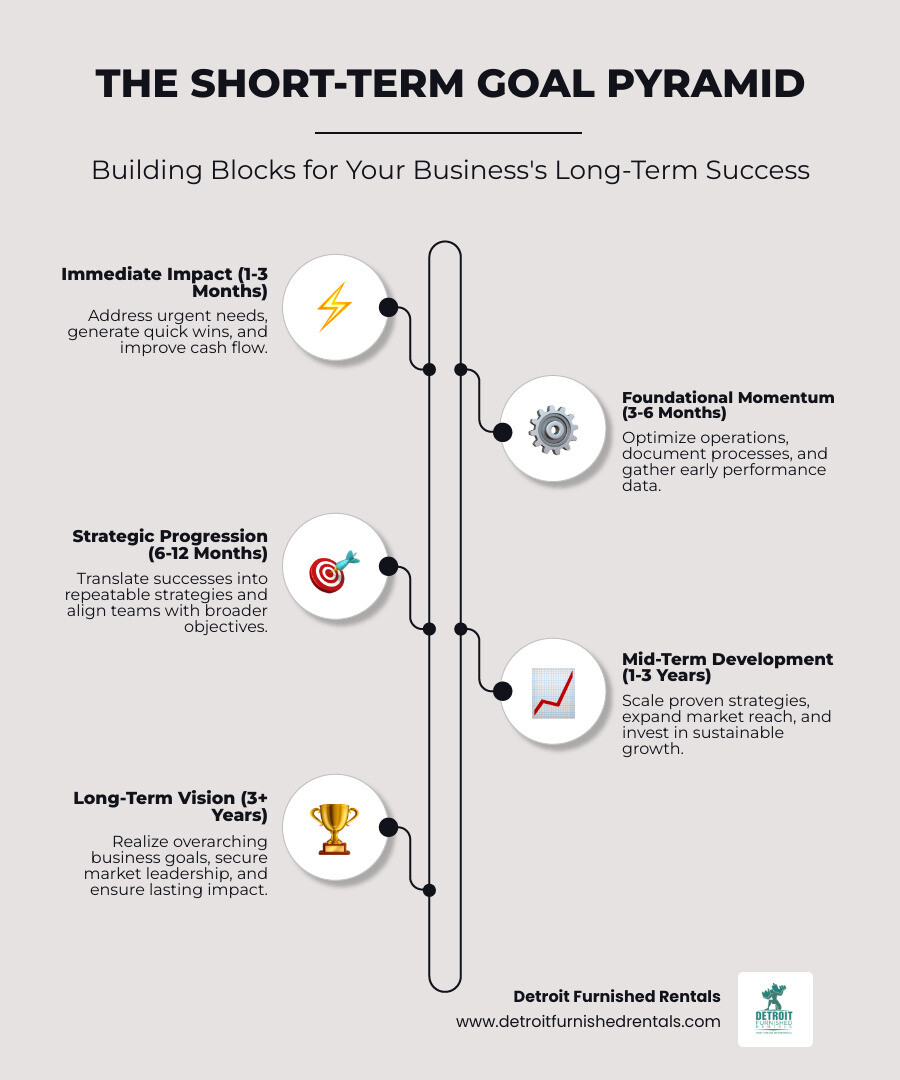
Understanding the Landscape: Short-Term vs. Long-Term Goals
Running a business requires balancing two mindsets: the sprinter and the marathon runner. Short term business goals are your sprints—tactical moves that create quick wins. Long-term goals are your marathon strategy—the big-picture vision guiding you over several years.

Many businesses stumble under the pressure for immediate results, leading to short-termism—an excessive focus on quarterly profits at the expense of future health. The challenge isn’t choosing between profit and growth, but pursuing both without compromise.
The Core Differences
Understanding what separates short-term from long-term goals helps you create a cohesive strategy. The key distinctions lie in their timeline, purpose, flexibility, and scope.
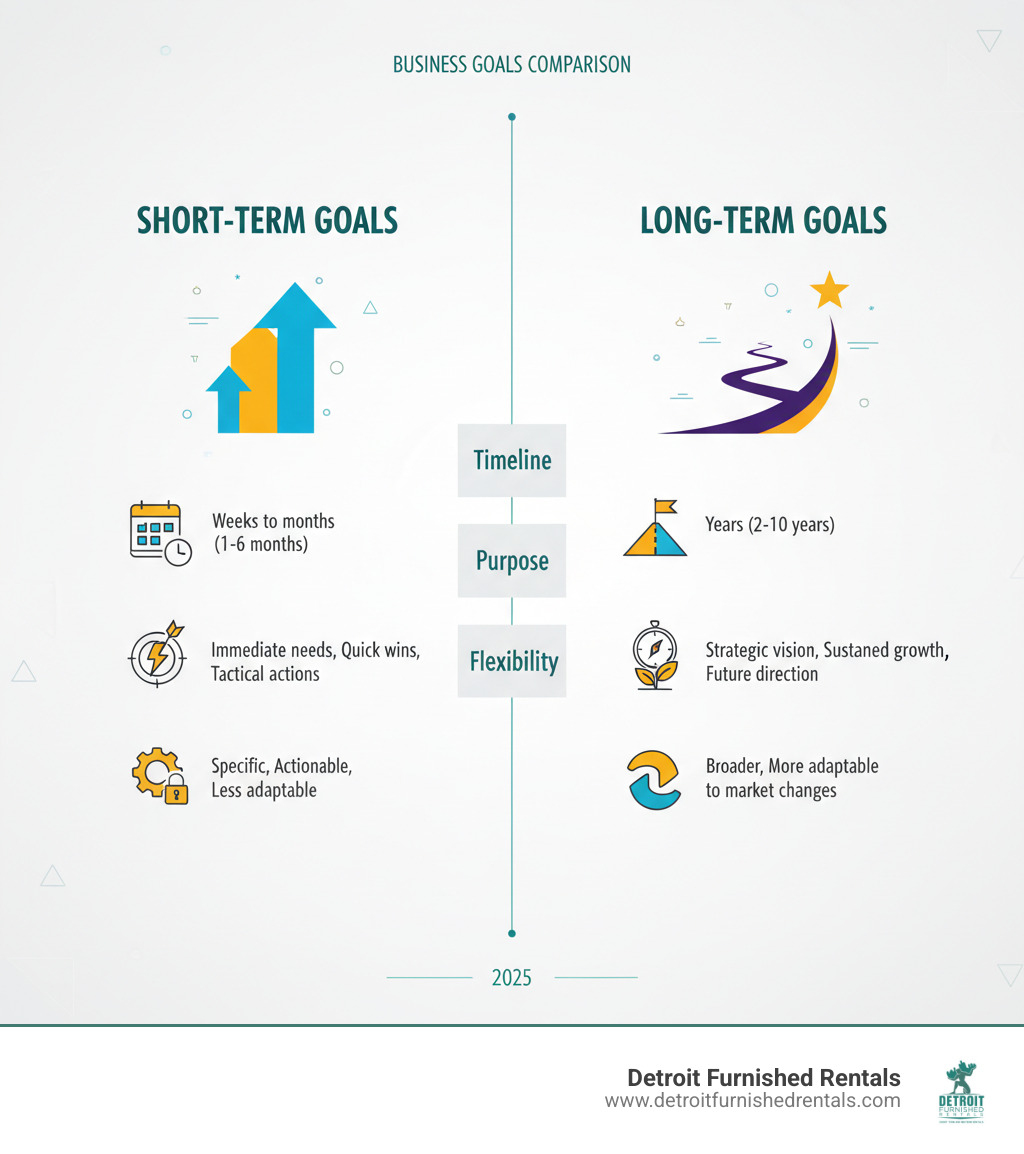
| Metric | Short-Term Goals | Long-Term Goals |
|---|---|---|
| Timeline | Weeks to months (typically 1-3, up to 6 months) | Years (typically 2-5, sometimes up to 10 years) |
| Purpose | Immediate needs, quick wins, tactical actions | Strategic vision, sustained growth, future direction |
| Flexibility | Specific, actionable, less adaptable | Broader, more adaptable to market changes |
| Scope | Departmental, project-specific, operational | Company-wide, overarching, visionary |
Short-term goals answer, “What do we need to do right now?” with specific, measurable actions. Long-term goals answer, “Where do we want to be?” and define your ultimate destination. Think of short-term goals as the individual steps on a staircase and long-term goals as the floor you’re climbing toward.
Why Balancing Both is Crucial for SMEs
Small and medium-sized enterprises (SMEs) face intense pressure to focus on immediate survival due to limited resources and thin margins. This can lead to reactive decisions—like slashing marketing budgets or delaying hires—that damage long-term growth.
Successful SMEs understand that you can’t choose between surviving today and thriving tomorrow. A strategy that does both is essential for:
- Sustainable growth: Align immediate actions with your future vision. Documenting processes today builds scalable systems for tomorrow.
- Avoiding margin erosion: Focus on smart operational efficiencies, like using technology to automate tasks, rather than making across-the-board cuts.
- Diversifying revenue streams: Build resilience by exploring new packages or partnerships, reducing dependence on a single customer segment.
- Agile decision-making: Use good data to adapt to market changes quickly without losing sight of your long-term strategy.
Thriving businesses see short-term and long-term goals as two parts of the same strategy. Your immediate wins should fuel your long-term success, not undermine it.
How to Set Effective Short-Term Business Goals
Clear targets are essential for any business. Short term business goals provide direction, align your team, and ensure your work has a purpose. For a service business like Detroit Furnished Rentals, these goals must be practical and straightforward, creating a followable roadmap for everyone.

Crafting SMART Goals for Immediate Clarity
The SMART framework transforms vague wishes into concrete targets. It provides immediate clarity on what success looks like and how to measure it.
- Specific: Clearly define what you want to accomplish.
- Measurable: Use metrics to track progress and confirm success.
- Achievable: Set realistic goals based on your resources.
- Relevant: Ensure the goal aligns with broader business objectives.
- Time-bound: Set a deadline to create urgency and focus.
For example, instead of “get more bookings,” a SMART goal would be: “Increase direct bookings for our Downtown Detroit apartments by 15% by June 30th through improved local SEO and targeted social media campaigns.” This goal is clear, measurable, and creates accountability for your team.
Using OKRs to Connect Actions to Vision
While SMART goals are great for specific targets, the Objectives and Key Results (OKR) framework connects your short term business actions to your long-term vision.
- Objective: A qualitative, inspirational goal (e.g., “Deliver an unparalleled guest experience in Detroit”).
- Key Results: Quantifiable outcomes that prove you’re making progress (e.g., “Achieve a Net Promoter Score of 8.5,” “Reduce complaint resolution time to one hour”).
OKRs align your entire team by showing how daily tasks contribute to the company’s vision. For easier tracking, consider using dedicated OKR software instead of spreadsheets.
Combining SMART goals and OKRs provides both tactical clarity for immediate priorities and a connection to the bigger picture, turning every small win into a deliberate step toward long-term success.
10 Actionable Short-Term Business Strategies for Long-Term Success
Here are ten actionable short term business strategies that create immediate impact while paving the way for long-term success. These are foundational steps that build lasting value.

Boost Customer Loyalty and Retention
Retaining an existing customer is cheaper than acquiring a new one. Implement a simple loyalty program to reward repeat business. Use feedback channels like post-stay surveys and track your Net Promoter Score (NPS) to spot problems early and respond quickly, which significantly reduces churn.
Document Processes for Future Scalability
Create Standard Operating Procedures (SOPs) for all routine tasks, from guest check-in to maintenance. Documented, repeatable systems ensure consistency, simplify training, and make your business scalable. This is non-negotiable if you have ambitions for expansion or franchising potential.
Leverage Data to Uncover New Opportunities
Your existing data holds valuable insights. Analyze purchasing trends and review SEO reports to understand customer needs and search behavior. Use this market analysis to create specialized service packaging or identify gaps your competitors are missing.
Optimize Website SEO and Online Presence
Improve your online visibility with focused SEO efforts. Start with a website audit to fix technical issues and ensure your site is fast and mobile-friendly. Target local keywords like “furnished apartments Detroit” to attract high-intent customers and create relevant content to position yourself as a local expert.
Improve Social Media Engagement and Marketing
Social media is a cost-effective marketing channel. Focus on genuine engagement by showing your business’s personality and sharing behind-the-scenes content. Encourage employee engagement to add authenticity, and use targeted paid ads to expand your reach to the right audience.
Implement Employee Incentive Programs
Feeling unrecognized is a top reason employees leave. Implement simple recognition systems, offer performance bonuses, and provide professional development opportunities. Happy, motivated employees provide better service, which leads to higher customer retention.
Streamline Financial Organization
Tight financial organization is foundational. Use a detailed budget tracker to monitor all revenue and expenses. Automate accounting and payroll where possible, and conduct quarterly expense reviews to find cost-saving opportunities without sacrificing quality.
Engage with the Local Detroit Community
Being an active part of the community is good business. Participate in local events, form partnerships with other local businesses, and volunteer. This builds relationships, generates referrals, and fosters brand loyalty that advertising can’t buy.
Go Green and Promote Sustainability
With 78% of customers preferring green companies, sustainability is a competitive advantage. Implement eco-friendly practices like using energy-efficient appliances and green cleaning supplies. Highlight these efforts on your website and social media to attract environmentally conscious guests.
Test New Messaging and Offers
Reduce risk by testing new ideas on a small scale first. Use A/B tests on your website to find the most effective messaging. Pilot new services or amenities in a few properties to gather feedback before a full rollout. Let data analysis guide your decisions.
Document and Analyze Everything
This ties it all together. Consistently document your processes and analyze the data from all your efforts. This cycle of implementation, measurement, and refinement is what transforms short-term tactics into a sustainable, long-term strategy.
The Pitfalls of a “Short Term Business” Mindset
While short term business goals are essential, an exclusive focus on quick profits—or “short-termism”—can damage your business’s future. It’s like trimming a plant for today’s appearance without watering its roots; eventually, it will wither.

Pressure from shareholders and market competition can push companies toward decisions that look good this quarter but create long-term problems. Prioritizing only the present sacrifices the very things that make a business sustainable.
The Negative Impact on Employees and Innovation
When companies aggressively chase short-term profits, their people often suffer first. Cost-cutting measures like employee layoffs may offer immediate financial relief but lead to damaged morale, lost knowledge, and lower productivity. Similarly, slashing R&D budgets stifles innovation, leaving the business vulnerable to competitors who continue to invest in the future.
This environment makes talent retention nearly impossible. The best employees leave for companies that invest in their growth, often driven by CEO biases toward immediate results.
The Broader Environmental and Social Consequences
Short-term thinking also has consequences beyond the company. When immediate profit is the only goal, environmental and social responsibilities are often ignored. This can lead to resource depletion, waste, and a failure to address major issues like climate change.
However, consumers are paying attention: 78% of customers prefer to purchase from environmentally responsible companies. This means sustainable practices are not just ethical but also good for business. Corporate social responsibility involves making decisions today that consider tomorrow’s consequences. Businesses that integrate long-term sustainability with short-term performance are the ones that will ultimately thrive.
Frequently Asked Questions about Short-Term Business Goals
Here are answers to some of the most common questions about setting and managing short term business goals.
What is a good timeframe for a short-term goal?
A good timeframe is typically one to three months. A quarterly (three-month) period is often ideal because it aligns with business planning cycles and fits the SMART criteria. This is long enough to see measurable results but short enough to maintain focus and adapt quickly. Quarterly goals also create natural checkpoints to review progress and course-correct throughout the year.
How do short-term goals contribute to long-term success?
Short term business goals are the building blocks of your long-term vision. They contribute by:
- Creating momentum: Achieving quick wins boosts team morale and motivation.
- Providing data: Tracking short-term results gives you valuable insights to adjust your long-term strategy.
- Breaking down big plans: They make a large, multi-year vision feel less overwhelming and more achievable by dividing it into manageable steps.
Each completed short-term goal is a stepping stone that moves you closer to your ultimate destination.
How do you measure the success of a short-term business goal?
Measurement is crucial for accountability. The key is to use specific metrics and track them consistently.
- Define Key Performance Indicators (KPIs): For every goal, identify a specific, measurable KPI. For a sales goal, this could be revenue growth; for a customer service goal, it could be your Net Promoter Score (NPS).
- Track Relevant Metrics: Monitor metrics like website traffic, conversion rates, and profit margins to gauge performance.
- Use Frameworks: If you use the OKR framework, your Key Results are inherently measurable targets.
- Conduct Regular Check-ins: Review your progress weekly or monthly to identify roadblocks and make adjustments. Tools like OKR software can simplify this process.
Consistent measurement creates a feedback loop that drives continuous improvement and ensures your short-term efforts align with your long-term vision.
Conclusion
Running a business in a dynamic city like Detroit means every day brings new challenges and opportunities. It’s easy to feel pulled in a dozen directions at once. But here’s what we’ve learned: short term business goals aren’t just about putting out fires or hitting this month’s numbers. They’re the foundation that everything else gets built on.
When you set clear, focused goals—whether you’re using the SMART framework or connecting daily actions to bigger dreams through OKRs—you create momentum. You boost customer loyalty. You streamline the operations that used to eat up your time. You spot opportunities hiding in your own data. And most importantly, you give your team something tangible to rally around.
But we’ve also seen the other side of the coin. Companies that chase short-term profits without thinking about tomorrow often pay a steep price. Employee morale suffers. Innovation dries up. The environment takes a hit. That’s why balance matters so much. We need those immediate wins, absolutely. But we need them to build toward something lasting, something sustainable, something that makes Detroit—and our businesses—stronger over time.
The truth is, achieving your short term business goals requires focus and the right environment. If you’re a professional working on a project in Detroit, whether it’s a three-month consulting gig, a temporary assignment, or launching something new, you need a place that lets you focus on what matters. You don’t need the hassle of figuring out furniture, Wi-Fi, or where to park. You need to walk in, set down your laptop, and get to work.
That’s exactly what we provide at Detroit Furnished Rentals. Our apartments are fully equipped, centrally located, and designed for people who have important work to do. Need to bring your dog along? We’re pet-friendly. Want to be close to downtown for client meetings? We’ve got you covered. Every detail is handled so you can concentrate on hitting those goals and building your success story in Detroit.
Ready to find your perfect base for your next Detroit project?
Explore our furnished properties for your next business project