Why the Phantom of the Opera Captivates Millions Worldwide
Of the Phantom of the Opera, one truth is clear: it’s one of the most beloved musicals in theatrical history. Known from the stage, the 2004 film, or its iconic imagery, this haunting love story has reached over 160 million people in 205 cities worldwide.
Quick Facts About The Phantom of the Opera:
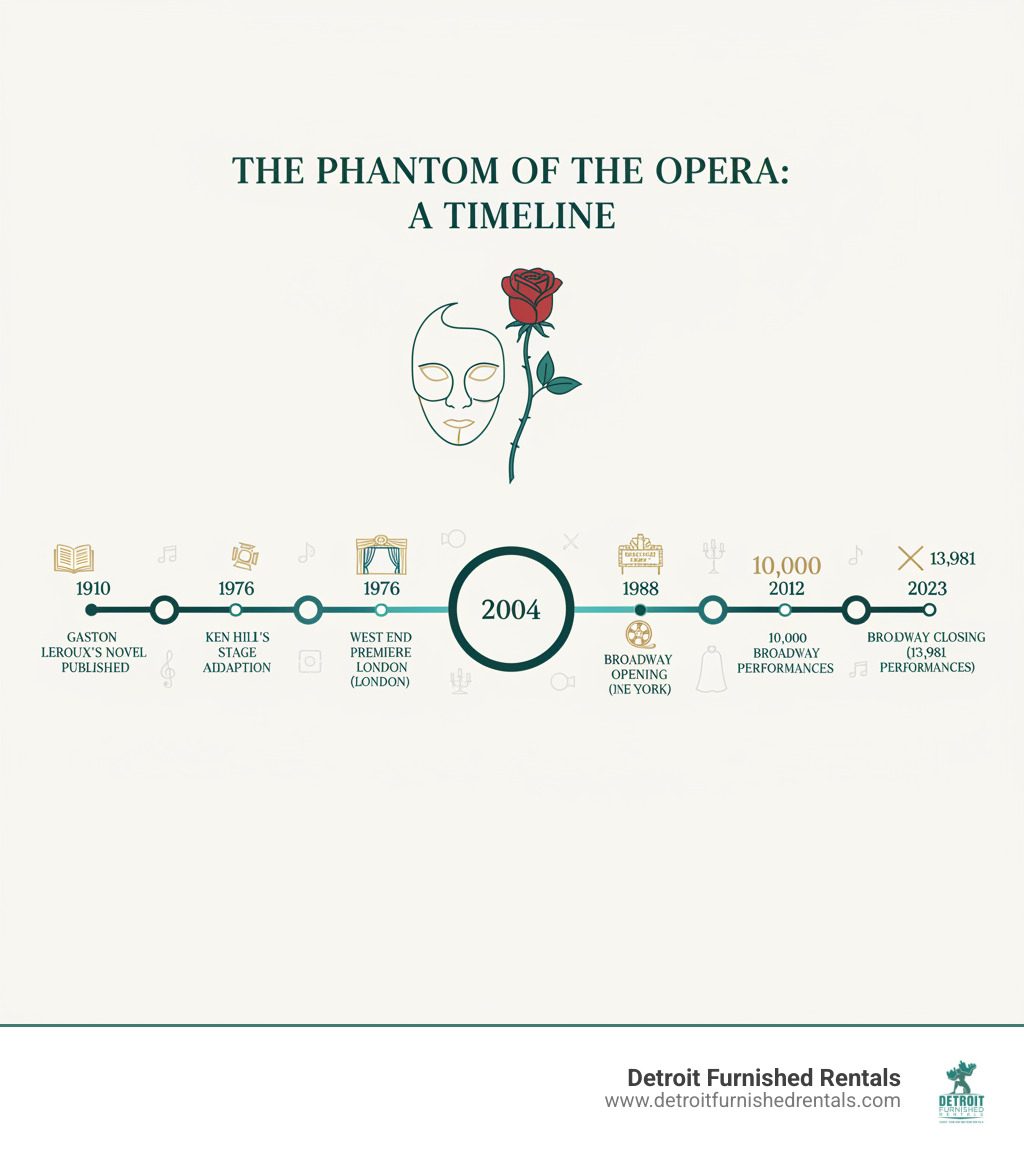
- Origin: Based on Gaston Leroux’s 1910 French novel
- Music: Composed by Andrew Lloyd Webber
- Premiered: London’s West End (1986), Broadway (1988)
- Broadway Record: Longest-running show in Broadway history with 13,981 performances
- Global Success: Over $6 billion in worldwide gross receipts
- Key Songs: “The Music of the Night,” “All I Ask of You,” “Masquerade”
- Story: A disfigured musical genius living beneath the Paris Opera House becomes obsessed with a young soprano named Christine Daaé
The story is simple: a masked figure haunts the Paris Opéra House, tutoring a young singer with whom he becomes dangerously obsessed. A love triangle emerges, but it’s the execution—Andrew Lloyd Webber’s sweeping music, spectacular staging, and unforgettable moments like the chandelier crash—that transformed this Gothic tale into a global phenomenon.
The show won both the 1986 Olivier Award and 1988 Tony Award for Best Musical, running on Broadway for 35 years before its celebrated closing in April 2023. The film adaptation, starring Gerard Butler and Emmy Rossum, introduced the story to millions more.
What makes the Phantom endure? Perhaps it’s the timeless themes of beauty versus deformity and obsession versus love. Or maybe it’s simply that the music is sweeping, memorable, and emotionally devastating.
From Page to Stage: The Origins of a Masterpiece
The journey of the Phantom of the Opera from a French novel to a global phenomenon was a dramatic one, requiring vision and creative genius to transform Gaston Leroux’s Gothic tale into a theatrical spectacle.
In 1910, French author Gaston Leroux published Le Fantôme de l’Opéra, a serialized novel blending mystery, romance, and horror. He set his story in the magnificent Paris Opéra House (the Palais Garnier), where a disfigured musical genius haunts the building and becomes obsessed with a young soprano.
Leroux’s novel was compelling because he wove real events and legends into his fiction. The Paris Opera House does have an underground lake, and a chandelier counterweight really did fall in 1896, killing one person. These details gave the story a chilling, atmospheric edge.

In the mid-1980s, Andrew Lloyd Webber, fresh off the success of Cats, saw the potential for a “high romance” musical in Leroux’s novel. Teaming up with producer Cameron Mackintosh, he set out to create an entirely new adaptation, assembling a dream team to build a theatrical spectacle that would redefine audience expectations.
The Creative Team Behind the Curtain
Behind every great show is a team of brilliant minds, and of the Phantom of the Opera had some of the best. Composer Andrew Lloyd Webber created a score blending operatic grandeur with unforgettable melodies. Legendary director Harold “Hal” Prince gave the show its grand scale and emotional intensity. Designer Maria Björnson created the iconic visual world, from the candlelit lair to the famous half-mask. Lyricist Charles Hart and book co-writer Richard Stilgoe crafted the narrative and emotional core, while choreographer Gillian Lynne added visual splendor with the show’s ballet sequences. After workshopping the show, the team was ready to introduce their masterpiece to the world. You can learn more about the world’s most haunting love story and the minds who brought it to life.
The Core Story and Its Powerful Themes
At its heart, of the Phantom of the Opera is a tragic love story—a “Beauty and the Beast” for the Gothic age. It centers on a love triangle between the Phantom, a disfigured genius; Raoul, Vicomte de Chagny, a handsome nobleman; and Christine Daaé, the young soprano they both love.
The musical explores timeless themes that resonate with audiences. It examines the line between love and obsession, as the Phantom’s possessive adoration clashes with Raoul’s gentle devotion. The Phantom’s character embodies the pain of isolation and otherness, as his deformity has forced him into a life of bitterness and longing for connection. The story also digs into the tension between beauty and deception, asking how much appearances matter.
Music itself becomes a character—the Phantom’s means of expression, his weapon, and his gift. Through music, he both lifts and entraps Christine. Finally, the musical challenges simple notions of good versus evil. The Phantom is a murderer, yet his suffering evokes pity, forcing audiences to grapple with ideas of redemption and cruelty. These powerful themes give the musical its lasting power.
The Music of the Night: Characters and Key Songs
The magic of the Phantom of the Opera lives in its unforgettable music and richly drawn characters. Andrew Lloyd Webber created a sophisticated musical language, using recurring themes (leitmotifs) to signal characters and emotions, telling the story through song.
The vocal demands are extraordinary, requiring a soaring soprano for Christine, a commanding baritone or tenor for the Phantom, and a charming lyric tenor for Raoul. These are not roles for the faint of heart.
The Main Characters
The heart of the Phantom of the Opera beats through its complex characters:
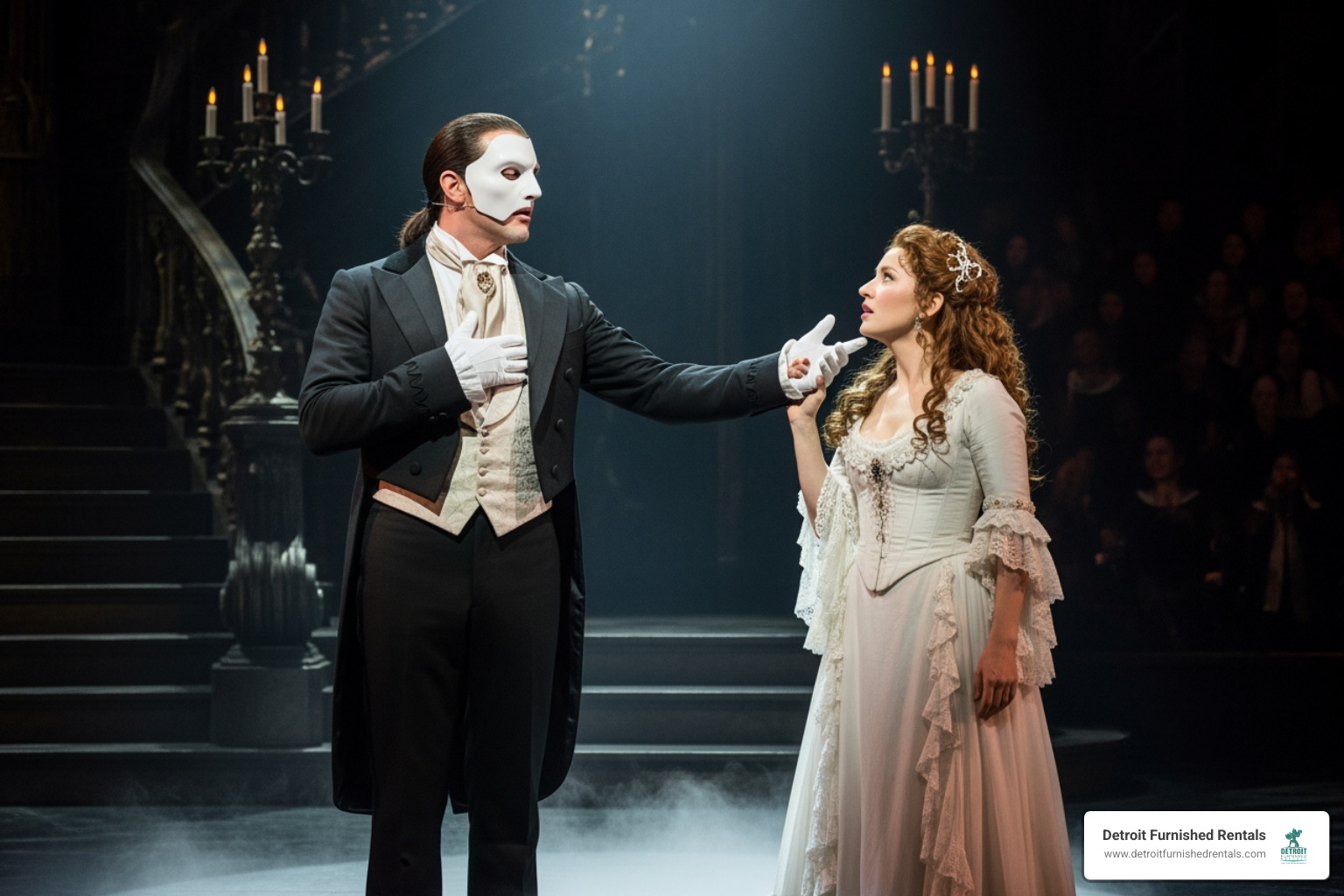
- The Phantom (Erik): A disfigured musical genius hiding beneath the Paris Opéra House. His obsession with Christine drives the plot, making him both a villain and a tragic figure.
- Christine Daaé: A talented young soprano torn between her fear of the Phantom, whom she believes is her “Angel of Music,” and her growing love for Raoul.
- Raoul, Vicomte de Chagny: Christine’s childhood friend and patron of the opera. He represents conventional love and stability and is determined to protect her.
- Madame Giry: The stern ballet mistress who acts as the Phantom’s reluctant intermediary, hinting at a mysterious shared past.
- Meg Giry: Madame Giry’s daughter, a ballet dancer and Christine’s best friend, who introduces the legend of the “Opera Ghost.”
- Carlotta Giudicelli: The opera’s arrogant prima donna and a target of the Phantom’s wrath, providing comic relief and tension.
Key Musical Numbers of the Phantom of the Opera
The score contains some of the most recognizable songs in musical theatre history, each advancing the plot and revealing character.
- “The Phantom of the Opera”: The electrifying title song where the Phantom lures Christine to his world, marked by its driving rock organ and iconic descending motif.
- “The Music of the Night”: The Phantom’s seductive ballad, revealing his dark, beautiful world to Christine. It’s a showcase of his vulnerability and manipulative power.
- “All I Ask of You”: A tender love duet between Christine and Raoul, representing hope and a life free from the Phantom’s influence.
- “Masquerade”: A grand ensemble number that opens Act II with a burst of color, shattered by the Phantom’s terrifying appearance.
- “Think of Me”: Christine’s debut aria, showcasing her talent and marking her change from chorus girl to star.
- “The Point of No Return”: The climactic duet where performance and reality blur, leading to the Phantom’s public unmasking.
Each song in the musical contributes to the rich mix of the Phantom of the Opera, creating a complete emotional journey.
The Enduring Legacy of the Phantom of the Opera
The story of the Phantom of the Opera is more than a successful musical; it’s a cultural phenomenon that redefined theatrical success. For over three decades, this haunting love story has captivated audiences, broken records, and created unforgettable moments of theatrical magic.
A Record-Shattering Run
When it opened in London in 1986 and on Broadway in 1988, no one could have predicted the juggernaut the Phantom of the Opera would become. The numbers are extraordinary. The Broadway production ran for 35 years, closing on April 16, 2023, after a record 13,981 performances. Globally, the show has been seen by over 160 million people in 205 cities and has grossed over $6 billion, making it one of the most successful entertainment properties in history. It remains the second longest-running musical in London’s West End.
Critics in 1988 recognized its power. In his original 1988 Broadway review, Frank Rich of The New York Times wrote, “It may be possible to have a terrible time at The Phantom of the Opera, but you’ll have to work at it.”
Critical and Audience Reception
The show was an immediate critical success, winning the 1986 Laurence Olivier Award and the 1988 Tony Award for Best Musical. Critics praised its spectacle, emotional depth, and Andrew Lloyd Webber’s sweeping score. The staging—especially the famous chandelier crash—became the gold standard for theatrical spectacle.
But its true legacy lies with the audience. Generations of theatergoers fell in love with the show, making it a cultural touchstone for first dates, family traditions, and rites of passage. The iconic white half-mask became one of the most recognizable images in entertainment, symbolizing the show’s blend of romance, tragedy, and spectacle.
This is the true legacy of the Phantom of the Opera: not just the records it broke, but the way it wove itself into the fabric of popular culture, creating memories that audiences carry with them long after the final curtain.
Beyond the Stage: Adaptations and Global Tours
The magic of the Phantom of the Opera quickly spread beyond London and Broadway. National tours brought the full spectacle across America, while international productions have played in over 200 cities in 21 languages, from Japan to Mexico. A streamlined 95-minute version, Phantom: The Las Vegas Spectacular, ran for over 2,600 performances.
The show’s global reach was celebrated with a 25th-anniversary concert at London’s Royal Albert Hall in 2011, broadcast to cinemas worldwide. Even after the pandemic, the show’s appeal continues, with an International Tour resuming in 2023 and new immersive experiences planned.
Film Adaptations of the Phantom of the Opera
The story’s cinematic history dates back to the 1925 silent film starring Lon Chaney, a horror classic. However, the definitive film version for many is Joel Schumacher’s 2004 adaptation, starring Gerard Butler as the Phantom, Emmy Rossum as Christine, and Patrick Wilson as Raoul.
The lavish film grossed over $154 million worldwide and was a hit with audiences, who gave it an 84% score on Rotten Tomatoes and praised Rossum’s “exceptional” performance. Critics were less kind, giving it just a 32% rating and debating Butler’s rock-influenced vocals.
The film made several changes from the stage show, including moving the chandelier crash to the climax and expanding the Phantom’s backstory. Despite mixed reviews, the film introduced the musical to a new generation, cementing the legacy of the Phantom of the Opera.
Frequently Asked Questions about The Phantom of the Opera
For those curious about the Phantom of the Opera, here are answers to some of the most common questions.
Is The Phantom of the Opera based on a true story?
The story is fictional, but author Gaston Leroux was inspired by real events and legends of the Paris Opéra House (the Palais Garnier). The building does have an underground cistern that Leroux turned into a lake, and a chandelier counterweight really did fall in 1896, tragically killing a concierge. Leroux wove these facts and other folklore into his gothic novel, giving it a hauntingly authentic feel.
What are the most famous songs from the musical?
The score is filled with iconic songs that have become classics of musical theatre. The most famous include the Phantom’s seductive ballad “The Music of the Night,” the romantic duet “All I Ask of You,” the spectacular ensemble number “Masquerade,” and the electrifying title song, “The Phantom of the Opera.” Each one is essential to the emotional journey of the Phantom of the Opera.
Why did The Phantom of the Opera close on Broadway?
After a historic 35-year run, the original Broadway production of the Phantom of the Opera closed on April 16, 2023. The show’s high weekly operating costs, combined with a slow return of post-pandemic tourism, made it financially unsustainable to continue.
When the closing was announced, ticket sales surged, proving the show’s enduring popularity but confirming the economic challenges of running such a massive production for decades. While that specific run has ended, the legacy of the Phantom of the Opera continues. New tours and productions are planned globally, including a North American tour launching in November 2025, ensuring the story will live on.
Conclusion
For over a century, the story of the Phantom of the Opera has captivated audiences worldwide. From Gaston Leroux’s gothic novel to Andrew Lloyd Webber’s record-breaking musical, this tale of love, obsession, and tragedy is a timeless masterpiece.
Its endurance comes from the unforgettable music, the tragic love story, and the sheer theatrical magic of the production. With a 35-year Broadway run and over $6 billion in worldwide gross, the Phantom of the Opera is more than a show—it’s a cultural icon, with its music and imagery recognized globally.
If you’re planning to visit Detroit to experience our city’s vibrant theatre district—home to historic venues like the Fisher Theatre—you’ll want a comfortable home base. At Detroit Furnished Rentals, we offer centrally located, fully equipped, pet-friendly apartments, giving you easy access to all of Detroit’s theatrical offerings.
Like the Phantom’s sanctuary, everyone deserves a special place to call their own. Discover the perfect accommodation for your Detroit theatre experience and let us help make your visit as memorable as a night at the opera.