Why Your Furnished Apartment Lease Matters More Than You Think
A furnished apartment lease is a legally binding rental agreement for a property that comes equipped with furniture, appliances, and essential household items, allowing tenants to move in immediately without purchasing furnishings. These leases typically differ from standard rental agreements in terms of duration, security deposits, tenant responsibilities for furniture care, and often include detailed inventory lists documenting all provided items.
Key Components of a Furnished Apartment Lease:
- Lease Duration: Typically 1-12 months (or 9 months for students), with options for short-term (30+ days) or month-to-month flexibility
- Security Deposit: Often higher than unfurnished rentals, usually capped at 1-3 months’ rent to cover furniture
- Inventory List: Detailed documentation of all furnishings, their condition, and estimated value
- Tenant Liability: Responsibility for furniture damage beyond normal wear and tear
- Notice Period: Generally 1-3 months for termination, depending on lease type and location
- Rent Amount: Higher than unfurnished units to account for furniture and convenience
Whether you’re a traveling nurse on a 13-week assignment, a corporate professional relocating for a project, or someone between permanent homes, understanding your furnished apartment lease protects you from unexpected fees, clarifies your responsibilities, and ensures a smooth rental experience. The lease defines everything from what happens if the coffee maker breaks to how much notice you need to give before moving out.
The furnished rental market has grown significantly in recent years, driven by demand for flexible, move-in-ready housing. Many companies now offer furnished apartments in hundreds of cities, with lease terms starting at just 30 days and options for monthly renewal. This flexibility comes with specific legal requirements and clauses that differ substantially from traditional unfurnished rentalsmaking it essential to understand exactly what you’re signing.
I’m Sean Swain, founder of Detroit Furnished Rentals, and I’ve been providing furnished apartment lease options to corporate travelers, relocating professionals, and traveling nurses in the Detroit metropolitan area since transitioning from my transportation business into the short-term rental industry. My experience managing multiple properties across major booking platforms and direct channels has given me insight into what makes a furnished lease work for both tenants and landlords.
Understanding the Different Types of Furnished Leases
Not all furnished apartment lease agreements are created equal. Think of them like coffee orders—some people need a quick espresso shot, while others want a leisurely latte. The same goes for furnished rentals. Your lease type should match your lifestyle, whether you’re in Detroit for a three-month work project or settling in for a full academic year.
The furnished rental market has exploded in recent years precisely because people’s lives have become more mobile. Traveling nurses, corporate relocators, students, and professionals between permanent homes all need housing that bends to their schedules, not the other way around. That’s where the variety of lease types comes in.
At Detroit Furnished Rentals, we’ve built our business around this reality. We know that a software consultant on a six-month contract needs something completely different than a family waiting for their new home to close. That’s why understanding your lease options matters—it’s the difference between a rental that works with your life and one that fights against it.
Short-term leases typically run from 30 days to six months, perfect for temporary assignments or trial periods in a new city. These are the workhorses of the furnished rental world, giving you the flexibility to extend or wrap up without the weight of a year-long commitment.
Long-term leases for furnished apartments usually span six months to a year, sometimes longer. They offer more stability and often come with slightly better rates since landlords appreciate the predictability. For professionals relocating to Detroit while house hunting, these provide a comfortable home base without the pressure of immediate decisions.
Then there’s the beautiful simplicity of month-to-month flexibility. After an initial term (often three to six months), your lease automatically renews each month until either party gives notice. It’s housing that breathes with your changing plans.
Whether you’re looking at a furnished apartment as your primary residence or a secondary residence during a work assignment, the lease structure will reflect that purpose. Primary residence leases tend toward longer terms, while secondary residence agreements accept shorter durations—often with a three-month minimum.
For traveling healthcare workers, corporate teams, and business professionals exploring Detroit, we’ve designed our offerings around these flexible timeframes. If you’re curious about the shorter end of the spectrum, check out our page on short-term rentals in Detroit for more details.
Student housing leases deserve their own mention. These typically align with academic calendars—think nine-month terms that match the fall and spring semesters. They often don’t automatically renew, requiring students to sign fresh agreements if they’re staying for summer sessions.
Corporate housing agreements are another beast entirely. These are usually negotiated between employers and property managers, covering everything from billing arrangements to early termination clauses tied to project completion. They’re designed for efficiency, letting companies move employees without the headache of individual lease negotiations.

The Mobility Lease (‘Bail Mobilité’)
Here’s where things get interesting from a global perspective. France introduced something called the ‘Bail Mobilité’ through their ELAN law—a specialized furnished apartment lease built specifically for people on the move.
This lease type runs between one and ten months and is designed exclusively for students or professionals in temporary situations. The landlord can’t require a security deposit, and tenants get flexible termination rights. It’s a remarkably tenant-friendly approach that recognizes modern work patterns.
While Michigan doesn’t have this exact lease type, the philosophy behind it resonates deeply with what we do at Detroit Furnished Rentals. We understand that our guests—whether they’re traveling nurses on 13-week assignments or engineers on project rotations—need housing that adapts to their professional realities, not the other way around.
The spirit of flexibility and purpose-driven housing that defines the Bail Mobilité is exactly what drives our approach to furnished rentals in Detroit. If you’re curious about the specific French regulations, you can explore the specific rules for the mobility lease.
Standard vs. Flexible Term Leases
When you’re comparing furnished apartment lease options, you’ll generally encounter two main categories: fixed-term contracts and flexible arrangements.
Fixed-term contracts are the traditional approach. You sign for a specific period—typically 12 months for a primary residence or nine months for student housing. These leases usually include automatic renewal clauses unless either you or the landlord provides proper notice (often 30 to 60 days before the end date). They offer stability and predictability, which works beautifully if your plans are set in stone.
But life rarely cooperates with stone, does it?
That’s where flexible term leases shine. Month-to-month options let you extend your stay as needed after an initial commitment period. Three-month and six-month leases give you a middle ground—enough time to settle in without locking you down for a full year.
The notice periods for these flexible leases tend to be shorter too, often just 30 days instead of 60 or more. This makes them ideal for Detroit professionals whose project timelines might shift or whose permanent housing search is taking longer than expected.
We’ve seen this flexibility become increasingly important in Detroit’s growing professional community. That’s why we maintain a selection of apartments that offer 6-month leases—that sweet spot between commitment and freedom.
The key is matching your lease type to your actual situation. A three-month corporate assignment calls for a short-term lease. A year-long fellowship? A standard fixed-term makes sense. Still figuring out if Detroit is your forever city? Month-to-month flexibility gives you room to explore without penalty.
Your furnished apartment lease should support your goals, not constrain them. That’s the whole point of choosing furnished in the first place.
Decoding Your Furnished Apartment Lease Agreement
Picture yourself sitting at a coffee shop, about to sign your furnished apartment lease for that perfect Detroit loft you just toured. The document looks intimidating—pages of legal jargon and clauses that seem designed to confuse rather than clarify. But here’s the thing: this isn’t ancient hieroglyphics. It’s your roadmap to a smooth rental experience, and understanding it is simpler than you think.

Your furnished apartment lease is a legally binding contract that spells out exactly how your rental relationship works. Think of it as a mutual promise between you and your landlord that protects everyone involved. The first few sections cover the basics: who’s renting to whom, the exact property address, and what makes it a furnished rental. You’ll also find your lease start and end dates clearly stated. Some leases even include language about prorated rent if you’re moving in mid-month—because let’s face it, not everyone’s timing lines up perfectly with the first of the month.
The key to reading your lease isn’t memorizing every word. It’s knowing which sections matter most and what questions to ask before you sign.
Essential Components of a Furnished Apartment Lease
Every furnished apartment lease should cover certain fundamentals. These are the building blocks that define your entire rental experience.
Let’s start with the rent amount and when it’s due. This seems obvious, but pay attention to the details. Most leases specify rent is due on the first of each month, but check whether there’s a grace period (maybe a few days) before late fees kick in. Speaking of which, late fees should be clearly stated—perhaps $50 if you’re more than five days late, or $25 for a bounced check. Know these numbers upfront so there are no surprises.
Then there are utilities. Your lease needs to spell out which ones are included in your rent and which you’ll pay separately. Maybe water and trash are covered, but electricity is on you. Some leases even include an allowance system—like $50 toward electricity each month, with any overage billed to you. At Detroit Furnished Rentals, we try to make this as straightforward as possible, often including internet because we know our business travelers need reliable connectivity.
The security deposit for a furnished rental deserves special attention. It’s typically higher than what you’d pay for an unfurnished place, and for good reason—it’s protecting not just the walls and floors, but also that comfortable couch, the dining table, and all the kitchen equipment. This deposit sits in escrow as security for your obligations. If you leave the place in great shape, you get it back. If there’s damage beyond normal wear and tear, unpaid rent, or if the place needs extra cleaning, deductions come out of this deposit. Some leases specify a cleaning fee—maybe $100—that’s automatically deducted at move-out.
If you have a pet, this section of your lease becomes your best friend. At Detroit Furnished Rentals, we love furry companions, but every property has its own rules. Your lease will detail any pet fees, deposits, or restrictions. Never assume your pet is welcome just because you saw a dog in the building—get it in writing. For more guidance on finding the perfect spot for you and your four-legged friend, check out our guide to pet-friendly apartments in Detroit.
Your lease will also state occupancy limits—the maximum number of people who can live in the apartment. This isn’t arbitrary; it’s based on safety codes and ensures everyone has adequate living space.
Finally, there’s maintenance and repairs. Who fixes what when something breaks? Generally, landlords handle major structural issues and appliance breakdowns, while tenants are responsible for keeping everything clean and in good condition. If you accidentally damage something through misuse or neglect, that repair typically falls on you.
The Crucial Inventory and Condition Report
Here’s where a furnished apartment lease really differs from a standard rental agreement. When we say “fully furnished,” we mean you can arrive with just your suitcase and live comfortably from day one.
A fully furnished apartment includes everything you need: a bed with a headboard, dresser, and nightstands in the bedroom; a couch, coffee table, and TV in the living room; a dining table with chairs; and a fully equipped kitchen with a stove, fridge, microwave, coffee maker, toaster, cookware, and dishes. Basically, all the stuff that makes a place feel like home without you having to buy or move any of it.
Your lease will include an inventory and condition report—sometimes called an “État des lieux” in other countries. This document lists every single item in the apartment, from the largest piece of furniture down to the can opener, along with its condition when you move in.
Read this report carefully. Walk through the apartment with the list in hand and verify everything. Notice a scratch on the coffee table? A chip in a plate? Write it down. Better yet, take photos and videos of everything. This isn’t paranoia—it’s smart protection for both you and your landlord.
Why does this matter so much? Because when you move out, this inventory determines what’s normal wear and tear versus actual damage. You’re not responsible for the couch cushions getting a bit flatter after six months of use. But if there’s a new stain or tear that wasn’t documented at move-in? That might come out of your security deposit. The inventory report, along with your photos, creates a clear baseline that protects everyone.
Prohibited Clauses and What to Watch Out For in Your Furnished Apartment Lease
Not everything that appears in a lease is necessarily legal or enforceable. Some clauses cross the line into unfair territory, and Michigan law protects tenants from these overreaches.
Mandatory automatic rent payment clauses that force you to use only direct debit are often illegal. You should have options for how you pay your rent. Similarly, any clause allowing your landlord to enter without notice is generally unenforceable except in genuine emergencies. We have the right to inspect our properties or make repairs, but we need to give you reasonable notice—typically 24 hours. Your home is your private space, even when you’re renting it.
Watch out for clauses that try to make you waive your legal rights. Michigan’s landlord-tenant laws give you certain protections—like the right to a safe, habitable living space—and no lease clause can take those away. If a lease tries to make you sign away your rights, that clause is likely void.
Unreasonable restrictions on your use of the property should also raise red flags. While landlords can set reasonable rules for community living and safety, restrictions that go beyond what’s necessary might not hold up.
If something in your furnished apartment lease feels off or unfair, trust your instincts. Ask questions. Seek clarification. If needed, get legal advice before signing. For a broader understanding of what constitutes prohibited clauses in rental agreements, you can review information at the List of prohibited clauses in rental agreements.
At Detroit Furnished Rentals, we believe in transparent, straightforward leases that protect both parties fairly. Your lease should feel like a mutual agreement, not a trap. Take the time to read it, understand it, and ask questions about anything that’s unclear. That’s not being difficult—it’s being smart.
Rights, Responsibilities, and Key Differences
When you sign a furnished apartment lease, you’re entering into a partnership that works best when both sides understand their role. Think of it as a dance—when everyone knows the steps, everything flows smoothly. Let’s break down what that means in practical terms.

As your landlord, we have clear obligations to you. Our primary duty is providing a safe, habitable, and well-maintained furnished apartment. Every appliance should work when you arrive, and if something breaks during your stay, we’re responsible for fixing it promptly—assuming it wasn’t damaged through misuse. We’re also legally required to respect your right to quiet enjoyment, which means you get to live in peace without us constantly popping by unannounced. Michigan law typically requires us to give you reasonable notice (usually 24 hours) before entering your apartment, except in genuine emergencies like a burst pipe or fire.
Your responsibilities as a tenant are equally straightforward but important. Beyond paying rent on time each month, you’re expected to maintain the cleanliness and condition of both the apartment and its furnishings. This means treating the furniture with reasonable care, cleaning regularly, and reporting any maintenance issues promptly so we can address them before they become bigger problems. You’re responsible for damages beyond normal wear and tear—the difference between a coffee stain on the carpet versus the carpet naturally fading over time.
The lease termination and renewal procedures outlined in your furnished apartment lease deserve careful attention. Most fixed-term leases require advance notice if you don’t plan to renew, typically one to three months depending on your specific agreement. If you stay past your lease end date without our written consent, you may be considered a holdover tenant, which can result in higher rental rates or legal action. Similarly, if you’re absent from the apartment for an extended period without notifying us—say, 10 consecutive days in some agreements—we might consider it abandonment and take steps to regain possession.
The eviction process is the last resort for both parties, but it’s governed by strict legal procedures. In Michigan, we can only pursue eviction through the court system for valid reasons like non-payment of rent, lease violations, or illegal activity. We can’t just change the locks or remove your belongings—that would be illegal. Understanding these procedures protects both of us and ensures everything is handled fairly and legally.
Furnished vs. Unfurnished Leases: A Comparison
While both types involve renting a place to live, a furnished apartment lease operates quite differently from its unfurnished counterpart. The differences go beyond just whether there’s a couch in the living room—they affect everything from how long you commit to how much you pay upfront.
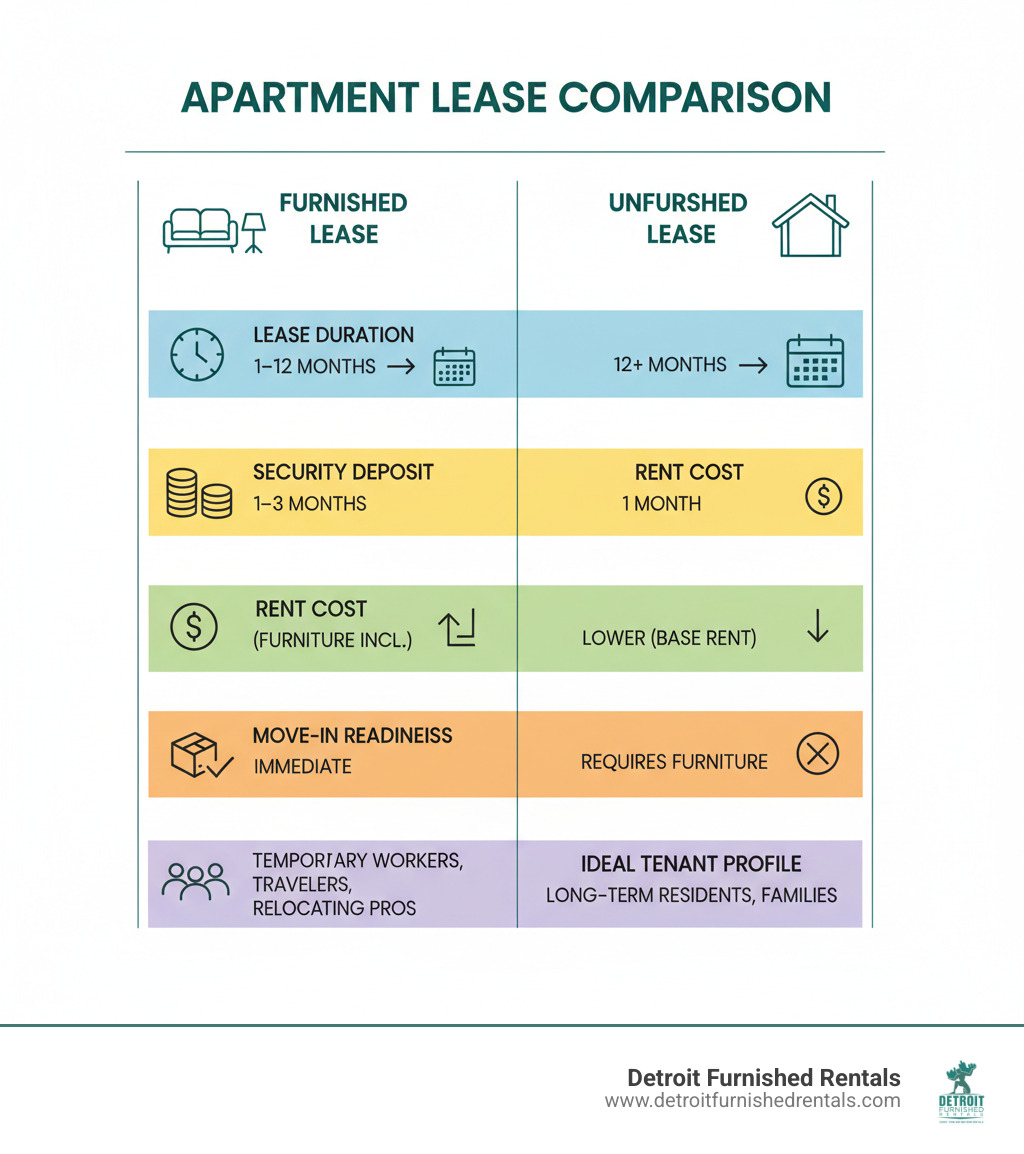
Lease duration is one of the biggest distinctions. Furnished leases typically run shorter, anywhere from one to twelve months, with many offering month-to-month flexibility after an initial term. Unfurnished apartments, on the other hand, usually require a standard 12-month commitment or longer. This shorter duration for furnished rentals reflects their appeal to traveling professionals, relocating employees, and anyone in transition who needs flexibility.
The security deposit for a furnished rental is almost always higher—often two to three months’ rent compared to just one month for unfurnished units. Why? Because we’re not just protecting against property damage; we’re also covering the furniture, appliances, and all those kitchen gadgets that make your move-in seamless. If the coffee maker breaks or the dining chair gets damaged, that security deposit helps cover replacement costs.
Rent prices naturally run higher for furnished apartments. You’re paying for the convenience of walking in with just your suitcase and having everything you need already there. No furniture shopping, no moving trucks, no assembling IKEA bookcases at midnight. That convenience has real value, which is reflected in the monthly rate.
The notice period for ending your lease also differs. Furnished leases often require just one month’s notice, especially for month-to-month arrangements, while unfurnished leases typically ask for two to three months. This shorter notice period aligns with the more flexible, transient nature of furnished rentals.
Finally, the tenant profile for each type tells its own story. Furnished apartments attract traveling nurses, corporate relocators, business professionals on temporary assignments, and people between permanent homes. Unfurnished apartments typically appeal to long-term residents, families putting down roots, and anyone planning to stay put for years. At Detroit Furnished Rentals, we specialize in that first group—people who need comfortable, well-equipped spaces without the long-term commitment.
Regional Regulations: From France to Michigan
Here’s something many people don’t realize: local laws matter tremendously when it comes to your furnished apartment lease. What’s legal and standard in one place might be completely different just a few states or countries away.
In France, for example, furnished rentals are governed by specific legislation like the ALUR Law and ELAN Law, which set minimum furnishing requirements, maximum lease durations, and tenant protections. French law even defines exactly what furniture must be included for a rental to qualify as “furnished”—down to dishes and bedding.
Here in Michigan, we operate under the Michigan Truth in Renting Act, which requires landlords to provide tenants with specific information about their rights and responsibilities. This act covers everything from security deposit limits to entry notice requirements to eviction procedures. While Michigan doesn’t dictate exactly what furniture must be included in a furnished apartment lease the way French law does, it does establish clear rules about habitability, repairs, and the landlord-tenant relationship.
If you’re renting in certain cities, you might also encounter rent control zones or additional local ordinances that affect your lease. Detroit doesn’t currently have rent control, but understanding your local regulations—whether you’re in Michigan, Ohio, or anywhere else—is crucial for knowing your rights.
The bottom line? Always read your furnished apartment lease with an eye toward both the specific terms and the local laws that govern it. What seems like a standard clause might actually be unenforceable under your state’s tenant protection laws. When in doubt, ask questions. We’re here to make your rental experience smooth and transparent, and that starts with understanding the rules that protect both of us.