The most straightforward relocation package often becomes the primary source of employee burnout during a transition. You’ve likely seen the toll it takes when a talented professional spends their first month living out of a suitcase, especially when they could be thriving in detroit corporate housing for relocating employees. It’s a challenge to balance these human needs with the reality of predictable budgets and the complex tax landscape of 2026. We understand that a successful move isn’t just about transporting furniture; it’s about eliminating the logistical friction that prevents a person from feeling at home.
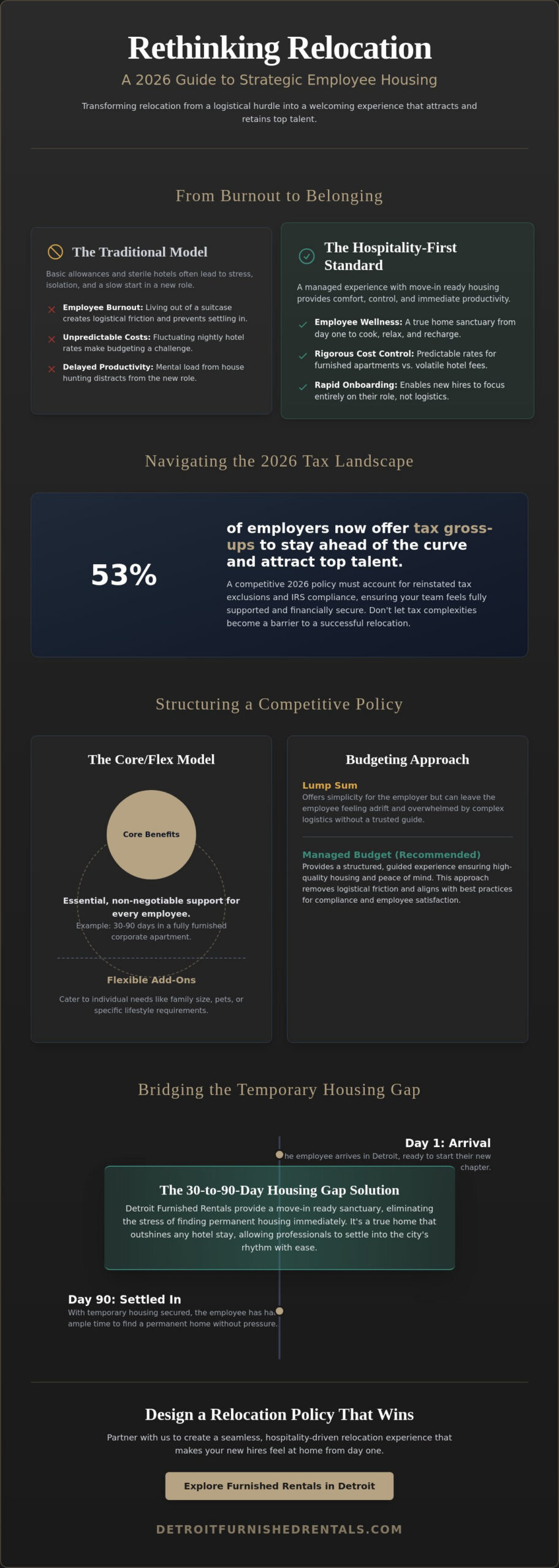
In this guide, you’ll learn how to design a competitive, cost-effective relocation policy that prioritizes both employee comfort and operational efficiency. By leveraging furnished apartments and lofts, you can offer a sanctuary that feels like a true home from day one. We’ll preview how to structure your benefits to include the reinstated 2026 tax exclusions and why 53% of employers now offer tax gross-ups to stay ahead of the curve. From understanding neighborhood nuances to managing the latest city-issued licensing requirements, this is your roadmap to a seamless Detroit transition that keeps your team productive and inspired.
Key Takeaways
- Move beyond basic moving allowances by designing a strategic framework that treats relocation as a warm welcome rather than just a logistical hurdle.
- Explore tiered benefit models that balance corporate budgetary precision with the high-end hospitality your employees deserve during their transition.
- Learn to bridge the 30-to-90-day “permanent housing gap” with detroit corporate housing for relocating employees, providing a domestic sanctuary that outshines traditional hotel stays.
- Gain clarity on the 2026 tax landscape, including how to handle IRS compliance and tax gross-ups to ensure your team feels fully supported and financially secure.
- Shift toward a hospitality-first standard that prioritizes move-in ready lofts and apartments, allowing your new hires to settle into the Detroit rhythm with ease.
What is an Employee Relocation Housing Policy?
An employee relocation housing policy is far more than a cold collection of reimbursement rules; it’s a thoughtful, strategic framework designed to bridge the gap between a signed offer letter and a productive first day. When you examine What is an Employee Relocation Housing Policy?, it’s clear that the focus has shifted from simple logistics to a curated, hospitality-driven experience. In the 2026 talent market, providing a high-quality environment like detroit corporate housing for relocating employees is a competitive necessity. It ensures that your newest team members aren’t distracted by the search for a safe, comfortable place to land. Modern HR departments have moved away from the old reimbursement model, which often leaves employees feeling isolated in sterile hotels. Instead, they embrace a managed experience that prioritizes the human element of the move.
The core objectives of such a policy are three-fold. First, it offers rigorous cost control by securing predictable rates rather than fluctuating nightly hotel fees. Second, it champions employee wellness by providing a domestic environment where they can cook, relax, and recharge. Finally, it facilitates rapid onboarding by removing the mental load of housing searches. This allows the professional to focus entirely on their new role while their living situation remains effortless and secure.
The Strategic Importance of Housing in 2026
Housing stability is a quiet but powerful driver of employee retention. If a new hire feels displaced or stressed during their first 90 days, the risk of early turnover increases significantly. A move-in ready approach, featuring furnished apartments and lofts, eliminates the Day 1 anxiety that often accompanies a cross-country move. A professional housing sanctuary provides an immediate sense of belonging that transforms a stressful transition into an effortless homecoming. By offering a space that reflects the local culture and architecture, you’re not just providing a bed; you’re introducing them to their new community with warmth and professional reliability.
Who Needs a Formal Relocation Policy?
While enterprise-level corporations often have dedicated relocation departments, small businesses and boutique firms benefit just as much from a structured plan. If your company frequently hires relocation-heavy roles, such as travel nurses or specialized corporate consultants, an ad-hoc approach is a liability. Without a formal policy, you face inconsistent costs and potential legal exposure regarding tax compliance. Utilizing detroit corporate housing for relocating employees through a structured policy ensures every hire receives the same high standard of care. This consistency protects your brand’s reputation and ensures that your budget remains predictable even as your team grows.
Structuring Your Policy: Tiers and Benefit Models
A successful relocation policy balances corporate precision with the inviting spirit of a boutique hotel. It isn’t a one-size-fits-all solution; rather, it’s a tiered system that recognizes different professional needs while maintaining a steady, logical rhythm. By categorizing benefits, you ensure that every person feels valued and that the company’s relocation budget remains predictable. The traditional model often relies on fixed allowances and pre-set services, but many modern firms are moving toward a Core/Flex model. This approach provides essential “core” benefits, such as detroit corporate housing for relocating employees, while allowing for “flexible” add-ons that cater to individual lifestyles and family needs.
Choosing between a lump sum and a managed budget is a pivotal decision for any HR leader. A lump sum offers simplicity for the employer, but it can leave the employee feeling adrift as they navigate complex logistics without a trusted guide. A managed budget provides a structured path toward finding high-quality furnished apartments, ensuring the hire lands in a space that feels like a sanctuary rather than a temporary stopgap. This managed approach aligns with best practices for Policy Implementation: Compliance, Tax Gross-Ups, and Logistics, mirroring the professional reliability found in high-level government relocation frameworks. By taking the lead on these details, you remove the logistical friction that can stall a new hire’s momentum.
Defining Your Relocation Tiers
Structuring your policy into distinct tiers allows for clear communication and fiscal responsibility. Tier 1 is typically reserved for executive-level hires, offering comprehensive support that includes family-sized furnished lofts and full-service moving coordination. Tier 2 focuses on mid-level management, providing standard mid-term rentals that serve as a comfortable, move-in ready bridge during the transition. For Tier 3, which includes entry-level roles or short-term assignments, a lump sum or shared housing option might be the most practical choice. This hierarchy ensures that the level of investment matches the strategic impact of the role, keeping the process both aspirational and practical.
The Core/Flex Advantage for Housing
Housing should always remain a “Core” benefit in your relocation strategy. It is the foundation of a successful move; without a stable, beautiful place to sleep, productivity suffers. The flexible portion of your policy allows employees to choose between sleek, modern lofts in the city’s historic core or quiet, family-oriented furnished apartments in established neighborhoods. This autonomy makes the transition feel personal and hospitable. Managing exceptions is also part of the process. When a unique situation arises that falls outside the standard policy, having detroit corporate housing for relocating employees as a pre-defined “Core” benefit makes it easier to justify adjustments while maintaining professional oversight and safety.
Bridging the Temporary Housing Gap with Furnished Rentals
The transition from a signed contract to a settled life often stalls in the 30-to-90-day window known as the permanent housing gap. This is the period after an employee arrives in a new city but before they’ve secured a long-term residence. Choosing detroit corporate housing for relocating employees during this phase ensures the momentum of a new hire isn’t lost to the fatigue of suitcase living. While many companies default to extended-stay hotels, these spaces often lack the domestic soul required for long-term focus. A true home environment acts as a sanctuary, allowing your team to decompress in a space that feels personal and permanent.
As noted in SHRM’s sample relocation policy, providing structured temporary housing is a cornerstone of professional relocation procedures. It eliminates the logistical friction of searching for short-term leases in an unfamiliar market. Proximity to the office and the quality of the local commute remain the most significant factors in employee satisfaction. By placing your talent in neighborhoods that mirror their lifestyle, you’re not just providing a roof; you’re facilitating a connection to the city’s cultural fabric from day one.
Why Furnished Apartments Outperform Hotels
The psychological benefit of a “home” environment cannot be overstated. Hotels, while convenient for a few nights, quickly become restrictive and isolating for stays lasting a month or more. Furnished apartments offer a sense of belonging that hotels simply can’t replicate. From a budgetary perspective, mid-term rentals are remarkably cost-effective. They typically save companies thousands of dollars on stays exceeding 30 days by avoiding the high nightly rates and occupancy taxes associated with the hospitality industry. You can see this in the market-specific standards found in furnished apartments detroit, where professional-grade amenities meet local charm.
Amenities That Drive Productivity
A move-in ready setup must go beyond basic furniture to include the tools of modern work. High-speed Wi-Fi, dedicated workspaces, and quiet zones are essential for the professional who occasionally works from home. In-unit laundry and fully equipped kitchens allow employees to maintain their daily rhythms, reducing the burnout that comes from constant dining out. Security and peace of mind are equally vital. We vet properties to ensure they meet rigorous safety standards, providing a secure environment where guests can truly relax. By removing these small daily stressors, detroit corporate housing for relocating employees allows your new hires to arrive at the office feeling refreshed, settled, and ready to contribute.
Policy Implementation: Compliance, Tax Gross-Ups, and Logistics
Implementing a relocation policy requires a delicate balance between professional reliability and the welcoming spirit of a local expert. It is the stage where abstract strategy transforms into a tangible sense of relief for your new hire. While previous sections focused on the “why” of detroit corporate housing for relocating employees, successful implementation relies on the “how” of fiscal compliance and logistical ease. This includes managing the transport of high-value goods, where clear Freight Forwarding and Logistics Management Fees provide the budget clarity needed for a smooth transition. By establishing a clear documentation trail and a network of trusted housing partners, you ensure that every move feels like a seamless homecoming rather than an administrative burden. Direct billing, for instance, removes the logistical friction of the reimbursement cycle, allowing employees to focus on their new roles while the company handles the granular details of the stay.
A structured approach to booking also protects the organization from the inconsistencies of the open market. Instead of leaving employees to navigate faceless rental platforms, a managed policy utilizes move-in ready lofts that meet specific professional standards. This level of oversight ensures that every sanctuary provided is safe, stylish, and fully equipped for immediate productivity. To see how these standards are applied in practice, you can explore corporate housing detroit for examples of stress-free, professionally managed stays that prioritize the guest’s peace of mind.
Navigating Tax Liabilities
The tax landscape for 2026 has shifted significantly, making clear communication more vital than ever. As of January 1, 2026, IRS Notice 2026-32 confirmed that qualified moving expense reimbursements are once again excludable from an employee’s taxable income. This reversal of the 2017 suspension applies to the cost of moving household goods and personal travel, but it does not extend to temporary housing. Because stays in detroit corporate housing for relocating employees remain taxable as wages, 53% of employers now offer tax gross-ups. These payments cover the additional tax liability, ensuring that the employee’s net pay remains untouched by the costs of their transition. Providing this level of financial protection is a hallmark of a competitive, hospitality-first policy.
Streamlining the Booking Process
Moving away from the traditional reimbursement model simplifies life for both HR and the relocating professional. When the company bills housing costs directly, it eliminates the need for employees to float large sums of money for their mid-term rentals. This direct-billed approach provides a steady, logical rhythm to the relocation process. It also allows HR to maintain a precise documentation trail, which is essential for reporting taxable wages on W-2 forms. By choosing a partner that offers move-in ready sanctuaries, you can simplify your corporate relocation logistics and ensure every new hire settles into the Detroit rhythm with ease and confidence.
The 2026 Standard: Transitioning to Move-In Ready Sanctuaries
The 2026 standard for relocation has evolved beyond simple logistical coordination; it’s now about curating a hospitality-first experience that feels like a warm embrace from a new city. A well-crafted policy acts as a silent recruiter for your brand, signaling to top-tier talent that their peace of mind is a corporate priority. By positioning mid-term furnished rentals as the foundation of your strategy, you move away from the cold reality of “temporary stay” and toward the comforting promise of a new home. Choosing detroit corporate housing for relocating employees ensures that your team isn’t just surviving a transition but is instead thriving within the city’s vibrant urban renewal from their very first night.
This sophisticated approach to housing eliminates the logistical friction that often haunts the first few weeks of a move. When an employee walks into a space that features thoughtful interior design, historic architectural character, and modern amenities, the psychological burden of relocation vanishes. It’s a steady, logical progression from a signed offer to a settled life. By investing in move-in ready sanctuaries, you provide the domestic ease necessary for a professional to focus on their new responsibilities with clarity and inspiration.
Creating a Sense of Belonging
The first 48 hours in a new city often define the long-term success of a relocation. If an employee spends that time navigating a sterile hotel room, they remain a visitor; if they spend it in a curated loft with a fully equipped kitchen and a dedicated workspace, they become a resident. Aesthetic appeal and high-end hospitality play crucial roles in professional comfort, helping to anchor the individual within the local cultural fabric. We encourage companies to choose housing that invites exploration of Detroit’s unique neighborhoods, turning a daunting move into an aspirational lifestyle upgrade. This sense of belonging is what transforms a talented hire into a loyal, long-term team member.
Partnering for Success
Identifying the right housing provider is the final step in launching a modern relocation program. While national, faceless rental platforms offer volume, they often lack the local expertise and professional reliability required for a seamless executive transition. A partner who understands the nuances of the local commute and the specific character of each neighborhood provides an invaluable layer of safety and style. To ensure your program meets these high standards, follow this final 2026 checklist:
- Audit Move-In Readiness: Ensure high-speed Wi-Fi, quiet zones, and laundry are standard in every unit.
- Confirm Tax Compliance: Verify that your gross-up calculations align with the latest 2026 IRS guidelines.
- Establish Direct Billing: Remove the reimbursement burden from your employees to simplify their first month.
- Vet Local Partners: Prioritize providers who offer boutique-level service and deep neighborhood knowledge.
By following this roadmap, you’ll create a relocation policy that is both practical and luxurious, ensuring your employees feel at home before they even step into the office. To see how we blend professional oversight with local warmth, Book your next professional relocation stay today and experience the difference of a true Detroit sanctuary.
Building a Future-Ready Relocation Strategy
Designing a modern relocation policy is a commitment to your team’s long-term success and peace of mind. You’ve seen how a tiered approach and clear tax compliance can protect your budget while providing a seamless transition for every new hire. By prioritizing detroit corporate housing for relocating employees, you eliminate the logistical friction that leads to burnout and early turnover. It’s about moving beyond the standard moving truck allowance to offer a true sense of belonging in the city’s most inspiring, historic neighborhoods.
Since 2015, we’ve focused on serving corporate professionals with a curated selection of lofts and apartments designed for immediate productivity and domestic ease. Our mid-term rentals specifically avoid the hotel fatigue that often stalls a new hire’s momentum during those first critical weeks. We invite you to Discover move-in ready housing solutions for your team and experience the difference of a hospitality-first approach. Your employees deserve a sanctuary that feels like home from the moment they arrive. Let’s make their Detroit transition the highlight of their professional journey.
Frequently Asked Questions
What is the average cost of an employee relocation package in 2026?
The total cost of a relocation package depends heavily on the distance of the move and the employee’s seniority level. Most modern programs budget for a combination of qualified moving expenses, which regained their tax-exempt status in 2026, and taxable benefits like temporary housing. While specific totals vary, companies often find that managed mid-term stays are more predictable than fluctuating nightly hotel rates.
Are relocation housing expenses tax-deductible for the employer?
Relocation housing expenses are generally deductible for the employer as a legitimate business expense. It’s important to remember that while the company can deduct these costs, the value of the housing is considered taxable income for the employee. To maintain a competitive edge, many firms use gross-up payments to cover the resulting tax liability for their new hires.
How long should a company provide temporary housing for a relocating employee?
A standard relocation policy typically provides temporary housing for a period of 30 to 90 days. This window offers enough time for the professional to settle into their new role and explore local neighborhoods before committing to a permanent residence. Providing this bridge effectively eliminates the “permanent housing gap” and reduces the stress of an immediate home search.
What is a “Lump Sum” relocation allowance and how does it work?
A lump sum allowance is a fixed cash payment given to an employee to manage their own moving and housing logistics. While this method is administratively simple for the employer, it often increases the logistical friction for the employee. For those utilizing detroit corporate housing for relocating employees, a managed budget usually provides a more supportive and hospitable experience than a self-managed cash payment.
Should I provide furnished or unfurnished housing for relocating staff?
Furnished housing is the ideal choice for temporary or mid-term transitions because it allows employees to move in with just their suitcases. Move-in ready apartments and lofts provide immediate domestic comfort without the burden of moving heavy furniture twice. This approach supports immediate productivity and helps the new hire feel like a resident of the city from their very first night.
What is “Grossing Up” in the context of relocation benefits?
Grossing up is the process of increasing a relocation payment to account for the taxes the employee will owe on that benefit. Since the IRS considers temporary housing as taxable wages, a gross-up ensures the employee receives the full intended value of the support. This practice is a standard of high-end hospitality and professional reliability in the 2026 talent market.
How can I reduce the cost of corporate housing without sacrificing quality?
You can reduce costs by choosing mid-term furnished rentals over expensive nightly hotel stays, which often carry higher tax burdens and rates. Partnering with a local expert who specializes in detroit corporate housing for relocating employees ensures access to curated properties that offer more space and better amenities than national platforms. Direct billing also streamlines the process and improves overall budget oversight.
What are the most important amenities for a professional mid-term rental?
The most essential amenities for a productive stay include high-speed Wi-Fi, a dedicated workspace, and a fully equipped kitchen. In-unit laundry and quiet zones are also critical for maintaining a healthy daily rhythm and preventing the fatigue associated with long-term travel. These features turn a temporary stay into a true sanctuary that supports both professional focus and personal well-being.