Understanding Detroit’s Metropolitan Hospital Landscape
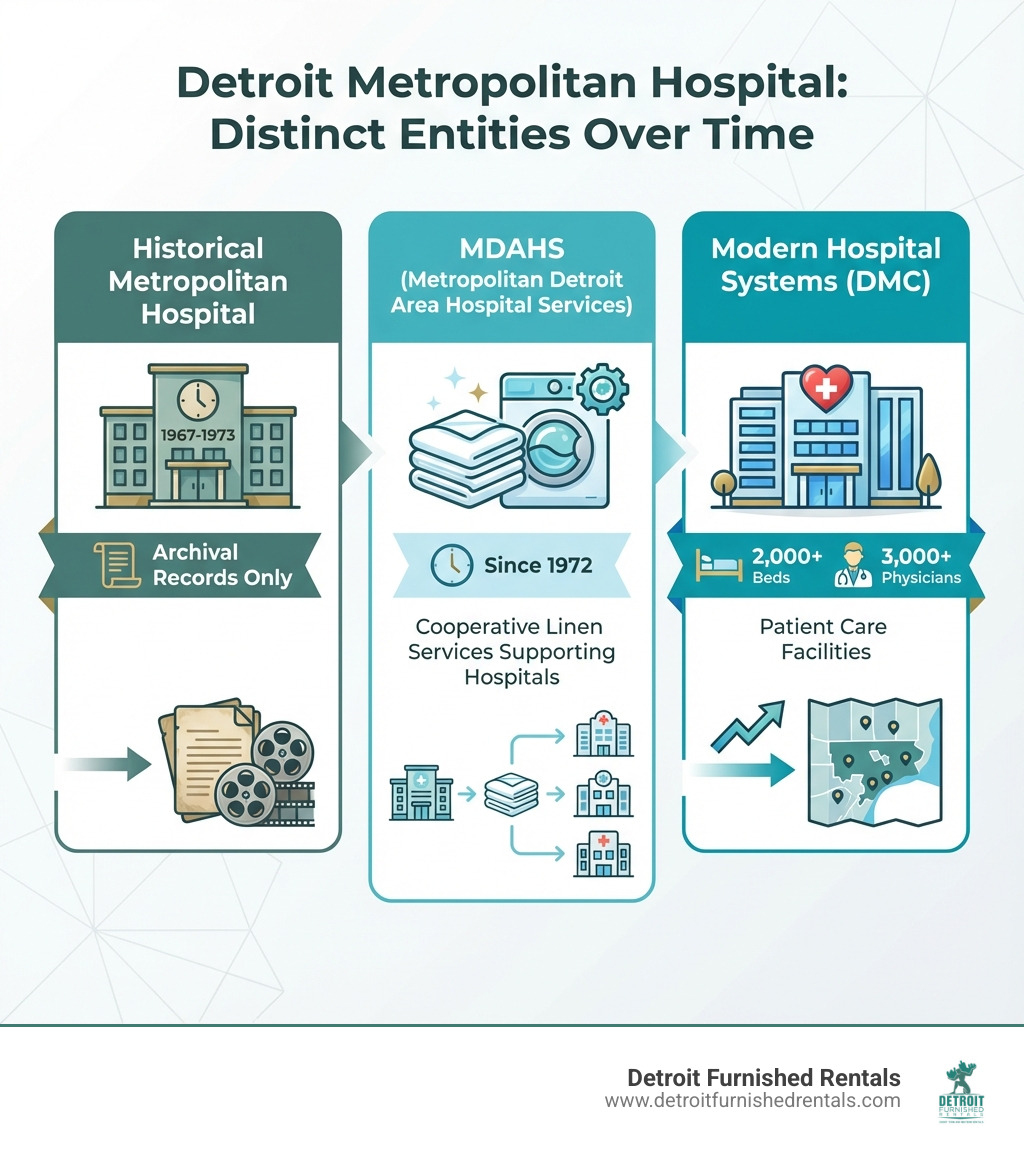
Detroit metropolitan hospital services can be confusing because the term refers to multiple distinct entities, not a single facility. Here’s what you need to know:
- Historical Metropolitan Hospital – A hospital that operated from 1967-1973, now only existing in archival records at Michigan State University
- Metropolitan Detroit Area Hospital Services (MDAHS) – A modern cooperative laundry facility providing premium linen services to area hospitals since 1972
- Detroit Medical Center (DMC) – The primary hospital network serving metropolitan Detroit today, with over 2,000 licensed beds and facilities including Detroit Receiving Hospital, Harper University Hospital, and Hutzel Women’s Hospital
- Metropolitan Behavioral Health – A behavioral health treatment facility in Dearborn offering inpatient and outpatient psychiatric care
If you’re searching for medical care in Detroit, you’re likely looking for the Detroit Medical Center, which has served the metropolitan Detroit area since 1886 and includes Michigan’s first Level I Trauma Center. The DMC offers world-class programs in oncology, organ transplant, cardiology, women’s services, neurosciences, and more.
For traveling professionals and nurses working in the Detroit metropolitan hospital systems, finding comfortable accommodations near major medical centers is essential. I’m Sean Swain, founder of Detroit Furnished Rentals, and I’ve helped countless healthcare professionals find flexible, fully-equipped housing near the Detroit metropolitan hospital network. Our properties offer the high-speed Wi-Fi, kitchen amenities, and pet-friendly options that make extended medical assignments feel like home.
Detroit metropolitan hospital vocabulary:
The Historical Metropolitan Hospital of Detroit
When people refer to the “Metropolitan Hospital” in Detroit, they might sometimes be thinking of a historical institution that played a role in the city’s healthcare landscape decades ago. While this hospital no longer operates as a patient care facility, its legacy is preserved in archival records, offering a glimpse into the past of Detroit’s medical community.
Our research shows that a “Metropolitan Hospital, Detroit” existed and generated administrative records between 1967 and 1973. These fascinating documents are housed within Michigan State University’s College of Human Medicine records. The collection, spanning 101 cubic feet, details the administrative and developmental aspects of the hospital during this six-year period.
These archival records reveal the involvement of Michigan State University’s College of Human Medicine in various healthcare initiatives tied to the Detroit metropolitan hospital landscape. For instance, the files contain information related to the planning and establishment of a Cancer Center in the Detroit area, an ambitious undertaking for its time. They also shed light on the Michigan Association for Regional Medical Programs, an organization comprising state medical schools and health agencies dedicated to coordinating the development of medical care facilities and services across the region.
Beyond specific programs, the archives document curriculum development, academic programs, and even early discussions around Health Maintenance Organizations (HMOs) and off-campus medical programs. This tells us that even in the late 1960s and early 1970s, the Detroit metropolitan hospital scene was dynamic, with educational institutions like MSU’s College of Human Medicine actively shaping the future of healthcare delivery. While it’s not a place you can visit for medical care today, the historical Metropolitan Hospital of Detroit offers a rich academic and administrative narrative for those interested in the evolution of healthcare in our city.

Metropolitan Detroit Area Hospital Services (MDAHS): The Modern Support System
Moving from history to the present, the name “Metropolitan Detroit Area Hospital Services” (MDAHS) refers to a crucial, yet often behind-the-scenes, entity supporting the modern Detroit metropolitan hospital ecosystem. MDAHS is not a hospital where patients receive direct medical care. Instead, it operates as a sophisticated, cooperative laundry facility, providing essential healthcare linen services to numerous hospitals and healthcare systems across the region.
Imagine the sheer volume of linens required daily by hospitals – sheets, scrubs, patient gowns, surgical drapes, and more. Ensuring these items are carefully cleaned, sterilized, and delivered on time is a monumental task critical for patient comfort and, more importantly, infection control. This is precisely the vital service MDAHS provides, acting as a silent guardian of hygiene in our healthcare facilities.

History and Mission of MDAHS
MDAHS began its operations in the early spring of 1972. It was initially formed as a cooperative laundry to serve four founding member hospitals: Pontiac General Hospital, St. Joseph Mercy Hospital (Ann Arbor), Sidney A. Sumby Memorial Hospital (River Rouge), and Wyandotte General Hospital. This cooperative model allowed these institutions to pool resources and achieve greater efficiency and cost-effectiveness in their linen management.
Over the decades, MDAHS has evolved, but its core mission remains steadfast: to provide premium healthcare linen to its member healthcare systems, their patients, and the communities they serve. Their vision is to be the premier provider of healthcare linen services in the Detroit metropolitan area, recognized for excellence, innovation, and reliability.
At the heart of MDAHS’s operations are its core values, which include maintaining high standards of safety, quality, responsiveness, innovation, dependability, integrity, and responsibility. These values underscore their commitment to delivering not just clean linens, but a service that upholds the highest standards of the healthcare industry. For more information on their services, you can visit their website: Premium Healthcare Linen Services.
State-of-the-Art Facilities and Environmental Focus
In June 2020, MDAHS marked a significant milestone by commencing production in its new, state-of-the-art facility. This impressive 115,000-square-foot building is a testament to their commitment to efficiency, technology, and environmental stewardship.
What makes this facility truly state-of-the-art? It’s not just its size, but its thoughtful design and incorporation of advanced, eco-conscious technologies. The building features a sustainable design, utilizing recycled materials in its construction. Furthermore, MDAHS employs eco-friendly cleaning products in its laundry processes, minimizing its environmental footprint. Perhaps one of the most innovative features is its wastewater heat reclamation system, which captures and reuses heat from wastewater, significantly reducing energy consumption.
This dedication to best practices and sustainability hasn’t gone unnoticed. MDAHS received the prestigious 2021 AGC Build Michigan Award, recognizing the excellence in construction and sustainable practices demonstrated by their new facility. This award highlights their leadership in not only providing essential healthcare support but also doing so in an environmentally responsible manner. The MDAHS team is rightly excited, as this advanced facility allows them to contribute to the care and comfort of a greater number of medical patients than ever before.
Key Partnerships and Accreditations
MDAHS’s continued growth and success are deeply intertwined with its strong partnerships within the Detroit metropolitan hospital community. The new facility, for instance, was funded through a joint venture involving some of the region’s most prominent healthcare providers: Henry Ford Health System, Michigan Medicine, and St. Joseph Health System. These collaborations underscore the cooperative spirit that drives MDAHS, allowing them to serve a broad network of medical institutions.
These partnerships are crucial for ensuring a steady supply of high-quality, hygienically clean linens to some of the busiest hospitals in the state. For instance, Henry Ford Health System operates major facilities like Henry Ford Hospital, a leader in advancing medicine and delivering innovative treatments for over a century. Michigan Medicine and St. Joseph Health System are also key players, contributing to a robust regional healthcare infrastructure.
Beyond partnerships, MDAHS holds important certifications and accreditations that speak to its operational excellence and commitment to hygiene standards. They are accredited and certified by the Healthcare Laundry Accreditation Council (HLAC). HLAC Accreditation is a rigorous standard for laundries processing healthcare textiles, ensuring that facilities meet stringent guidelines for cleanliness, safety, and quality. This accreditation provides assurance to the healthcare systems they serve that their linens meet the highest industry benchmarks, directly impacting patient safety and comfort.
Detroit Medical Center (DMC): A Pillar of Metropolitan Healthcare
When most people think of a Detroit metropolitan hospital today, they are likely thinking of the Detroit Medical Center (DMC). The DMC is a cornerstone of healthcare in our region, boasting a long and proud history of providing medical excellence. Its record of service has been integral to the Metropolitan Detroit area for well over a century, establishing it as a leader in patient care, education, and innovation.
The scale of the DMC is impressive: it operates with more than 2,000 licensed beds and is supported by over 3,000 affiliated physicians. This extensive network means that a vast array of medical needs, from routine care to highly specialized treatments, can be met within the DMC system.
The DMC’s legacy stretches back to 1886 with the founding of Children’s Hospital. Throughout its history, the DMC has been at the forefront of medical advancements. A notable achievement, for instance, was the creation of the first mechanical heart at Harper Hospital more than 50 years ago, a testament to the groundbreaking research and innovation fostered within its facilities. This spirit of innovation continues to define the DMC’s role in shaping the future of healthcare in Detroit and beyond.
Key DMC Hospitals and Specialties
The Detroit Medical Center is not a single hospital but a network of specialized facilities, each excelling in distinct areas of healthcare. Together, they form a comprehensive system capable of addressing a wide spectrum of patient needs.
One of the most critical facilities is DMC Detroit Receiving Hospital. This institution holds the distinction of being Michigan’s first Level I Trauma Center, playing a pioneering role in the evolution of emergency medicine. It hosts one of the busiest and most well-equipped emergency departments anywhere, ready to handle the most severe injuries and medical emergencies 24/7. Detroit Receiving is also home to the oldest and largest verified burn center in the state, one of only 43 such centers in the entire country, providing specialized care for burn victims. Its leading 24/7 hyperbaric oxygen program, Metro Detroit’s first certified primary stroke center, and the nationally recognized Rosa Parks Geriatric Center further highlight its diverse expertise. Detroit Receiving offers specialized care in emergency medicine, complex trauma, critical care, orthopaedics, neurosciences, nephrology, pulmonology, diabetes, geriatrics, and urology. It’s also a Center of Excellence for disaster preparedness, serving as a model for regional, state, national, and federal agencies.
DMC Harper University Hospital has distinguished itself in surgery and medicine, renowned for its clinical expertise, innovative research, and advanced education. As a specialty referral hospital, Harper has established Centers of Excellence in neurosciences, bariatric surgery, vascular services, multidisciplinary cardiovascular services, hypertension, stroke prevention, and heart failure. Its commitment to cardiac care is evident, with its Cardiovascular Institute now ranked among the “Best Hospitals” in America for Heart Care and Heart Surgery by U.S. News & World Report.
DMC Hutzel Women’s Hospital is nationally recognized for cutting-edge research and comprehensive care dedicated to women’s health. It excels in high-risk obstetrics, infertility, reproductive genetics, neonatology, maternal fetal medicine, midwifery, gynecology, urogynecology, menopause, permanent birth control, and alternatives to hysterectomy. As Michigan’s first and only hospital for women, Hutzel is home to the National Institutes of Health (NIH) Perinatology Research Branch (PRB), solidifying its reputation as a leader in women’s health among physicians and researchers nationwide.
The DMC Cardiovascular Institute (CVI), launched in 2009 and headquartered at DMC Harper University Hospital, is a world-class heart and vascular treatment center. It is dedicated to clinical care and research across all areas related to the health of the heart and circulatory system, providing the most comprehensive cardiovascular services and treatments available in Michigan.
These facilities, along with DMC Children’s Hospital of Michigan (an international leader in pediatric and adolescent medicine with over 40 clinical specialties and a Level 1 Trauma Center for children), collectively represent the comprehensive and specialized care available at the Detroit Medical Center.
Patient and Community Resources at the Detroit metropolitan hospital system
The Detroit metropolitan hospital system, particularly the Detroit Medical Center (DMC), understands that providing excellent medical care extends beyond the hospital walls. They are deeply engaged with the community and offer a wide array of patient resources to ensure a smooth and supportive healthcare journey.
Community engagement is a core aspect of DMC’s mission. They actively support local initiatives and work towards creating healthier futures for the Detroit community. This commitment often involves partnerships and programs designed to improve public health outcomes and address specific community needs.
For patients and visitors, the DMC provides clear and accessible resources. We understand that navigating a hospital stay or visit can be challenging, which is why the DMC has streamlined processes. For example, they offer an Emergency Room Online Check-in, allowing patients to choose an arrival time and wait comfortably at home before coming to the hospital. This innovative service helps manage wait times and improves the patient experience.
Visitor policies are regularly updated to ensure the safety of patients, visitors, and staff. For instance, general visiting hours are typically from 8 a.m. to 8 p.m., with specific guidelines for the number of visitors allowed and restrictions for children in patient rooms. Details regarding these policies, along with parking information, accepted insurance plans, and options for pre-registering for hospital visits, are readily available.
Beyond logistics, the DMC offers comprehensive patient support. This includes assistance with understanding billing and insurance, options for payment plans, and resources for Medicare. Patients can also easily request medical records, find a doctor, or schedule telehealth appointments, which have become increasingly vital for convenient access to care. Spiritual support, services for Arab American patients, and guidance on legal and ethical decisions are also part of their holistic approach to patient care. All these resources are centralized on the DMC Patient Services page, making it a valuable hub for anyone interacting with the DMC system.
Specialized Care: Metropolitan Behavioral Health
In the comprehensive landscape of the Detroit metropolitan hospital facilities, specialized care for mental health is a crucial component. Metropolitan Behavioral Health stands out as a dedicated center addressing the significant need for accessible, high-quality behavioral health services in Southeast Michigan and its surrounding communities. Located in Dearborn, Michigan, this facility offers comprehensive inpatient psychiatric treatment, ensuring that individuals receive the focused care they need.
Mental health support is not a one-size-fits-all solution, and Metropolitan Behavioral Health understands this deeply. They provide a range of custom programs designed to meet the unique needs of different age groups and conditions, offering hope and healing to those struggling with mental health challenges.
Services and Levels of Care
Metropolitan Behavioral Health offers various levels of care to ensure that patients receive the appropriate intensity of treatment based on their condition and needs.
For those requiring intensive support, inpatient care is available for patients aged 12 and up. This involves around-the-clock supervision and treatment in a structured environment, ideal for individuals experiencing acute mental health crises or needing stabilization. The inpatient programs are specialized to cater to:
- Adult Inpatient: Comprehensive psychiatric treatment for adults.
- Adolescent Inpatient: Custom care for young people aged 12 and above, addressing the specific mental health challenges faced during adolescence.
- Older Adult Inpatient: Specialized programs designed for the unique mental health needs and complexities of older adults.
- Co-Occurring Disorders Treatment: An integrated approach for individuals who are managing both mental health issues and substance use disorders concurrently. This holistic treatment acknowledges that these conditions often intertwine and require coordinated care for better long-term outcomes.
Beyond inpatient services, Metropolitan Behavioral Health also provides robust outpatient programs for individuals who require structured treatment but can live at home or in a less restrictive environment. These include:
- Partial Hospitalization Program (PHP): This program offers intensive, structured treatment for several hours a day, multiple days a week, serving as a step-down from inpatient care or an alternative for those needing significant support without full hospitalization.
- Intensive Outpatient Program (IOP): A more flexible option than PHP, IOP provides structured therapy and support for fewer hours per day, allowing individuals to maintain more of their daily routines while still engaging in crucial treatment.
These varied levels of care ensure that from initial crisis to ongoing recovery, patients at Metropolitan Behavioral Health have access to a continuum of support custom to their personal journey toward mental wellness.
A Partnership for Mental Wellness in the Detroit metropolitan hospital landscape
Metropolitan Behavioral Health is a powerful example of how collaboration can significantly improve healthcare services. This facility is the result of a strategic partnership between two major healthcare entities: Corewell Health and Universal Health Services. This integrated partnership was forged specifically to address the pressing need for accessible, high-quality behavioral health services in Southeast Michigan and its surrounding communities.
The collaboration brings together the strengths and resources of both organizations, allowing Metropolitan Behavioral Health to offer comprehensive and patient-centered treatment that provides hope and healing. By combining their expertise, Corewell Health and Universal Health Services are making a substantial impact on the mental wellness of our community.
This partnership is particularly vital because it allows for a broader reach and a more robust offering of services, from inpatient care to various outpatient programs. It signifies a collective commitment to ensuring that individuals struggling with mental health challenges in the Detroit metropolitan hospital service area have somewhere to turn for professional and compassionate care. For those seeking more information or assistance, help is readily available. You can learn more about their programs and services at More on Metropolitan Behavioral Health.
Frequently Asked Questions about Detroit Metropolitan Hospital
We often hear questions about what “Detroit Metropolitan Hospital” actually refers to. Given the various entities that share a similar name or serve the metropolitan area, it’s easy to get confused. Let’s clarify some common queries:
What was the original Detroit Metropolitan Hospital?
The original “Metropolitan Hospital, Detroit” was a historical hospital that operated from approximately 1967 to 1973. It is no longer an active patient care facility. Its history and administrative records are preserved within the archives of Michigan State University’s College of Human Medicine, offering insights into its planning, development, and involvement in regional medical programs during that era.
What is Metropolitan Detroit Area Hospital Services (MDAHS)?
Metropolitan Detroit Area Hospital Services (MDAHS) is a modern, cooperative laundry facility that provides essential, premium, and hygienically cleaned linen services to major hospital systems and healthcare providers in the Detroit metropolitan area. It has been operating since 1972 and plays a crucial support role in patient comfort and infection control, but it is not a hospital where patients receive direct medical treatment.
What are the main hospitals in the Detroit metro area today?
The primary and most comprehensive hospital network serving the Detroit metropolitan hospital area today is the Detroit Medical Center (DMC). The DMC encompasses several major facilities, including:
- Detroit Receiving Hospital (Michigan’s first Level I Trauma Center)
- Harper University Hospital (known for surgery, medicine, and Centers of Excellence in various specialties)
- Hutzel Women’s Hospital (a leader in women’s health and research)
- Children’s Hospital of Michigan (a dedicated pediatric facility)
- DMC Cardiovascular Institute (for heart and vascular care)
Additionally, other major healthcare systems like Henry Ford Health System and Corewell Health also operate significant hospitals and facilities within the Detroit metropolitan area, offering a wide range of medical services.
Your Guide to Detroit’s Healthcare Landscape
As we’ve explored, the term “Detroit metropolitan hospital” encompasses a rich and complex healthcare ecosystem, from historical institutions to modern support services and leading patient care networks. We’ve seen how entities like the historical Metropolitan Hospital paved the way, how Metropolitan Detroit Area Hospital Services (MDAHS) ensures the foundational hygiene of our medical facilities, and how the Detroit Medical Center (DMC) stands as a pillar of comprehensive and specialized patient care. Furthermore, specialized facilities like Metropolitan Behavioral Health address critical needs in mental wellness across Southeast Michigan.
This intricate network ensures that residents and visitors to Detroit have access to a broad spectrum of medical services, from emergency trauma care and advanced cardiovascular treatments to cutting-edge women’s health and vital behavioral health support. The dedication to medical excellence, innovation, and community well-being is evident across these institutions.
For those visiting Detroit for medical care, whether you’re a traveling healthcare professional, a patient seeking specialized treatment, or a family member supporting a loved one, finding comfortable and convenient accommodation is key. Detroit Furnished Rentals offers comfortable, fully-equipped apartments strategically located near major medical centers throughout the city. Our properties provide the amenities needed for an extended stay, including fully equipped kitchens, dedicated workspaces, and pet-friendly options, making your time in Detroit as stress-free and comfortable as possible.
To learn more about the various medical facilities and services available in our vibrant city, we invite you to explore our comprehensive guide: Learn more about Detroit’s top medical facilities in our comprehensive Detroit Hospitals Area Guide.