Find Detroit’s Crown Jewel: A World-Class Art Museum
The detroit art museum, officially known as the Detroit Institute of Arts (DIA), stands as one of America’s premier cultural institutions. If you’re planning a visit, here’s what you need to know at a glance:
Quick Visit Guide:
- Location: 5200 Woodward Avenue, Detroit, MI 48202
- Hours: Tuesday-Thursday 9am-4pm, Friday 9am-9pm, Saturday-Sunday 10am-5pm (Closed Mondays)
- Admission: Free for tri-county residents; general admission fee for others
- Collection Size: Over 65,000 artworks spanning from ancient civilizations to contemporary pieces
- Must-See: Diego Rivera’s Detroit Industry Murals
- Time Needed: 2-3 hours for highlights, full day for comprehensive visit
Founded in 1885, the DIA has grown into a cultural powerhouse that USA Today readers voted the #1 art museum in the United States in 2023. The museum’s collection is valued at over $8 billion and ranks among the top six encyclopedic art collections in the country.
The Beaux-Arts building itself is a masterpiece, designed by Paul Philippe Cret and completed in 1927. Located in Detroit’s Cultural Center Historic District, the museum spans 658,000 square feet and houses more than 100 galleries. From ancient Egyptian artifacts to cutting-edge contemporary art, the DIA offers a global journey through human creativity.
Whether you’re a traveling professional looking to explore Detroit’s cultural scene during your stay or a dedicated art enthusiast, the DIA delivers an accessible, world-class museum experience right in the heart of the city.
Planning Your Essential Visit
Getting to the detroit art museum is easier than you might think, and we’re here to help you plan a smooth, stress-free visit. Whether you’re staying with us at Detroit Furnished Rentals just a short distance away or coming from across the state, a little planning goes a long way toward making your museum experience truly memorable.
Planning Your Visit to the Detroit Art Museum
The Detroit Institute of Arts sits right in the heart of the city at 5200 Woodward Avenue, in the beautiful Cultural Center Historic District. It’s a prime location that puts you close to other cultural attractions and makes for an easy day of exploration. Need directions? This map link will get you there without any wrong turns.
The museum is open Tuesday through Sunday, with hours that work for different schedules. Tuesday through Thursday, you can visit from 9 a.m. to 4 p.m. If you’re looking for an evening out, Friday hours extend until 9 p.m., perfect for after-work visits or a cultural date night. Weekends bring slightly later opening times, with Saturday and Sunday hours from 10 a.m. to 5 p.m. The museum closes its doors on Mondays, so plan accordingly. You’ll also want to note holiday closures on New Year’s Day, Juneteenth, Independence Day, Thanksgiving Day, Christmas Eve, and Christmas Day.
Here’s something that makes the DIA special: if you live in Macomb, Oakland, or Wayne counties, admission is completely free. This incredible access comes thanks to a property tax millage that voters approved, ensuring the museum serves its community. For visitors from outside these three counties, there’s a general admission fee. That some special exhibitions may require a separate ticket on top of general admission.
Getting to the museum is straightforward whether you’re driving or taking public transit. The QLine stops right at the Warren Avenue/Ferry Street station, making it a breeze if you’re coming from downtown or Midtown. Several DDOT and SMART FAST Woodward bus routes (routes 461 and 462) also serve the area. If you’re driving, you’ll find paid parking options nearby, typical of major city attractions.
What’s On Now: Exhibitions and Events
The detroit art museum never sits still. There’s always something new to find, from rotating exhibitions to special events that bring the galleries to life in unexpected ways. We recommend checking the official calendar before your visit so you don’t miss anything that catches your eye.
Right now and in the coming months, you might catch exhibitions like Guests of Honor: Armor as Fashion (running from April 25, 2025, through April 26, 2026), which offers a fascinating look at how armor functioned as both protection and fashion statement. The Highlights from the Modern Collection is an ongoing exhibition that showcases standout pieces from the museum’s impressive modern art holdings. Coming this fall, Contemporary Anishinaabe Art: A Continuation (opening September 28, 2025) celebrates the vibrant work of Indigenous artists. The museum also features Reimagined African American Art Galleries and hosts the 17th Annual Community Group Art Exhibition, reflecting its deep commitment to diverse voices and community involvement.
The DIA has an impressive track record of bringing world-class exhibitions to Detroit. Past visitors have been blown away by shows like Van Gogh in America (2022), which explored how American collectors and museums (including the DIA itself) championed the Dutch master before Europe caught on. The museum also hosted Star Wars™ and the Power of Costume, bringing iconic movie magic to the galleries. Other memorable past exhibitions include Yoko Ono’s Freight Train, Dawoud Bey: Detroit Portraits, Annie Leibovitz: American Music, and a stunning collection of work by legendary landscape photographer Ansel Adams.
But the museum experience extends far beyond the gallery walls. Friday Night Live! turns the museum into an evening destination with performances and special programming. You can get hands-on with art through workshops like the Adult ArtMaking Workshop: Clay Creatures or sessions exploring the Islamic World. The Detroit Film Theatre screens everything from independent cinema to classic films, adding another dimension to your cultural experience. Big Picture Guided Tours offer deeper insights into the collection, while programs like Refresh, Restore, & Revitalize Educator Mornings cater to specific interests and professional development. There truly is something for everyone, whether you’re an art history buff, a curious beginner, or somewhere in between.
Exploring the Detroit Art Museum: A World-Class Collection
The real magic of the detroit art museum reveals itself when you step into its galleries. With over 65,000 artworks spread across more than 100 galleries, the DIA offers something truly special—a complete journey through human creativity, from ancient civilizations to contemporary masterpieces. We’re talking about one of the top six encyclopedic art collections in the entire United States, all right here in Detroit.
What makes this collection so remarkable isn’t just its size, but its depth. Whether you’re drawn to Renaissance paintings, ancient Egyptian artifacts, or cutting-edge contemporary installations, you’ll find world-class examples here. The museum’s curators have spent over a century building a collection that tells the full story of human artistic expression across cultures and continents.
Must-See Masterpieces
Let’s be honest—with 65,000 artworks, you might wonder where to start. While every piece in our collection deserves attention, some have become absolute icons that draw visitors from around the world.
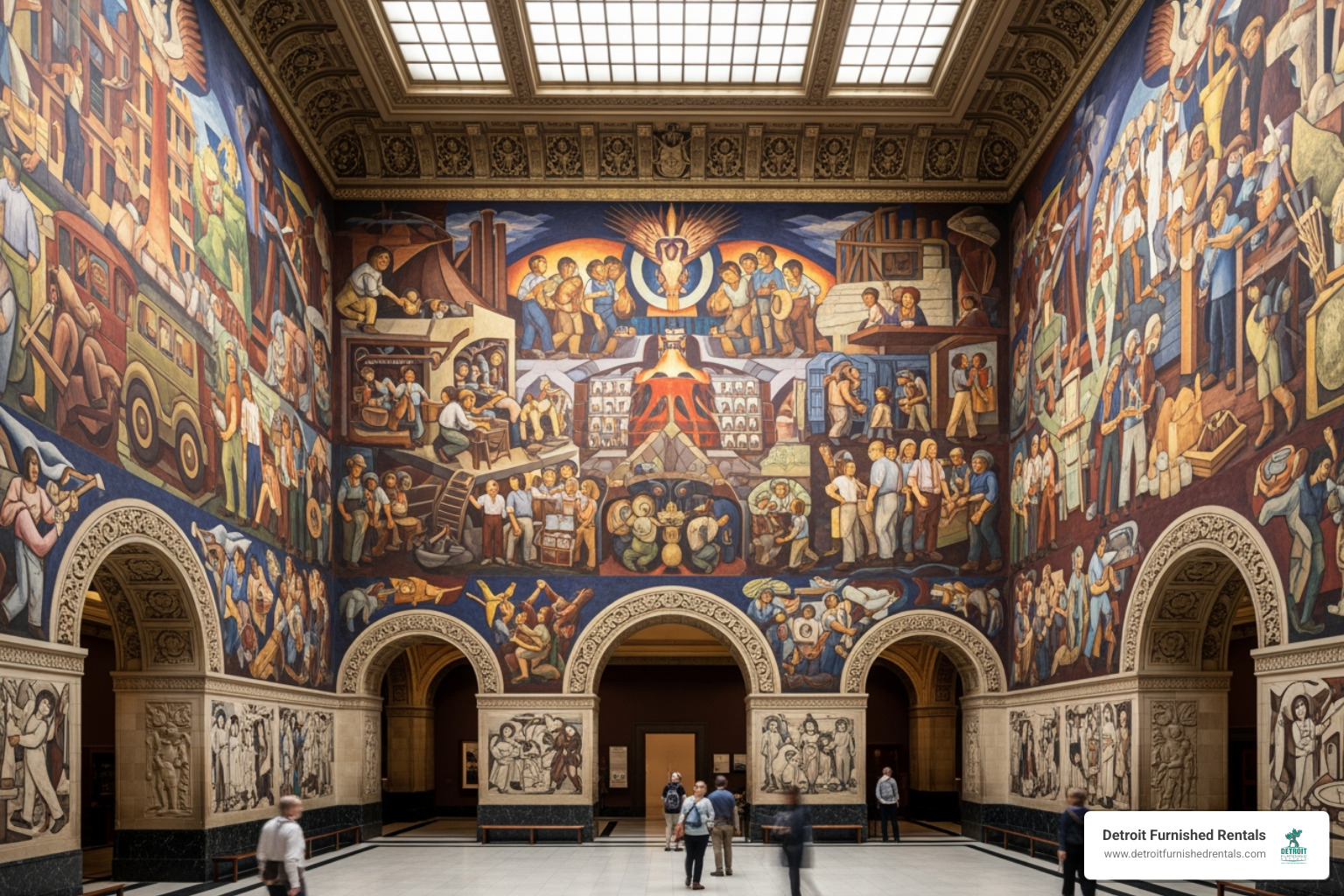
The crown jewel is undoubtedly Diego Rivera’s Detroit Industry Murals. When you walk into Rivera Court, these massive frescoes completely surround you. Commissioned in 1932, they capture the raw power and dignity of Detroit’s industrial workers and manufacturing prowess. Rivera himself called these murals his most successful work, and it’s easy to see why. The scale alone is breathtaking, but it’s the vibrant storytelling—the way Rivera celebrates the working class and Detroit’s industrial heart—that makes this an unforgettable experience.
Here’s a fun piece of art history trivia: the DIA was the very first museum in the United States to acquire a Van Gogh painting. That pioneering piece? Vincent van Gogh’s Self-Portrait, which still hangs in our galleries today. This bold acquisition in the early 20th century showed just how forward-thinking the museum’s leadership was. Similarly, Henri Matisse’s The Window was another groundbreaking early addition to an American public collection.
You’ll also want to seek out Pieter Bruegel the Elder’s The Wedding Dance. This lively painting captures 16th-century peasant life in remarkable detail—you could spend twenty minutes just taking in all the individual characters and their stories. Frederic Church’s dramatic Cotopaxi shows an erupting South American volcano in all its terrifying glory, while James Whistler’s Nocturne in Black and Gold: The Falling Rocket represents an early leap toward abstract art that was for its time.
Want to preview what you’ll see or plan your must-visit list? Explore the collection online before your visit.
Global Art and Culture
The beauty of an encyclopedic museum is that it takes you everywhere. In a single afternoon at the detroit art museum, you can travel from ancient Egypt to Renaissance Italy, from the American frontier to contemporary Japan. That’s exactly what we mean by a world-class collection.
Our American art holdings are considered among the finest anywhere, with nearly 3,000 works spanning from 1600 to 1950. These pieces capture the full sweep of American history, society, and creative spirit. Walk through these galleries and you’ll see the nation’s story unfold through paintings, sculptures, and decorative arts.
The European paintings collection is equally impressive, featuring close to 1,000 paintings from the 1100s through 1850. Renaissance masterpieces, Dutch Golden Age works, Flemish paintings, Italian Baroque pieces—they’re all here, representing the greatest artistic achievements of European civilization.
One area we’re especially proud of is our African American art collection. The General Motors Center for African American Art, established in 2000, was one of the first curatorial departments at a major fine arts museum devoted exclusively to African American art. These galleries are continuously reimagined and expanded, ensuring that vital stories and artistic contributions receive the recognition they deserve. If this aspect of Detroit’s cultural heritage resonates with you, consider also visiting The Charles H. Wright Museum of African American History during your stay.
Our ancient art galleries transport you thousands of years back in time. The Egyptian, Greco-Roman, and Ancient Near Eastern collections—many pieces originally acquired through pharmaceutical magnate Frederick Stearns—offer a window into civilizations that shaped our world. The Islamic art collection features 833 objects showcasing the incredible artistry and craftsmanship of Islamic cultures across centuries.
Don’t miss the Native American art galleries, which feature both traditional and contemporary Anishinaabe works. These pieces honor the Indigenous peoples of the Great Lakes region and demonstrate the continuity of artistic traditions into the present day.
Finally, the DIA actively engages with contemporary art, constantly acquiring and commissioning works from today’s most innovative artists. Pieces like Yoko Ono’s Freight Train and Ellsworth Kelly’s Green show that the museum isn’t stuck in the past—it’s very much a living institution that champions the art being created right now. Our specialized curators are always studying, curating new exhibitions, and recommending acquisitions that keep the collection fresh and relevant.
This global perspective is what makes a visit to the DIA so enriching. You’re not just seeing beautiful objects—you’re experiencing the full breadth of human creativity across time and culture.
The Story of the DIA: Architecture and History
Behind every great museum lies a compelling story, and the detroit art museum has one that mirrors Detroit itself—a tale of grand vision, artistic triumph, and remarkable resilience. The Detroit Institute of Arts isn’t just a place to view masterpieces; it’s a masterpiece in its own right, with a history as rich and layered as the artworks it protects.
The Architecture of the DIA
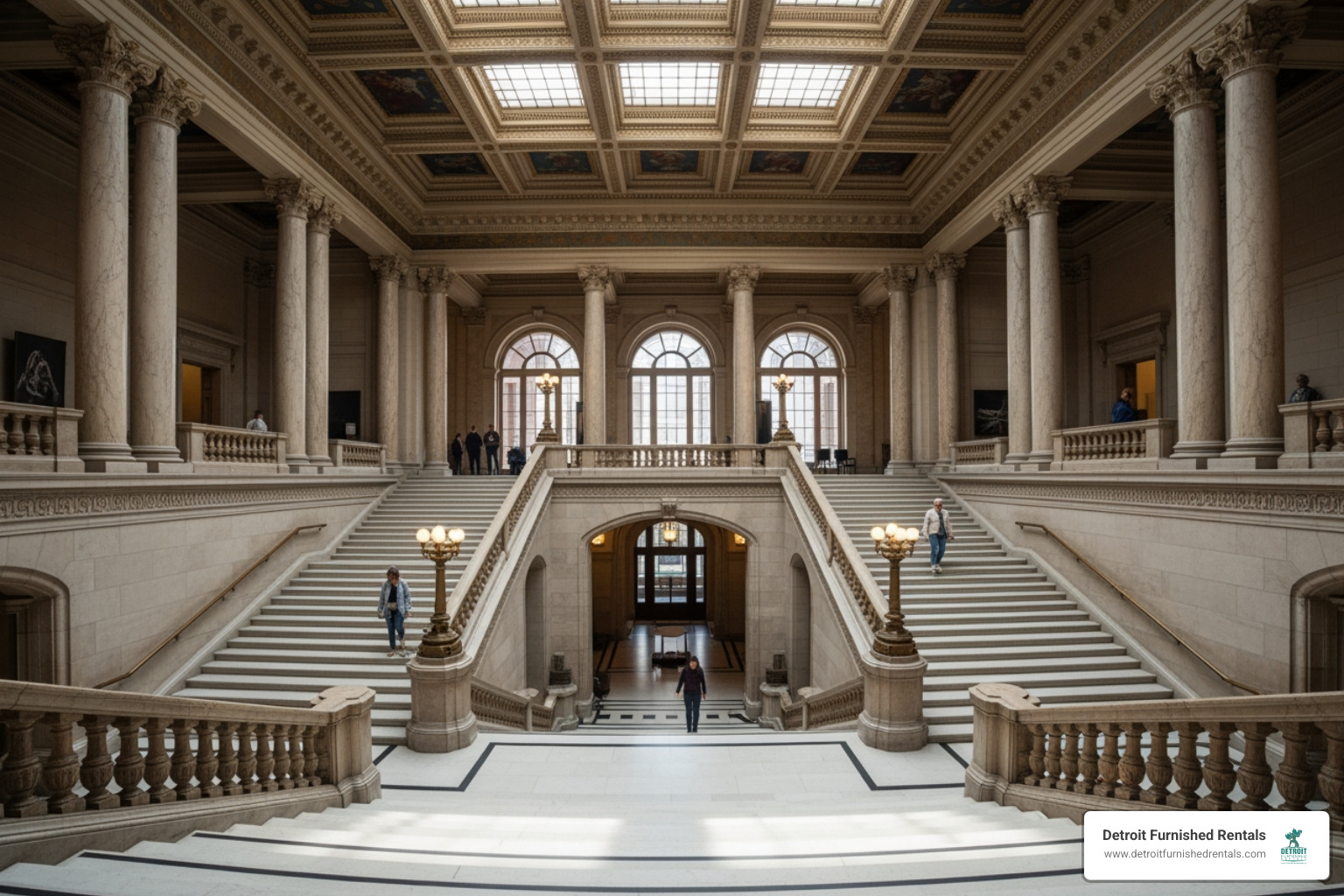
Walking up to the DIA for the first time, you’ll immediately understand why people call it a “temple of art.” The main building, designed by the celebrated architect Paul Philippe Cret, was completed in 1927 as a stunning example of Beaux-Arts style architecture. Cret drew inspiration from Italian Renaissance design, creating a structure that feels both grand and welcoming—no small feat when you’re working with such monumental proportions.
The building tells its own story through its evolution. As the collection grew, so did the museum itself. South and North wings were added in the 1960s and 1970s, giving the expanding collection room to breathe. Then came a major change—a $158 million renovation and expansion completed in 2007. This ambitious project, overseen in part by architect Michael Graves, modernized the facilities while respecting the historic character of Cret’s original vision.
Today, the building encompasses a sprawling 658,000 square feet and houses more than 100 galleries. But it’s not just about the art on the walls. The complex includes a 1,150-seat theatre, a 380-seat hall for recitals and lectures, an art reference library, and even a conservation services laboratory where experts work to preserve artworks for future generations. Every corner of this architectural gem serves a purpose in bringing art to life.
The Enduring Legacy of the Detroit Art Museum
The story of the detroit art museum begins back in 1885, though its roots reach even further to 1883 when the Detroit Museum of Art was established following a successful art loan exhibition. Those early visionaries dreamed of making Detroit an “art center of the West,” and they set about making that dream a reality with remarkable determination.
The museum’s golden age of acquisition came under the leadership of William Valentiner, who served as director from 1924 to 1945. Valentiner had extensive contacts throughout Europe and a gift for securing patronage from Detroit’s wealthy industrialists. It was during his tenure that the museum acquired some of its most treasured works, including Van Gogh’s Self-Portrait—the first Van Gogh to enter any American museum—and commissioned Diego Rivera’s iconic murals.
The museum’s growth was fueled largely by the wealth generated during Detroit’s booming auto industry era. Local industrialists and collectors saw the museum as a way to bring culture and sophistication to their rapidly growing city, and they opened their wallets accordingly.
But the DIA’s story isn’t all smooth sailing. The museum faced its greatest challenge during Detroit’s municipal bankruptcy in 2013. With the museum’s collection valued in the billions, there was real fear that these treasures might be sold off to pay the city’s creditors. It was a dark moment that threatened to scatter one of America’s great art collections to the winds.
What happened next became known as the “Grand Bargain,” and it stands as one of the most remarkable rescue efforts in museum history. Through an unprecedented collaboration, the DIA itself contributed $100 million, private foundations pledged $330 million, and the state added $350 million. This $780 million agreement protected the collection for public ownership and ensured it would remain in Detroit where it belongs.
Even before the bankruptcy crisis, the community had already demonstrated its commitment to the museum. In 2012, voters in Macomb, Oakland, and Wayne counties approved a property tax levy (or millage) that generates about $23 million annually. This funding not only stabilized the museum’s finances but also made general admission free for residents of these three counties—a gift that keeps on giving.
The museum’s financial health continues to strengthen. The endowment, which stood at $89.3 million in 2012, has grown substantially, with a goal of reaching $400 million to achieve true self-sustainability. It’s a testament to careful stewardship and community support.
Through boom times and crisis, the DIA has remained standing—a testament to Detroit’s resilience and its people’s deep commitment to culture and the arts. It’s more than just a building full of beautiful things; it’s a gathering place, a source of civic pride, and proof that art matters to communities in profound ways. If you’re drawn to Detroit’s rich cultural landscape, you’ll find plenty more to explore at More Detroit Museums.
Frequently Asked Questions about the Detroit Art Museum
As you’re planning your visit to the detroit art museum, we know a few practical questions might pop up. Let’s address the most common ones we hear from visitors preparing their trip to the DIA.
Is the Detroit Institute of Arts free?
Here’s the good news: if you live in Macomb, Oakland, or Wayne counties, admission to the Detroit Institute of Arts is completely free. This wonderful benefit exists thanks to a property tax millage that local residents approved in 2012, showing just how much the community values this cultural treasure.
For visitors coming from outside these three Michigan counties, there is a general admission fee to enter the museum. It’s worth noting that while general admission covers access to the permanent collection, some special exhibitions may require a separate ticket. We always recommend checking the museum’s official website before your visit to see what’s on display and if any additional fees apply.
How long does it take to go through the Detroit Institute of Arts?
The honest answer? It really depends on what kind of experience you’re looking for. If you’re short on time and want to hit the major highlights—like the Rivera murals, the Van Gogh self-portrait, and a few other iconic pieces—you can accomplish a meaningful visit in about 2 to 3 hours.
But here’s the thing: with over 100 galleries and 65,000 artworks spanning from ancient Egypt to contemporary installations, you could easily spend an entire day at the detroit art museum and still not see everything. Many visitors find themselves returning multiple times to fully appreciate different sections of the collection. If you’re staying with Detroit Furnished Rentals during your visit, you’ll have the perfect opportunity to spread your museum exploration across several trips, taking your time to truly absorb the incredible art on display.
What is the most famous piece in the DIA?
While the Detroit Institute of Arts houses countless celebrated artworks—from Van Gogh’s groundbreaking Self-Portrait to Bruegel’s intricate Wedding Dance—one masterpiece rises above the rest in terms of fame and cultural significance: Diego Rivera’s Detroit Industry Murals.
These magnificent frescoes completely transform the museum’s central Rivera Court into an immersive experience. Created in 1932 during the height of Detroit’s industrial power, the murals depict the city’s workers, factories, and the assembly lines that changed manufacturing forever. Rivera himself considered this fresco cycle his most successful work, and it’s easy to see why. The murals are not just beautiful—they’re a powerful statement about labor, technology, and the human spirit that captures the very essence of Detroit’s identity. Many visitors plan their entire trip to the DIA specifically to stand in Rivera Court and experience these towering works of art firsthand.
Conclusion
As we come to the end of our exploration, it’s clear that the Detroit Institute of Arts is so much more than a collection of beautiful objects behind glass. It’s a living, breathing part of Detroit’s soul—a detroit art museum that has weathered the city’s storms and emerged stronger, more vital, and more essential than ever.

Think about it: here’s an institution that survived a city bankruptcy, rallied an entire community to protect its treasures, and now welcomes hundreds of thousands of visitors each year to experience art from every corner of the globe. From ancient Egyptian artifacts to Diego Rivera’s magnificent murals celebrating Detroit’s industrial heritage, the DIA tells stories that matter—stories of human creativity, resilience, and connection across cultures and centuries.
Whether you spend a few focused hours with the museum’s highlights or dedicate an entire day to wandering through its 100+ galleries, you’ll leave with something meaningful. Maybe it’s a new appreciation for Van Gogh’s early influence in America, or perhaps it’s the powerful image of Rivera’s workers that will stay with you. Whatever draws you in, the DIA delivers an experience that’s both world-class and genuinely welcoming.
If you’re planning an extended stay in Detroit to fully explore the cultural landscape, Detroit Furnished Rentals offers the perfect home base. Our comfortable, fully equipped apartments are centrally located, giving you easy access to the museum district and all the incredible attractions the city has to offer. After a day immersed in art and culture, you’ll appreciate coming back to a space that feels like home.
The DIA stands as a testament to what’s possible when a community believes in the power of art and culture. It’s not just a must-visit destination—it’s a cultural guide that helps us understand both Detroit’s past and its vibrant present. We hope this guide has inspired you to experience it for yourself. Discover all of Detroit’s best museums and start planning your Detroit adventure today.