Why the Ambassador Bridge Matters to Detroit and Beyond
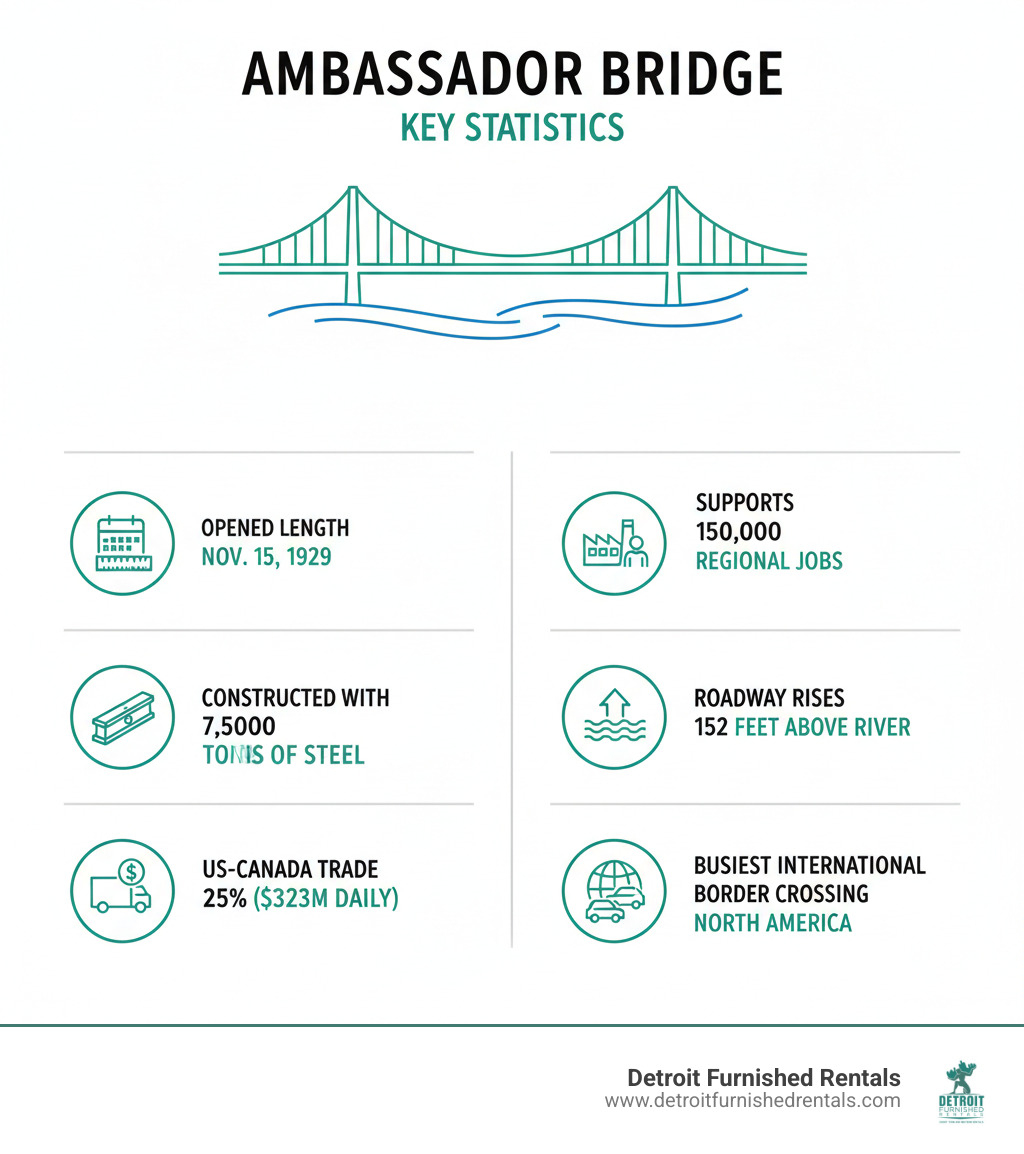
The Ambassador Bridge is North America’s busiest international border crossing, connecting Detroit, Michigan to Windsor, Ontario across the Detroit River. This iconic suspension bridge handles over 25% of all merchandise trade between the United States and Canada, with approximately $323 million worth of goods crossing daily along with more than 10,000 commercial vehicles.
Quick Facts About the Ambassador Bridge:
| Feature | Details |
|---|---|
| Location | Connects Detroit, Michigan and Windsor, Ontario |
| Total Length | 7,500 feet (2,300 m) or 1.5 miles |
| Main Span | 1,850 feet (560 m) |
| Height Above Water | 152 feet (46 m) |
| Opened | November 15, 1929 |
| Daily Traffic | 10,000+ trucks, 4,000+ passenger vehicles |
| Operating Hours | 24/7, every day of the year |
| Current Toll | US$9.00 / CA$12.00 (2025) |
When it opened in 1929, the Ambassador Bridge held the world record as the longest suspension bridge span. Today, it remains privately owned and stands as a critical piece of infrastructure supporting 150,000 regional jobs and $13 billion in annual production in the Detroit-Windsor area.
Whether you’re a traveling professional like yourself exploring Detroit’s connection to Canada, a history buff interested in engineering marvels, or simply curious about this landmark visible from many parts of the city, understanding the Ambassador Bridge helps you appreciate Detroit’s unique position as an international gateway city.
The History and Engineering of a Landmark
Picture Detroit in the 1920s: factories humming, the automotive industry booming, and thousands of people and goods needing to cross between the United States and Canada every single day. The problem? They were all stuck waiting for ferries.
The ferry system simply couldn’t keep up. Freight cars would pile up for hours, sometimes stretching back for blocks. A train tunnel did exist beneath the river, but it was nowhere near enough to handle the growing demand. Meanwhile, warehouses in Chicago overflowed with grain that couldn’t reach eastern markets, and foreign goods sat stranded in eastern warehouses, unable to move west. Something had to change.
The idea of building a bridge wasn’t new. People had proposed it before, but each time the plans fell apart. Ship captains worried the bridge would block their navigation routes. The estimated cost seemed astronomical. Some politicians, including Detroit’s Mayor John Smith, opposed having a privately-owned international crossing. But as the economic pressure mounted, these objections gradually gave way to necessity.
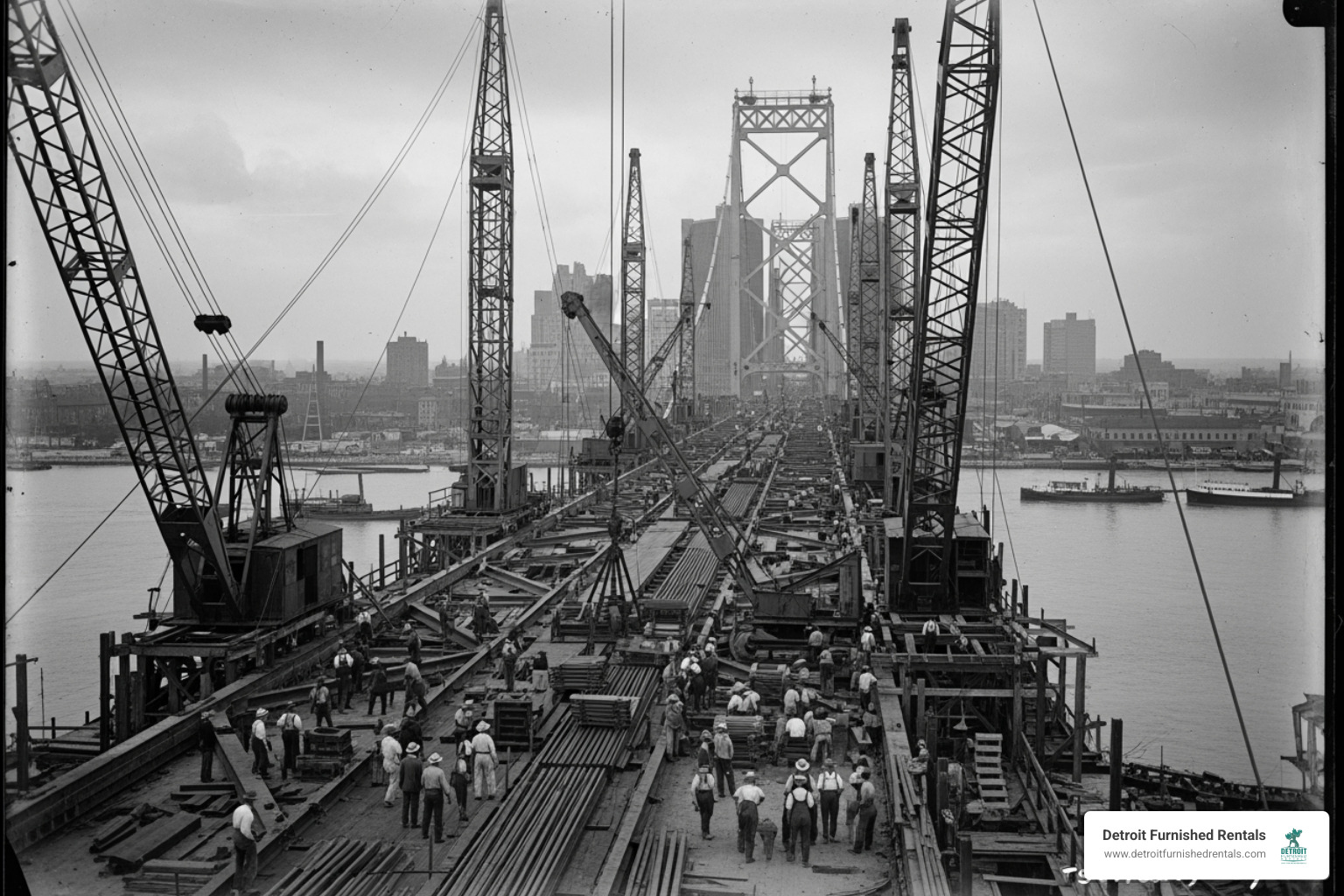
Enter Joseph A. Bower, a Detroit financier who saw opportunity where others saw obstacles. Bower committed $23.5 million to the project, an enormous sum in the 1920s. With funding secured, the McClintic-Marshall Company of Pittsburgh took on the construction challenge. They broke ground in May 1927, and what followed was a remarkable display of engineering speed and skill.
Just two and a half years later, the Ambassador Bridge opened to traffic on November 15, 1929. The bridge was actually finished ahead of schedule, a rarity for projects of this scale. It immediately transformed how goods and people moved between the two countries. If you’re curious about the full story of this engineering achievement, The Ambassador Bridge: A Monument to Progress offers a fascinating deep dive.
Key Figures and Construction of the Ambassador Bridge
Behind every great bridge stands a cast of characters, and the Ambassador Bridge had its share of both heroes and villains. Joseph A. Bower provided the financial backbone, but the road to funding wasn’t smooth. At one point, a Toronto financier hired to sell bridge securities embezzled the money and later died in prison after a murder conviction. The 1920s were nothing if not dramatic.
The actual construction was a marvel of its time. Workers assembled 21,000 tons of steel piece by piece, high above the Detroit River. When completed, the bridge claimed the title of the world’s longest suspension bridge span, holding that record until 1931. While built primarily for function, the designers incorporated subtle Art Deco design elements that reflected the architectural style of the era.
Fast forward to 1979, and the bridge changed hands. Manuel “Matty” Moroun and his Central Cartage Company bought the bridge by purchasing shares on the New York Stock Exchange. The Moroun family’s ownership would later become a source of controversy, particularly regarding maintenance and their opposition to competing crossings, but that’s a story we’ll get to later.
Key Dimensions and Statistics
Let’s talk about what makes the Ambassador Bridge such an impressive structure. The bridge stretches 7,500 feet (or about 1.5 miles) from the Detroit side to Windsor. That’s a substantial drive over water, giving you plenty of time to take in the views of both cities.
The main span, the section that actually hangs suspended over the river, measures 1,850 feet. When you’re crossing, you’re traveling 152 feet above the Detroit River, high enough that large cargo ships can pass underneath without any issues.
The bridge carries four lanes of traffic, handling the constant stream of commercial trucks and passenger vehicles that cross every day. If you’ve ever wondered why you can’t walk or bike across, here’s why: the bridge originally included pedestrian sidewalks, but those were closed after September 11, 2001, due to security concerns. Today, if you want to cross on foot, you’re out of luck at both the Ambassador Bridge and the nearby Detroit-Windsor Tunnel.
A Vital Artery for U.S.-Canada Trade
Here’s something that might surprise you: every single day, roughly $323 million worth of goods crosses the Ambassador Bridge. That’s not a typo – we’re talking about more than three hundred million dollars in merchandise, day after day, making this the busiest international crossing in North America by trade volume.
To put that in perspective, more than 25% of all merchandise trade between the United States and Canada flows across this single bridge. That’s a quarter of everything traded between two of the world’s largest economies, all funneling through one crossing between Detroit and Windsor. This incredible volume of trade is a big part of what makes Detroit such a unique international city, as we explore in our guide Travel Destination: Detroit, Michigan – An International Scene.
The bridge’s importance goes far beyond impressive numbers. It’s absolutely critical to the automotive industry, which depends on smooth cross-border logistics to keep assembly lines running. When the bridge slows down or stops, the economic impact ripples across the entire region – and fast. As this Reuters analysis explains, that’s exactly what makes it such a strategic chokepoint for North American trade.
The Ambassador Bridge’s Economic Impact
Let’s talk about what the Ambassador Bridge really means for the people who live and work in the Detroit-Windsor region. According to a 2004 Border Transportation Partnership study, this single bridge supports a staggering 150,000 jobs and generates $13 billion in annual production. Those aren’t just statistics – they represent real families, real paychecks, and real businesses on both sides of the border.
The bridge handles between 60 and 70 percent of all commercial truck traffic in the region. That’s an enormous amount of eighteen-wheelers rumbling across the Detroit River every day, carrying everything from auto parts to agricultural products.
The automotive industry particularly depends on the Ambassador Bridge for what’s called “just-in-time” manufacturing. This system means parts arrive at factories exactly when they’re needed, not hours or days earlier. It saves money and space, but it also means any delay can bring entire assembly lines to a grinding halt. Car parts and even partially assembled vehicles often cross the bridge multiple times during production, bouncing back and forth between facilities in Michigan and Ontario. When traffic flows smoothly, this system works beautifully. When it doesn’t? Well, that’s when things get expensive.
Notable Incidents and Disruptions
While the Ambassador Bridge usually hums along quietly doing its job, it has occasionally made headlines for less routine reasons.
In early 2022, the bridge became the center of international attention during the “Freedom Convoy” protests. Truckers blockaded access to the crossing, and the economic impact was immediate and severe. Major automakers like Ford and Toyota had to slow or stop production at multiple plants. The blockade served as a wake-up call about just how vulnerable North American trade is to disruptions at this single crossing.
Construction and maintenance on a structure this massive inevitably comes with risks. In 2000, a scaffold collapse during maintenance work tragically killed a worker. More recently, in July 2023, construction worker Spencer Baker survived a terrifying 43-meter fall from scaffolding into the Detroit River below. Thanks to quick-thinking rescue crews, he lived to tell the tale, though his recovery was long and difficult.
The bridge has also been at the center of some unexpected human dramas. In 2025, U.S. Customs and Border Protection reported detaining numerous undocumented immigrants who had accidentally driven onto the bridge from the Detroit side. Many had simply taken a wrong turn, not realizing they were about to cross an international border. Imagine the shock of making a wrong exit and suddenly finding yourself in another country, facing detention! The incidents highlighted ongoing concerns about signage and the very real consequences of an accidental wrong turn in this part of Detroit.
Crossing the Bridge: A Traveler’s Guide
Planning to cross the Ambassador Bridge between Detroit and Windsor? Whether you’re heading to Canada for business, exploring a new city, or visiting family across the border, the journey itself is straightforward – but crossing any international border does require some preparation. Think of it as a bit more involved than your typical road trip, but nothing too complicated once you know what to expect.
The bridge welcomes both passenger vehicles and commercial trucks, with separate lanes and procedures designed to keep traffic moving efficiently. If you’re new to Detroit and want to understand more about getting around our city in general, our Detroit Transportation Guide for Visitors is a great resource. But for the border crossing itself, we recommend checking out the official Know before you go guide from U.S. Customs and Border Protection before you hit the road.
Current Operations at the Ambassador Bridge
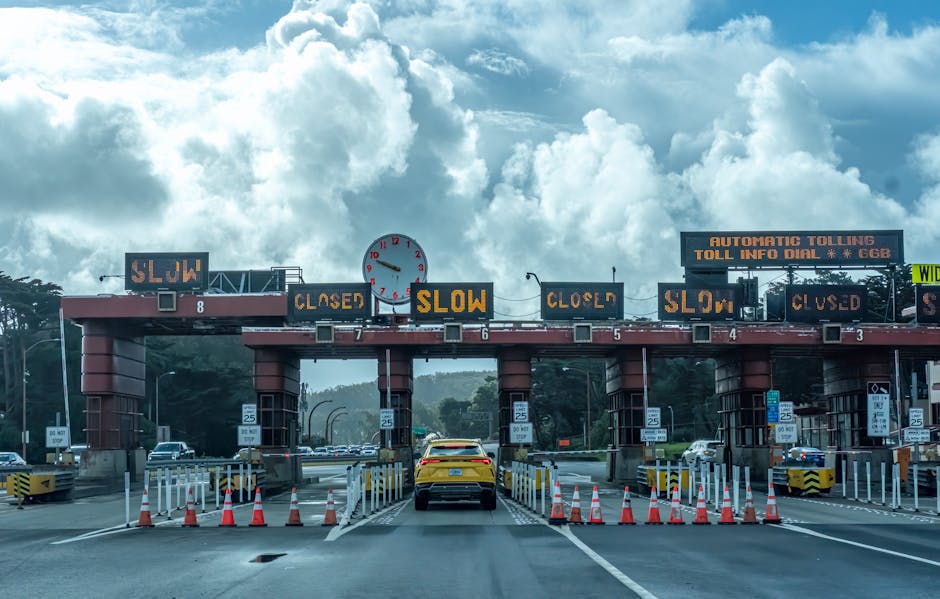
Here’s something you might not expect about the Ambassador Bridge: it never sleeps. This crossing operates 24 hours a day, 7 days a week, 365 days a year. Christmas morning? Open. New Year’s Eve at 3 AM? Open. This constant availability is essential for maintaining the continuous flow of trade and travel between our two nations.
As of 2025, you’ll pay a toll of US$9.00 or CA$12.00 to cross. The bridge accepts both cash and major credit cards, so you have options when you reach the toll plaza. Just remember – have your payment ready to keep things moving smoothly!
If you’re a frequent traveler between Detroit and Windsor, you’ll want to know about the expedited crossing programs. The NEXUS program is designed for pre-approved, low-risk travelers, and it can save you significant time at the border. NEXUS lanes heading into Canada typically operate Monday through Friday from 6:00 AM to 11:00 PM, with varied hours on weekends and holidays. Coming back into the U.S.? Those NEXUS lanes run Monday to Friday from 5:30 AM to 8:00 PM.
For commercial drivers, the FAST (Free and Secure Trade) program offers similar benefits. Dedicated FAST booths provide 24-hour service on weekdays, helping keep goods moving efficiently across the border.
You’ll also notice a duty-free store near the bridge – a popular stop for many travelers looking to take advantage of tax-free shopping. However, the store has been at the center of some controversy, particularly regarding its fuel sales. Critics point out that the profits from tax-free fuel (reportedly about sixty cents from each U.S. gallon going directly to the bridge owner) don’t contribute to maintaining Michigan’s roads like regular gas taxes do. It’s an ongoing debate about private ownership versus public benefit.
Required Documents and Border Procedures
Let’s talk paperwork, because this is where being prepared really matters. When you cross the Ambassador Bridge, you’re not just driving to another city – you’re entering another country. Both U.S. Customs and Border Protection (CBP) and the Canada Border Services Agency (CBSA) take their responsibilities seriously, and they will check your documents carefully.
Every traveler needs proper identification, and yes, that includes children. A crying toddler doesn’t get a free pass on documentation! Here are your options for acceptable travel documents:
Valid Passport – This is your best bet and the most widely accepted document for international travel. If you have one, bring it.
NEXUS Card – Perfect for frequent travelers who’ve gone through the pre-approval process. It works for both identification and expedited processing.
Improved Driver’s License or Improved Driver’s License – Some U.S. states and Canadian provinces offer these special licenses that prove both your identity and citizenship. Michigan happens to be one of those states, which is convenient for Detroit residents!
U.S. Passport Card – This wallet-sized alternative to a passport book works for land and sea travel to Canada, Mexico, the Caribbean, and Bermuda. It’s less expensive than a full passport and easier to carry.
FAST Card – Specifically for commercial drivers enrolled in the FAST program, this card provides both identification and expedited border processing for eligible truck drivers.
The key thing to remember? Everyone in your vehicle needs their own document. You can’t share a passport or use one document for multiple people. It sounds obvious, but it’s worth mentioning because border agents see these mistakes more often than you’d think.
If you have any questions about what documents you need or whether your specific situation requires additional paperwork, don’t hesitate to contact CBP or CBSA directly before your trip. Border requirements can occasionally change, so it’s always smart to verify the current rules on the official websites. A few minutes of preparation can save you from being turned away at the border – which would definitely put a damper on your travel plans!
Controversy and the Future of Detroit-Windsor Crossings
The Ambassador Bridge might be an engineering marvel and economic powerhouse, but it’s also been at the center of some serious controversy over the years. Unlike most major international crossings, this bridge remains privately owned by the Moroun family through the Detroit International Bridge Company on the U.S. side and the Canadian Transit Company in Canada. This private ownership has sparked countless legal battles, public disputes, and questions about whether a crossing this vital should really be in private hands.
One major flashpoint was the “Gateway Project,” designed to improve highway access to the bridge. What should have been a straightforward infrastructure upgrade turned into a prolonged saga of delays and legal fights. Things got so heated that bridge owner Matty Moroun and his chief deputy actually ended up in jail for refusing to comply with court orders! Critics argued that the delays weren’t just bureaucratic headaches – they suggested the holdup was strategic, forcing traffic to pass by the bridge’s profitable duty-free store. It’s a reminder that when private profit meets public infrastructure, tensions can run high.
The bridge’s physical condition has also raised eyebrows, particularly on the Canadian side. Windsor city officials haven’t minced words about the bridge’s deteriorating appearance. More alarmingly, they’ve called out the serious safety hazard of falling concrete – yes, chunks of concrete dropping from the bridge onto Windsor streets below. Reports of this crumbling concrete have fueled concerns that necessary repairs were being delayed or avoided, putting public safety at risk. Not exactly the kind of publicity any landmark wants!
The Gordie Howe International Bridge and a Proposed Second Span
The biggest challenge facing the Ambassador Bridge isn’t wear and tear – it’s competition. The Gordie Howe International Bridge, a new publicly-funded crossing being built downriver, represents a fundamental shift in how Detroit and Windsor will connect. This modern bridge promises direct highway access, reduced congestion, and all the efficiency improvements that come with 21st-century infrastructure planning.
Manuel Moroun didn’t take kindly to this new rival. He fought the Gordie Howe Bridge project tooth and nail, launching lawsuits and political campaigns to block its construction. Many observers believed his fierce opposition stemmed from the threat to his bridge’s profits, especially the lucrative duty-free gasoline sales that generate substantial revenue. After all, why would travelers stop at the Ambassador Bridge’s duty-free store if they could cross on a newer, faster bridge?
In response to the looming competition, Moroun’s company proposed building a second span – essentially a twin Ambassador Bridge right next to the original. It seemed like a logical move to increase capacity and stay competitive. But this proposal quickly ran into a maze of regulatory roadblocks on both sides of the border.
The permit situation became impossibly tangled. While the U.S. Coast Guard issued approval for a second span to coexist with the original bridge, Canadian permits expired and weren’t renewed. Transport Canada threw in an additional wrench: their permit included a condition requiring the original bridge to be dismantled within five years of any replacement opening. This fundamental conflict between American and Canadian requirements, combined with ongoing permit struggles, essentially killed the twin span dream.
Recent developments have confirmed what many suspected – the second span is dead. The bridge company has started demolishing properties in Windsor that were acquired specifically for the new span’s approach. It’s a clear signal that they’ve abandoned the project entirely.
With the Gordie Howe International Bridge nearing completion, the Detroit-Windsor crossing landscape is about to change dramatically. The Ambassador Bridge will certainly continue operating – it’s still a vital piece of infrastructure. But the monopoly is over. Recent reports show that trucking traffic on the Ambassador Bridge has dropped to near-historic lows as the Gordie Howe opening approaches. Shippers and logistics companies are clearly ready for an alternative.
For travelers staying with Detroit Furnished Rentals and exploring the region’s international connections, this shift means more options and potentially shorter wait times in the future. The Ambassador Bridge has served North America well for nearly a century, but the next chapter in Detroit-Windsor crossings is about to begin – one that includes both private enterprise and public infrastructure working side by side.
Frequently Asked Questions about the Ambassador Bridge
If you’re planning to cross the Ambassador Bridge or you’re simply curious about this iconic landmark, you probably have some questions. Let’s tackle the most common ones we hear from travelers and Detroit visitors:
Can you walk or bike across the Ambassador Bridge?
Unfortunately, no – and we know that’s disappointing for those who’d love to experience that panoramic view on foot! After the September 11, 2001 attacks, pedestrian and bicycle access to the Ambassador Bridge was permanently discontinued for security reasons. This measure helps ensure the safety of this critical international crossing point.
If you were thinking about the nearby Detroit-Windsor Tunnel as an alternative, that’s also off-limits for pedestrians and cyclists. So if you’re looking to make the journey between Detroit and Windsor, you’ll need to hop in a vehicle to do it. The good news? The drive itself offers some pretty spectacular views of both cities and the Detroit River!
What documents do I need to cross into Canada and return to the U.S.?
This is probably the most important question to get right before you head to the Ambassador Bridge! Every traveler, including children, needs valid identification and proof of citizenship to cross into Canada and return to the U.S.
Your best bet is always a valid passport – it’s universally accepted and keeps things simple. But you have other options too. A NEXUS card works great if you’re a pre-approved, low-risk traveler and want to use the faster lanes. Some U.S. states and Canadian provinces issue Improved Driver’s Licenses (EDL) or Improved Identification Cards (EIC) that serve as both identification and proof of citizenship. You can also use a U.S. Passport Card for land border crossings.
Because border requirements can change, we always recommend double-checking the latest rules with U.S. Customs and Border Protection (CBP) or Canada Border Services Agency (CBSA) before your trip. Better to be over-prepared than turned away at the border!
Why is the Ambassador Bridge privately owned?
The Ambassador Bridge is actually one of the few privately-owned international crossings in North America, which makes it pretty unique. Its private ownership goes all the way back to the 1920s when the bridge was first built.
Here’s what happened: Several attempts to secure public funding for a bridge connecting Detroit and Windsor had failed. The economic need was urgent – ferries and the existing train tunnel just couldn’t handle the volume of trade and travel. That’s when private financier Joseph A. Bower stepped up with the necessary capital, investing a substantial $23.5 million to make the bridge a reality.
Because private investors financed and built the bridge, it remained privately owned rather than becoming public infrastructure. The Bower family controlled it until 1979, when Manuel “Matty” Moroun acquired it through strategic stock purchases. It’s stayed in private hands ever since, operating independently of government ownership. This private ownership has certainly led to its share of controversy over the years, as we discussed earlier in this article, but it’s a fascinating piece of the bridge’s unique story!
Conclusion
Standing at 152 feet above the Detroit River, the Ambassador Bridge represents something far greater than its impressive steel framework and Art Deco details. It’s a living monument to what happens when vision meets determination – a privately-financed dream from the 1920s that became North America’s most vital international trade corridor.
Every day, this bridge carries the weight of $323 million in goods and supports 150,000 regional jobs. But beyond those staggering numbers, it’s also carried generations of families crossing to visit relatives, professionals commuting to work, and travelers like you finding the unique character of an international border city.
For us at Detroit Furnished Rentals, the Ambassador Bridge perfectly captures what makes Detroit special. We’re not just another American city – we’re an international gateway where two nations meet, trade flourishes, and cultures blend. When you stay with us in one of our furnished apartments, you’re positioning yourself at the heart of this dynamic, connected community. Many of our guests love exploring the international dimension of Detroit, and the bridge stands as the most visible symbol of that unique identity.
Whether you catch a glimpse of it lit up at night from downtown, drive across it yourself, or simply appreciate its role in keeping our regional economy humming, the Ambassador Bridge deserves its place among Detroit’s most significant landmarks. As the Gordie Howe Bridge prepares to open and reshape cross-border traffic patterns, the Ambassador’s legacy as a pioneering feat of engineering and commerce remains secure.
Ready to find more of what makes Detroit unforgettable? We invite you to Explore more of Detroit’s iconic landmarks and see why our city continues to fascinate visitors from around the world.