Why Symphony No. 6 Is Usually Called the Best Tchaikovsky Symphony
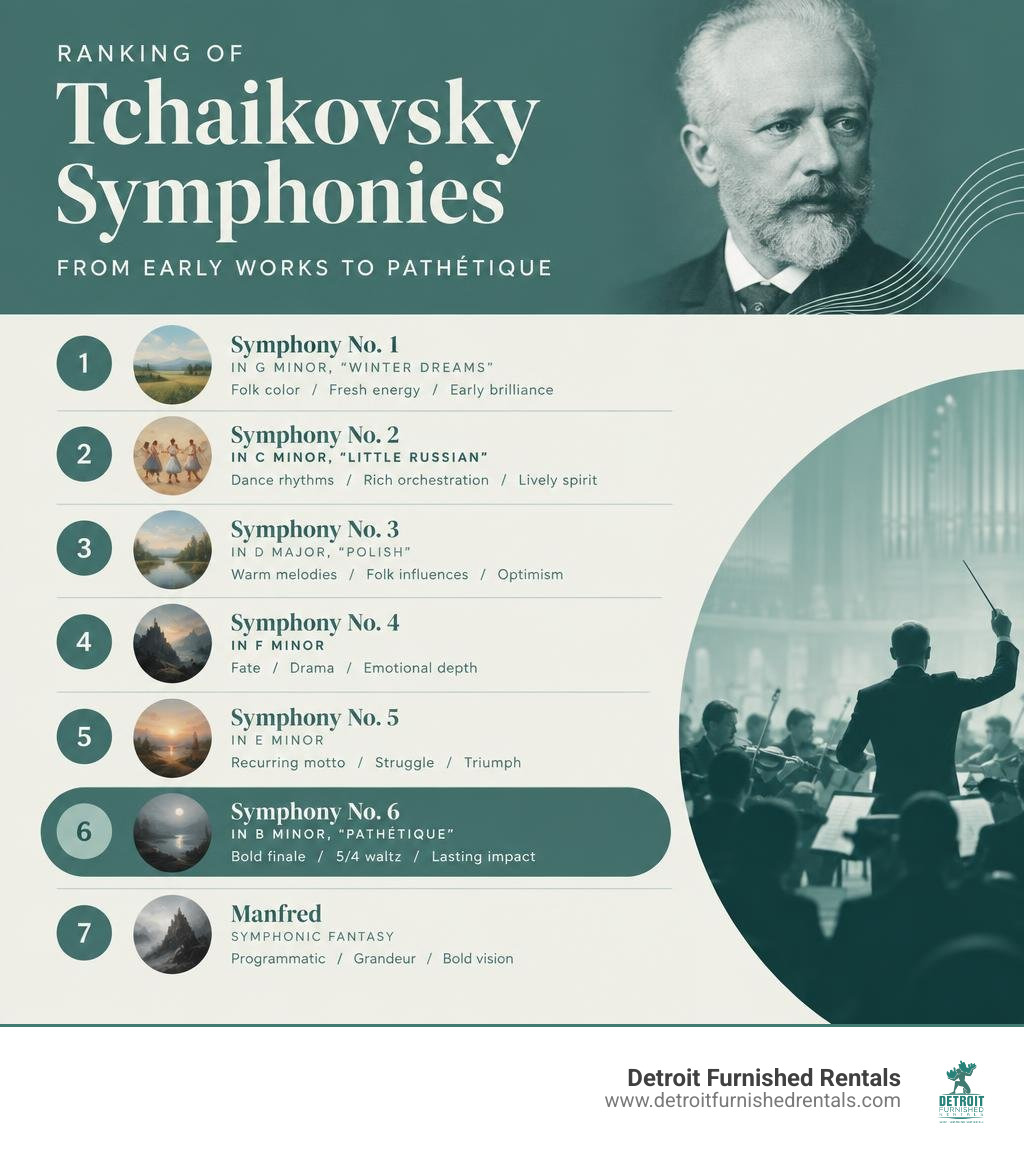
The best Tchaikovsky symphony is widely considered to be Symphony No. 6 in B minor, “Pathétique.” Its bold slow finale, unsettling 5/4 waltz, and emotional force make it one of Romantic music’s most distinctive works. Composed in 1893, it premiered on October 28, only nine days before Tchaikovsky’s death.
That said, there is a strong case for more than one winner. The Fourth delivers fate-driven drama, the Fifth turns a recurring motto into a hard-won triumph, and Manfred offers the biggest programmatic spectacle. The first three are heard less often, but bring folk color, dance rhythms, and a lighter side of the composer many listeners miss.
This ranking covers all six numbered symphonies plus Manfred, judging them by musical invention, emotional impact, orchestral color, and lasting influence.
I am Sean Swain, a Detroit-based hospitality entrepreneur and culture-focused travel writer who enjoys helping visitors find meaningful local experiences, from landmark performances to the best Tchaikovsky symphony on record. Whether you are listening between hospital shifts or planning a night at the orchestra, this guide gives you a clear place to start.
Handy best tchaikovsky symphony terms:
The Definitive Ranking: Finding the Best Tchaikovsky Symphony

Evaluating Pyotr Ilyich Tchaikovsky’s symphonic output requires balancing pure formal construction against raw emotional expression. Unlike classicists who prioritized strict architectural symmetry, Tchaikovsky poured his inner psychology into his orchestrations. When surveying his complete cycle alongside milestones like the Beethoven Symphonies 1 to 9 masterpieces ranked, we see an artist constantly wrestling with conventional Germanic form while forging a distinct Russian voice.
To rank these seven monumental works, we weigh four primary criteria:
- Thematic Cohesion: How effectively the musical ideas develop across movements.
- Orchestral Color: The imaginative use of instrumental textures, woodwind dialogues, and brass power.
- Emotional Resonance: The authenticity and intensity of the narrative arc.
- Historical and Canonical Impact: The enduring legacy of the work in concert halls worldwide.
Here is how all seven symphonies stand when judged against these rigorous artistic standards.
7. Symphony No. 3 in D major, Op. 29 “Polish”
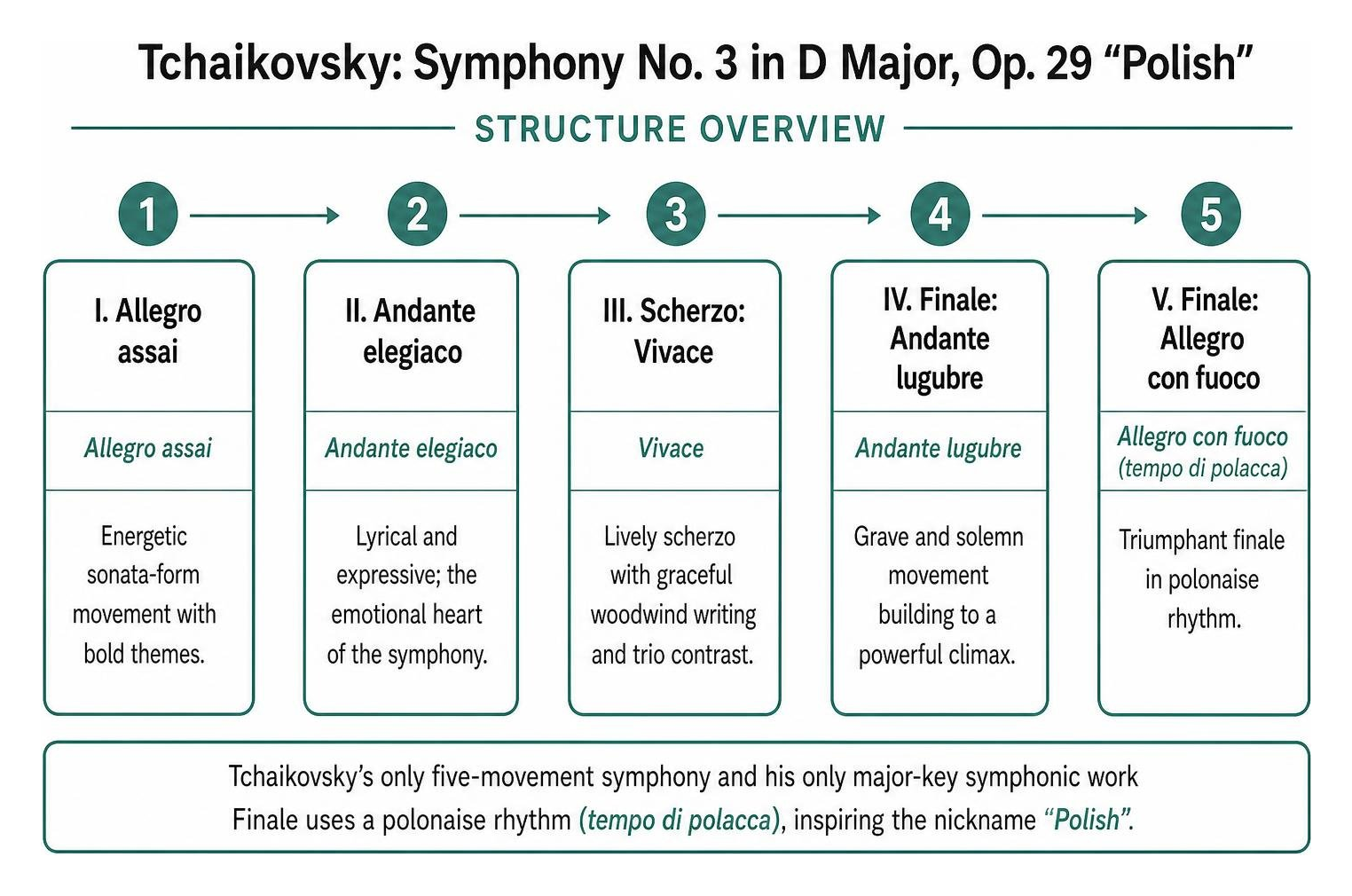
Often relegated to the bottom of critical lists, the Third Symphony is Tchaikovsky’s only five-movement symphony and his only major-key symphonic work outside the First’s tonal shifts. Written in 1875, it reflects a composer experimenting with German symphonic structures while leaning into his natural gift for dance.
The nickname “Polish” was not coined by Tchaikovsky, but rather stems from the final movement’s stately polonaise rhythm marked tempo di polacca. While the finale is marked con fuoco (“with fire”), the work as a whole feels more like a suite or a dress rehearsal for his great ballet scores (Swan Lake was composed shortly after).
What keeps the Third in seventh place is its episodic nature. As noted in critical surveys like All seven Tchaikovsky symphonies ranked, from worst to best | Classical Music , the work lacks the relentless dramatic inevitability of his later masterpieces. Nevertheless, its central Andante elegiaco offers genuine lyrical warmth, and the delicate woodwind writing in the Scherzo demonstrates his growing command of the orchestra.
6. Symphony No. 1 in G minor, Op. 13 “Winter Daydreams”
Composed in 1866 and heavily revised in 1874, “Winter Daydreams” represents Tchaikovsky’s youthful ambition and his agonizing early compositional struggles. The creation of the symphony caused the young composer severe insomnia and a near-nervous breakdown. However, when conducted by his mentor Nikolai Rubinstein in Moscow, it achieved warm public success.
The symphony captures the vast, melancholic beauty of the Russian landscape:
- First Movement (Dreams of a Winter Journey): Flutes and bassoons weave a wistful, folk-infused melody over tremolo strings.
- Second Movement (Land of Desolation, Land of Mists): An oboe solo unfurls one of Tchaikovsky’s earliest and most heart-rending melodies, layered with rich polyphonic counterpoint.
While the finale relies heavily on academic fugal passages that feel somewhat rigid, Symphony No. 1 remains an evocative, atmospheric gem brimming with sincere melodic charm.
5. Symphony No. 2 in C minor, Op. 17 “Little Russian”
If you are searching for pure, unadulterated rhythmic energy and vibrant nationalism, Symphony No. 2 (1872, revised 1879) delivers in spades. Nicknamed “Little Russian” by critic Nikolay Kashkin due to its use of Ukrainian folk songs (Ukraine then being termed “Little Russia” in the Russian Empire), this piece won immediate acclaim from “The Mighty Handful”—the nationalist group of Saint Petersburg composers led by Mily Balakirev.
The standout feature of this symphony is the exhilarating finale, built on the Ukrainian folk tune “The Crane” (Zhuravel):
- Introduction: A dramatic, sweeping brass fanfare sets the stage.
- Theme Presentation: A cheeky, bouncing motif appears in the first violins.
- Variation Chain: Tchaikovsky deploys a dazzling series of 24 orchestral variations, shifting instrumental colors with breathless momentum.
- Coda: A riotous, cymbal-crashing acceleration that brings concert halls to their feet.
The Second Symphony balances structural economy with infectious joy, standing as Tchaikovsky’s most successfully integrated nationalist composition.
4. Manfred Symphony in B minor, Op. 58
Nestled chronologically between the Fourth and Fifth Symphonies, the unnumbered Manfred Symphony (1885) is an epic programmatic tone poem in four massive scenes based on Lord Byron’s dramatic poem. Encouraged by Balakirev and heavily inspired by Hector Berlioz’s Symphonie fantastique, Tchaikovsky pushed the boundaries of the Romantic orchestra to its limits.
The narrative follows the brooding, guilt-ridden Manfred wandering the Alps:
- The Astarte Leitmotif: Manfred’s doomed lost love is depicted through soaring, fragile string writing.
- The Alpine Fairy: A sparkling, gossamer Scherzo that rivals Mendelssohn in sheer orchestral agility.
- The Bacchanale and Organ Finale: A wild, demonic orgy inside the underground palace of Arimanes that culminates in Manfred’s redemption, sealed by the sudden entry of a massive pipe organ.
Manfred requires immense orchestral forces and supreme stamina from the players. While its sheer scale can feel unwieldy, it contains some of the most thrilling and sonically lush music Tchaikovsky ever composed.
3. Symphony No. 5 in E minor, Op. 64
Premiered in Saint Petersburg in 1888, Symphony No. 5 is a tour de force of cyclical form. Built around a sinister “Fate” motto theme played by low clarinets at the outset, the work charts a psychological journey from crushing darkness to radiant triumph.
The symphony features several undeniable highlights:
- The Horn Solo of the Second Movement: One of the most famous and romantic French horn solos in all classical music, marked Andante cantabile, con alcuna licenza.
- The Third Movement Waltz: Instead of a traditional scherzo, Tchaikovsky inserts an elegant, bittersweet dance that briefly distracts from the overarching tension.
- The Cyclical Transformation: In the finale, the gloomy Fate theme returns in E major, transformed into a resolute, brass-heavy march of victory.
As explored in Gramophone – Tchaikovsky’s Fifth Symphony: A Guide to the Greatest Recordings – Gramophone , the Fifth balances tight thematic discipline with unbridled emotional passion, making it an eternal audience favorite.
2. Symphony No. 4 in F minor, Op. 36
Composed between 1877 and 1878 during the most catastrophic period of Tchaikovsky’s personal life—his disastrous, short-lived marriage to Antonina Miliukova—Symphony No. 4 is raw, unvarnished emotional turmoil translated into sound. Financed and supported by his patroness Nadezhda von Meck, Tchaikovsky wrote a detailed private program describing the opening brass fanfare as “the fatal force which prevents the impulse towards happiness from achieving its goal.”
Key structural and musical triumphs include:
- The Fate Fanfare: A terrifying blast from horns and bassoons that shatters the formal structure whenever hope arises.
- Pizzicato Ostinato Scherzo: The entire string section plays without bows for an entire movement, creating an astonishing percussive texture mimicking balalaikas.
- Folk Catharsis Finale: Tchaikovsky incorporates the Russian folk melody “In the Field Stood a Birch Tree” into a whirlwind of manic energy, asserting that if you cannot find joy within yourself, you must look to the happiness of others.
The Fourth is structurally audacious, emotionally visceral, and a masterclass in brass orchestration.
1. Symphony No. 6 in B minor, Op. 74 “Pathétique” (The Best Tchaikovsky Symphony)
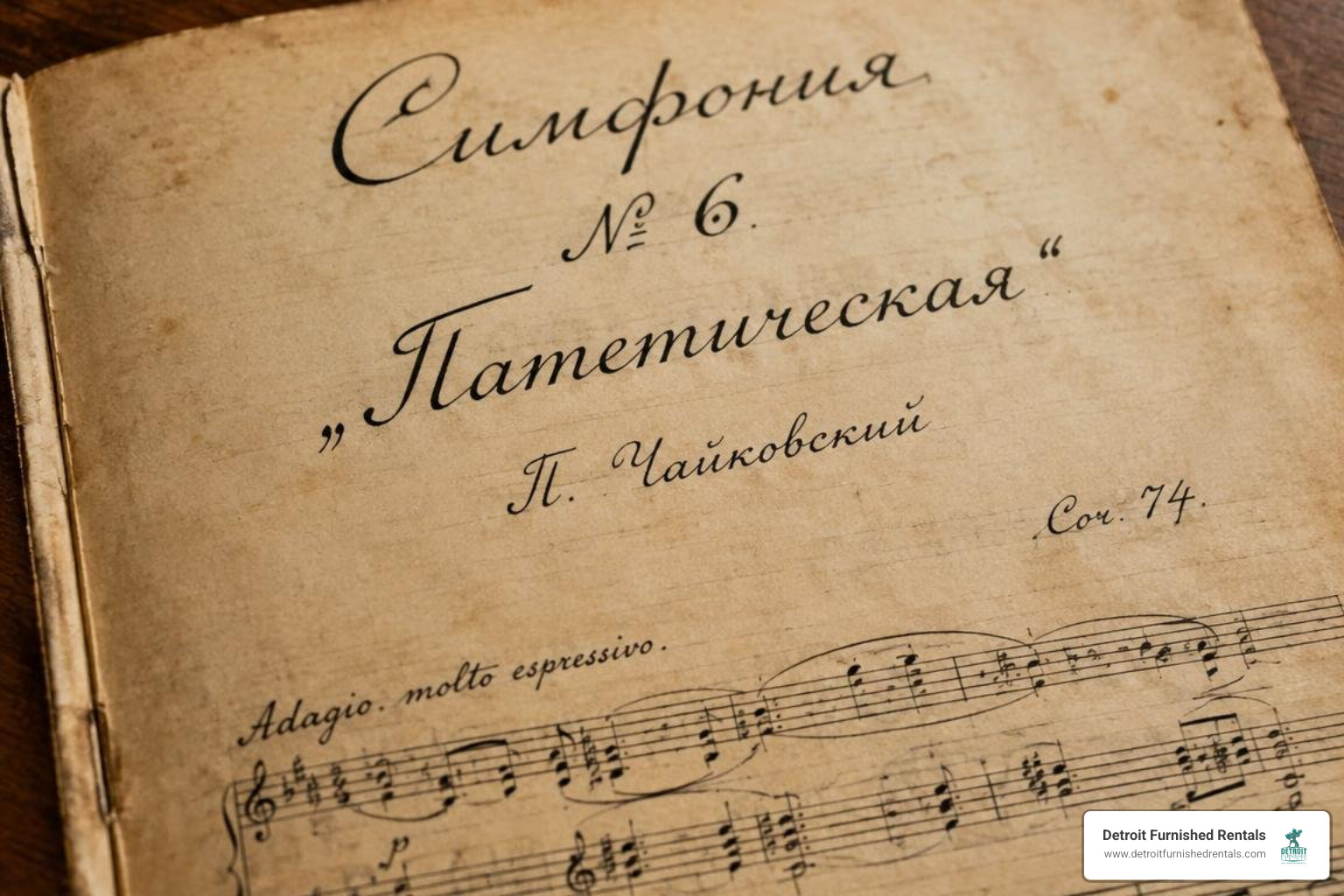
Standing at the pinnacle of his output, Symphony No. 6 in B minor, Op. 74, “Pathétique,” is undeniably the best Tchaikovsky symphony. Completed in August 1893 and premiered under the composer’s baton on October 28, 1893—just nine days before his sudden death—it represents the absolute culmination of late-Romantic symphonic art.
Dedicated to his beloved nephew Vladimir “Bob” Davydov, the work breaks every classical convention to achieve profound expressive sincerity:
- The Bassoon’s Abyss: The symphony opens with a solitary, growling bassoon solo rising from the murky depths of divided double basses.
- The 5/4 Limping Waltz: The second movement features an unconventional 5/4 meter, producing a graceful yet rhythmically unsettled dance—a waltz with a missing heartbeat.
- The False Victory: The third movement is a blistering, electrifying march that routinely fools unsuspecting audiences into premature applause.
- The Unprecedented Slow Finale: Instead of concluding with a festive display, Tchaikovsky writes an Adagio lamentoso. Built around interlocking descending lines in the strings, the music gradually collapses into absolute silence, underscored by a dying heartbeat pulse in the double basses and a fading gong stroke.
As detailed in scholarly analyses like Tchaikovsky: Symphony No.6 – MusicWeb International , the work’s extreme dynamic range (from pppppp to ffff) and formal bravery make it an untouchable masterpiece of existential grief.
Musical Anatomy: Structure, Form, and Biographical Turmoil
To understand the evolution across his symphonic career, examining his structural frameworks and personal milestones provides critical context:
| Symphony | Nickname / Program | Key Signature | Movements | Premiere Year | Defining Musical Feature |
|---|---|---|---|---|---|
| No. 1 | Winter Daydreams | G minor | 4 | 1868 (Moscow) | Atmospheric folk polyphony and lyrical oboe melodies |
| No. 2 | Little Russian | C minor | 4 | 1873 (Moscow) | Ukrainian folk tunes and 24-variation finale on “The Crane” |
| No. 3 | Polish | D major | 5 | 1875 (Moscow) | Unique 5-movement suite-like design ending in a Polonaise |
| No. 4 | None (Dedicated to von Meck) | F minor | 4 | 1878 (Moscow) | Terrifying Fate brass fanfare and all-pizzicato Scherzo |
| Manfred | Byron’s Manfred | B minor | 4 | 1886 (Moscow) | Expansive programmatic scoring with organ in the finale |
| No. 5 | None (Cyclical Fate) | E minor | 4 | 1888 (St. Petersburg) | Recurrent motto theme and iconic horn solo |
| No. 6 | Pathétique | B minor | 4 | 1893 (St. Petersburg) | 5/4 waltz, soft bass trombone textures, dying Adagio finale |
The Role of Biography and Influence
Tchaikovsky’s music cannot be fully separated from his life. Living as a closeted gay man in 19th-century imperial Russia caused him intense psychological distress, which repeatedly surfaced in his obsession with “blind, inescapable Fate.” The catastrophic 1877 marriage crisis directly fueled the emotional violence of Symphony No. 4, while the deep, unspoken intimacy behind the dedication of the Sixth Symphony to Vladimir Davydov imbues the Pathétique with naked vulnerability.
When compared to his contemporary Johannes Brahms, who clung to absolute classical purity, Tchaikovsky expanded symphonic form to mirror emotional states. In doing so, he laid the direct groundwork for Gustav Mahler, who adopted Tchaikovsky’s technique of concluding monumental symphonies with slow, devastating laments (as heard in Mahler’s Ninth).
Essential Recordings and Cycles: Interpreting the Masterpieces
Capturing the balance between Tchaikovsky’s volcanic emotional outbursts and his refined classical architecture requires supreme orchestral discipline. Conductors frequently fall into the trap of over-sentimentalizing the tempos or playing the brass so aggressively that the inner woodwind counterpoint is lost.
Several recording cycles have achieved legendary status, as surveyed in The Essential Tchaikovsky Symphony Cycles | InterClassical :
- Mariss Jansons & The Oslo Philharmonic (Chandos): Recorded in the 1980s, this cycle put the Oslo orchestra on the international map. Jansons delivers urgent spontaneity, transparent textures, and impeccable rhythmic precision without drowning in melodrama.
- Yevgeny Mravinsky & The Leningrad Philharmonic (Deutsche Grammophon, 1960): The historic benchmark for Symphonies 4, 5, and 6. Featuring searing Russian brass, lightning-fast tempos, and white-hot intensity, these stereo recordings remain hair-raising.
- Leonard Bernstein & The New York Philharmonic / Vienna Philharmonic (DG): Bernstein takes the opposite approach, stretching tempos to their absolute expressive limits. His late Pathétique finale is an agonizing, monumentally slow meditation on mortality.
- Teodor Currentzis & MusicAeterna (Sony Classical): A fiercely modern, high-voltage interpretation of Symphony No. 6 that emphasizes radical dynamic extremes and explosive orchestral violence.
Which Recording Captures the Best Tchaikovsky Symphony Performance?
For listeners wanting the complete symphonic journey in pristine audio quality, the complete Tchaikovsky: Complete Symphonies Orchestral & Concertos Russian Chandos box set by Mariss Jansons remains an ideal starting point.
If your goal is to experience the single greatest recorded interpretation of the Pathétique, audiophiles and critics frequently turn to modern high-resolution transfers of Mravinsky’s 1960 DG accounts or the stunningly detailed modern accounts analyzed in Tchaikovsky Symphony No.6, ‘Pathétique’ | Hi-Fi News .
Frequently Asked Questions About Tchaikovsky’s Symphonies
Why is Symphony No. 6 nicknamed the “Pathétique”?
The title was suggested by Tchaikovsky’s brother, Modest, the day after the 1893 premiere. In Russian, the word used was Pateticheskaya, which translates closer to “passionate,” “emotional,” or “full of pathos,” rather than the English connotation of “pitiable.” Tchaikovsky enthusiastically agreed to the title and sent it to his publisher.
Why are the first three symphonies performed less frequently than the last three?
The early symphonies lean more on classical formal models, decorative balletic phrasing, and episodic folk variations. While charming, they lack the intense psychological narrative, recurring motto themes, and shattering emotional climaxes that define Symphonies 4, 5, and 6, which dominate modern concert programming.
What is the significance of the “Fate” motif in Tchaikovsky’s music?
Tchaikovsky used the concept of an idée fixe (a recurring musical theme) to represent Fate—an external, inescapable force that shatters personal joy. In the Fourth Symphony, Fate is a violent brass fanfare; in the Fifth, it is a mournful funeral march that transforms over four movements; in the Sixth, Fate becomes an internal, existential collapse into darkness.
Conclusion: Experiencing Tchaikovsky Live
Nothing compares to hearing the thunderous brass fanfares, weeping string climaxes, and breathless silences of a Tchaikovsky symphony inside a world-class concert hall. Recorded audio can capture the notes, but live acoustic immersion reveals the true physical power of this music.
When planning an arts-centered weekend getaway or an extended musical retreat, having comfortable, elegant lodging near historic concert venues makes all the difference. Explore our guide to Detroit Symphony Orchestra events, tickets, and lodging to secure your tickets and find beautifully appointed accommodations within minutes of Orchestra Hall. Experience the drama, tragedy, and triumph of the world’s greatest symphonic repertoire in person.