Why Beethoven’s Sixth Symphony Still Feels Like a Walk Outdoors
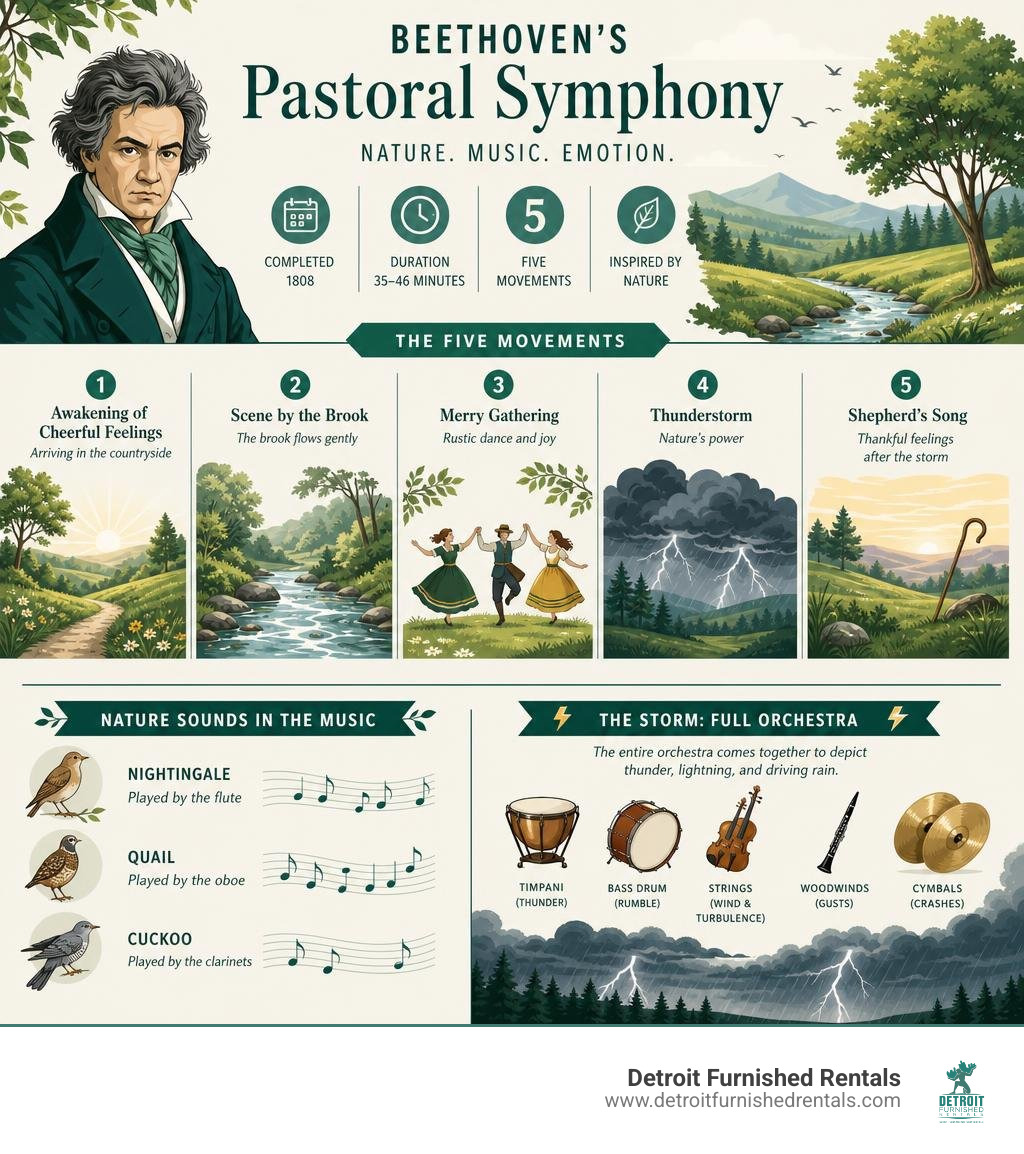
Beethoven’s Sixth Symphony, also called the “Pastoral,” is a five-movement musical journey through the countryside. Completed in 1808, it uses flowing strings, labeled bird calls, rustic dances, and a sudden storm to show not just what nature sounds like, but how being in nature can feel.
Unlike Beethoven’s other symphonies, the Pastoral has descriptive movement titles and connects its final three movements without a pause. Listen for the brook in the strings, the flute’s nightingale, the oboe’s quail, the clarinets’ cuckoo, and the full orchestra arriving for the storm. It usually lasts about 35 to 46 minutes.
Beethoven described the work as “more the expression of feeling than painting.” That idea is the key: this is not simply a soundtrack of birds and weather. It is music about calm, joy, fear, relief, and gratitude.
I am Sean Swain, a hospitality entrepreneur and Detroit-focused cultural writer who helps visitors connect with the city’s arts, history, and neighborhoods. While my professional background is in transportation and hosting rather than performance, this guide to the Beethoven Sixth Symphony is designed to make one of classical music’s most vivid works easy to hear and explore.
Know your beethoven sixth symphony terms:
Historical Context and the 1808 Premiere of the Beethoven Sixth Symphony
The story of the Sixth Symphony is intertwined with one of the most remarkable evenings in Western music history. On December 22, 1808, Ludwig van Beethoven organized an ambitious, four-hour benefit concert at the freezing Theater an der Wien in Vienna. The marathon program was staggering: it featured the public premieres of both his Fifth and Sixth Symphonies, the Fourth Piano Concerto (with Beethoven himself as soloist), portions of the Mass in C major, the concert aria Ah! perfido, and the hurriedly completed Choral Fantasy.
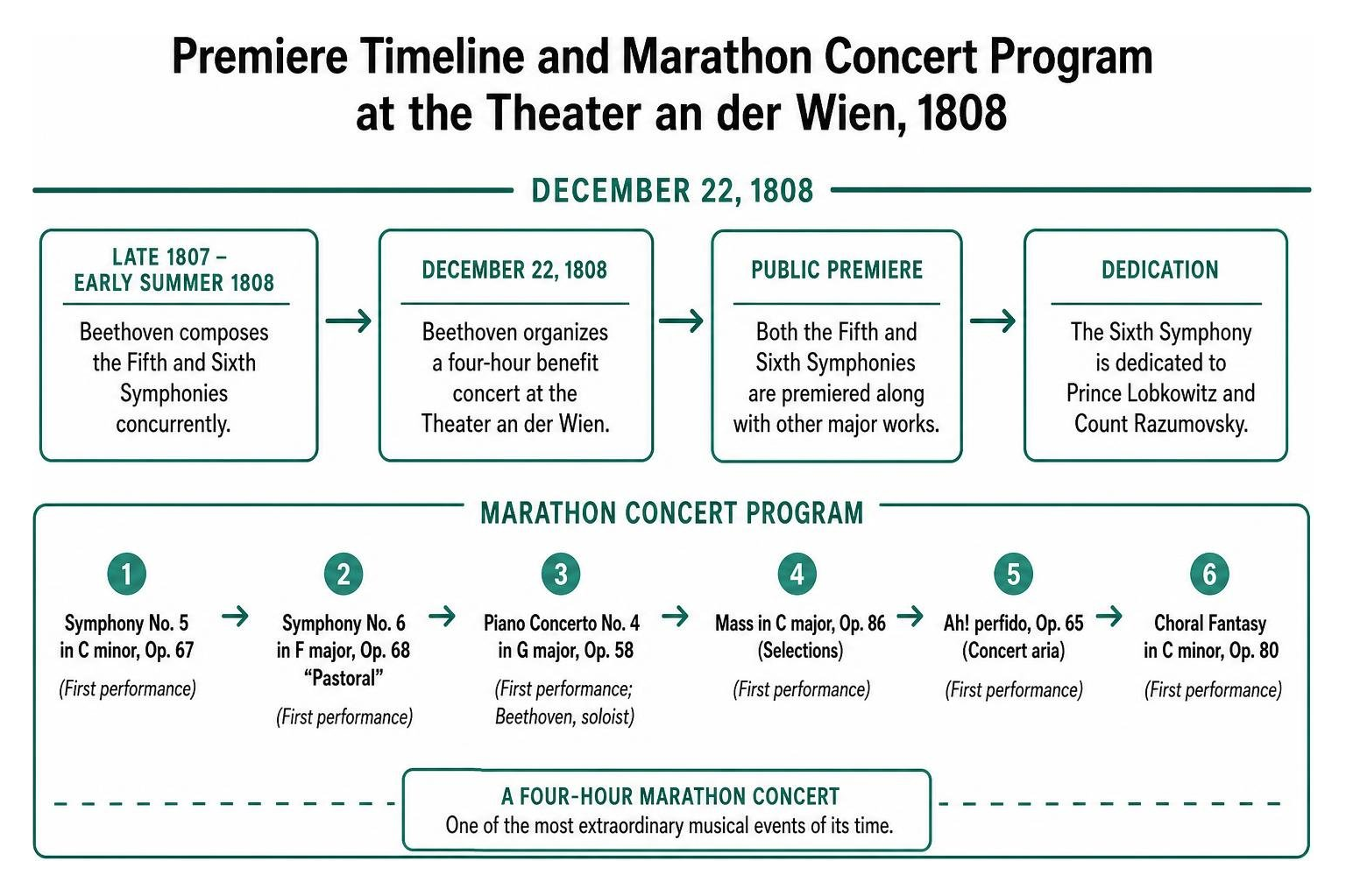
What makes the genesis of the Pastoral Symphony so compelling is that Beethoven composed it concurrently with the tempestuous Fifth Symphony between late 1807 and early summer 1808, although early sketchbooks show preliminary thematic ideas dating back to 1802. While the Fifth grapples with monumental rhythmic struggle—inspiring modern musicians to learn how to play Beethoven’s 5th Symphony on piano—the Sixth stands as its luminous, serene sibling.
Dedicated jointly to two of Beethoven’s key aristocratic patrons, Prince Joseph Franz Maximilian Lobkowitz and Count Andrey Razumovsky, the score represents an emotional sanctuary for the composer. By 1808, Beethoven was navigating profound personal crisis. His progressive hearing loss, laid bare in his heartbreaking 1802 Heiligenstadt Testament, was isolating him socially. In addition, 1808 was a chaotic year during which he moved between four separate Viennese residences.
Escaping the density of urban Vienna for rural retreats in Heiligenstadt, Grinzing, and Mödling became Beethoven’s therapy. He routinely took long, solitary walks through the woods, carrying small sketchbooks to jot down impressions of rustling leaves, babbling brooks, and open skies. Complete historical scores and original manuscripts preserved at Symphony No.6, Op.68 (Beethoven, Ludwig van) – IMSLP show how these rural wanderings crystallized into symphonic form.
Programmatic Philosophy: Feeling Versus Tone-Painting
The Sixth Symphony holds a distinct place in symphonic literature because of Beethoven’s specific aesthetic intent. Rather than composing purely abstract music or producing a literal, theatrical soundboard, Beethoven walked a careful artistic tightrope.
| Dimension | Symphony No. 5 in C minor, Op. 67 | Symphony No. 6 in F major, Op. 68 (“Pastoral”) |
|---|---|---|
| Primary Theme | Fate, heroic struggle, and triumph | Nature, rural life, and inner serenity |
| Movement Layout | 4 traditional movements | 5 programmatic movements (III, IV, V connected) |
| Harmonic Arc | C minor moving into blazing C major | Pastoral F major with a brief dip to F minor (Storm) |
| Emotional Focus | External tension and dramatic victory | Contemplative emotional response and thanksgiving |
| Orchestral Weight | Heavy brass and driving percussive drive | Lyrical woodwinds; heavy brass held in reserve |
Under the lens of 18th-century aesthetics and Kantian philosophy, the Pastoral Symphony balances two complementary realms: the “Beautiful” (found in the balance, pastoral drones, and melody of the rustic movements) and the “Sublime” (embodied by the chaotic, terrifying power of the fourth-movement tempest).
How the Beethoven Sixth Symphony Redefined Programmatic Music
Beethoven explicitly cautioned listeners and publishers regarding how the work should be perceived. When submitting the score to Breitkopf & Härtel, he requested the title: “Pastoral Symphony or recollections of country life. More an expression of feeling than painting.”
Rather than inventing programmatic symphonism from scratch, Beethoven drew upon the late 18th-century “characteristic symphony” tradition, most notably Justin Heinrich Knecht’s 1784 musical nature portrait Le Portrait musical de la nature. However, while Knecht attempted literal mimicry, Beethoven elevated the genre by prioritizing the human emotional reaction to the natural world.
As explored in critical Urtext publications like Symphony no. 6 F major (Pastoral Symphony) op. 68 | HN9816 | HN 9816, Beethoven wove traditional rustic musical topoi—such as drone fifths, horn calls, and woodwind trills—into formal sonata-allegro architecture. When viewing how Beethoven symphonies 1 to 9 masterpieces ranked across his career, the Sixth demonstrates that profound symphonic depth does not require turbulent tragedy; it can flourish through luminous, expansive tranquility.
Instrumentation and Unconventional Five-Movement Structure
To capture this pastoral world, Beethoven adjusted standard Classical orchestration in a remarkably inventive way. The score is scored for 2 flutes, 2 oboes, 2 clarinets, 2 bassoons, 2 horns, 2 trumpets, 2 trombones, timpani, piccolo, and strings.
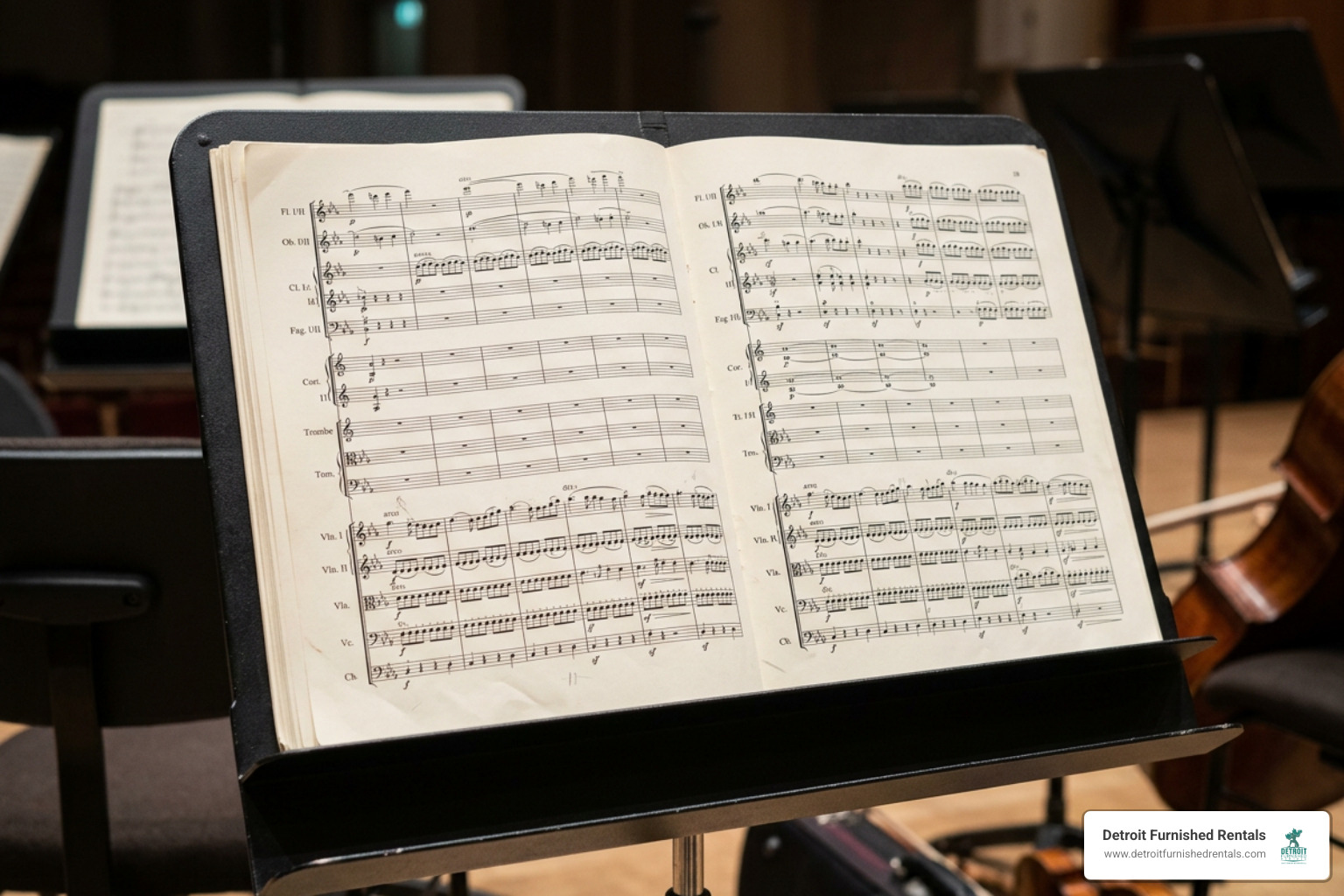
Crucially, Beethoven withheld his heaviest forces—the piccolo, trombones, and timpani—throughout the first three movements. By keeping these powerful voices silent, he established an airy, transparent acoustic texture. When the storm strikes in the fourth movement, the sudden unleashing of the shrieking piccolo, roaring timpani, and brass produces an overwhelming dynamic shock.
Furthermore, Beethoven expanded the classical four-movement framework into a five-movement narrative arc, directing the orchestra to play the final three movements attacca (without pause), creating a seamless dramatic transition from the village dance, through the tempest, to the final hymn of gratitude as detailed in scholarly editions at Beethoven: Symphony No. 6 in F Major, Op. 68.
Movement-by-Movement Guide to the Pastoral Symphony
Following the musical narrative of the Pastoral is like walking along a scenic countryside trail with Beethoven as your guide.
I. Awakening of Cheerful Feelings on Arrival in the Countryside
(Erwachen heiterer Empfindungen bei der Ankunft auf dem Lande)
Tempo: Allegro ma non troppo (2/4 time, F major)
The symphony opens quietly with an unhurried, airy theme in the violins over a gentle open drone in the cellos and violas. Beethoven immediately establishes a relaxed, sunny atmosphere by avoiding abrupt harmonic modulations. Instead, he repeats small melodic fragments across broad stretches of static harmony. By replacing dynamic tension with rhythmic repetition, the music creates an almost hypnotic sense of calm, perfectly mirroring the relief of leaving the bustling city behind.
II. Scene by the Brook: Birdsong and Flowing Water
(Szene am Bach)
Tempo: Andante molto mosso (12/8 time, B-flat major)
Scored in a rocking 12/8 meter, the second movement paints the gentle flow of water through undulating, muted lower strings. The melody drifts effortlessly among the woodwinds. In the movement’s famous closing cadenza, Beethoven introduces explicit bird calls, writing the specific species directly into the score:
- Flute: The nightingale’s high, trilling song
- Oboe: The rhythmic, repetitive call of the quail
- Two Clarinets (in unison): The characteristic two-note call of the cuckoo
As noted by classical analysts at the San Francisco Symphony – Beethoven: Symphony No. 6, these birdsongs are not tacked on as cheap sound effects; they fit naturally into the movement’s harmonic and structural design.
III. Merry Gathering of Country Folk: Peasant Dances and Rhythm
(Lustiges Zusammensein der Landleute)
Tempo: Allegro (3/4 time, F major)
The third movement serves as the symphony’s scherzo, sweeping us into a vibrant village festival. Beethoven channels the rhythm of the Austrian Ländler, a traditional folk dance.
Here, Beethoven injects warm humor: he depicts an amateur rustic tavern band. Listen for the syncopated, off-beat entrances of the oboe and a drowsy bassoonist who seems to wake up periodically just to play a simple three-note accompaniment figure (F – C – F). The energy builds into a boisterous Presto before stopping abruptly.
IV. Thunderstorm: The Arrival of Piccolo, Timpani, and Trombones
(Gewitter. Sturm)
Tempo: Allegro (4/4 time, F minor)
The festivities are interrupted without warning. A sudden drop in dynamic level and low, rumbling tremolos in the cellos and double basses signal distant thunder. Raindrops begin falling as staccato eighth notes in the violins.
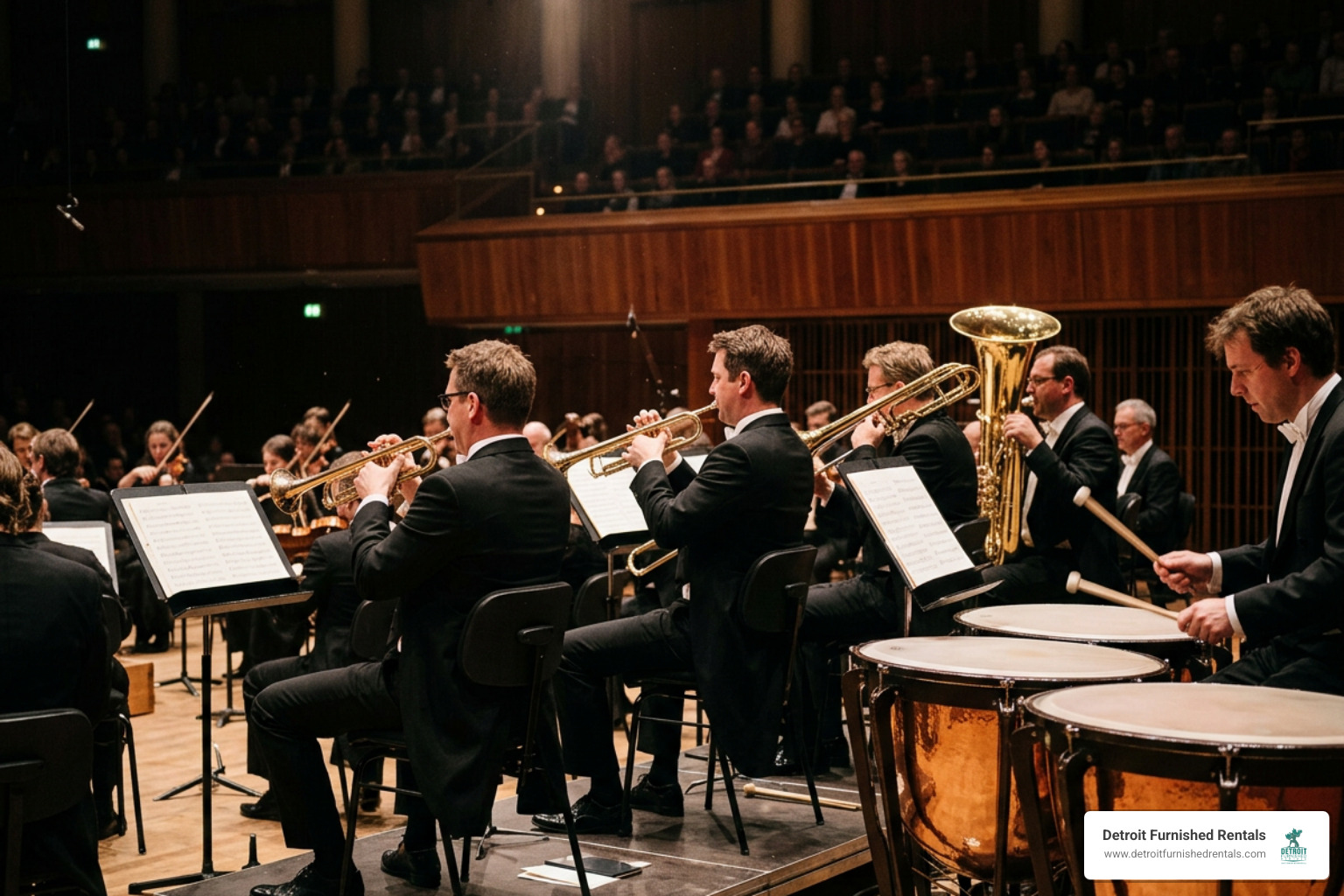
Within moments, the tempest breaks in full fury. Marking the only movement set in a minor key (F minor), this is where Beethoven unleashes the full might of the orchestra. The piccolo screams like howling gale-force winds, the timpani roars with genuine thunderclaps, and the trombones add ominous resonance. The 19th-century composer Hector Berlioz famously remarked that this movement was not merely a storm, but a cataclysmic deluge. As the thunder recedes, a solo flute plays a sweet, ascending scale, symbolizing a rainbow breaking through parting clouds.
V. Shepherd’s Song: Joyful and Thankful Feelings After the Storm
(Hirtengesang. Frohe und dankbare Gefühle nach dem Sturm)
Tempo: Allegretto (6/8 time, F major)
Moving directly from the clearing storm without a pause, the finale begins with a pure, lyrical clarinet call playing a traditional Swiss shepherd’s melody (ranz des vaches), echoed by the horn.
The entire orchestra then joins in an expansive, glowing hymn of thanksgiving in 6/8 time. Beethoven repeats a sweeping harmonic cycle (D–G–C–F) seven times across the movement’s coda, creating a feeling of infinite gratitude and peace. The symphony concludes not with bombastic fanfares, but with two soft, prayer-like orchestral chords that gently fade into silence.
Enduring Legacy and Cultural Impact
The Sixth Symphony permanently changed how composers approached storytelling in orchestral music, serving as a vital bridge between Classical form and Romantic programmatic expression.
Influence of the Beethoven Sixth Symphony on Later Romantic Masters
By proving that a symphony could follow an evocative narrative without sacrificing formal integrity, Beethoven opened the door for generations of composers. Hector Berlioz drew direct inspiration from the Pastoral when crafting the five-movement structure of his Symphonie fantastique in 1830.
Later Romantic masters expanded on these nature topoi:
- Bedřich Smetana channeled Beethoven’s flowing brook when depicting the gentle forest springs of Vltava (The Moldau).
- Richard Strauss built upon Beethoven’s storm orchestration to create his massive tone poem An Alpine Symphony.
- Anton Bruckner utilized the rustic, stomp-and-stride rhythms of the Pastoral scherzo as a structural blueprint for his own symphonic scherzos.
- Franz Liszt created virtuosic solo piano transcriptions of the symphony in 1840, making its complex orchestral voices accessible to salon audiences across Europe.
Just as we celebrate Beethoven’s Eroica Symphony and the legacy of the Third Symphony for reshaping heroic grandeur, the Sixth must be recognized for establishing the foundations of musical programmatic storytelling.
The Pastoral in Modern Pop Culture: From Disney’s Fantasia to The Simpsons
Beyond concert halls, the Pastoral Symphony has left a lasting footprint on popular culture:
- Disney’s Fantasia (1940): Walt Disney famously paired Beethoven’s Sixth with Greek mythological imagery, filling Mount Olympus with playful centaurs, pegasi, fauns, and a jovial, wine-drinking Bacchus dodging Zeus’s lightning bolts.
- The Simpsons (1990): In the acclaimed Season 2 episode “Itchy & Scratchy & Marge,” the children of Springfield turn off their televisions and head outdoors to play in idyllic, dialogue-free harmony, scored entirely to the first movement of the Sixth.
- Cinema & Television: The symphony’s serene melodies provide poignant emotional depth in films like Soylent Green (1973), where it accompanies Solomon Roth’s final view of Earth’s lost natural beauty, as well as classic television mystery series like Columbo (“Etude in Black,” 1972).
Frequently Asked Questions About the Pastoral Symphony
What makes the sixth symphony different from Beethoven’s other symphonies?
The Sixth is Beethoven’s only symphony that uses an unconventional five-movement structure, includes explicit descriptive titles for every movement, and joins its final three movements together without pause. It focuses on serene, nature-inspired emotional tranquility rather than tragic struggle.
Which specific bird calls are featured in the second movement?
In the coda of the second movement (Scene by the Brook), Beethoven explicitly labeled three woodwind instruments to represent specific bird species:
- The flute plays the trilling song of the nightingale.
- The oboe imitates the distinct, rhythmic rhythm of the quail.
- Two unison clarinets mimic the descending two-note call of the cuckoo.
Why are the last three movements played without a break?
Beethoven marked these movements attacca so the music flows without interruption. This musical choice mirrors real life: the cheerful country gathering is unexpectedly cut short by the approaching storm, and the relief of the shepherd’s hymn follows immediately once the rain clears.
Experiencing Live Symphonic Masterpieces
Nothing compares to hearing the Pastoral Symphony live in an acoustically balanced hall, where you can feel the quiet rustle of the muted strings and the floor-shaking rumble of the timpani during the storm.
For music lovers planning an arts getaway, hearing a world-class ensemble like the Detroit Symphony Orchestra inside historic Orchestra Hall in Detroit provides an unforgettable acoustic experience. Built with world-renowned natural resonance, the hall lets every woodwind birdcall and horn entrance ring out with crystalline warmth.
When you travel for a weekend of live symphonic masterworks, having a comfortable, quiet home base makes all the difference. At Detroit Furnished Rentals, we provide premium, fully equipped furnished apartments in the city’s most vibrant central neighborhoods. Located just minutes from Orchestra Hall, the Detroit Institute of Arts, and downtown dining, our accommodations ensure you can immerse yourself in cultural performances and relax in complete comfort.