Witness a Masterpiece: Detroit’s Iconic Fountain Rises Again
The Horace Dodge Fountain is a stunning 30-foot-tall stainless steel and granite water monument at the heart of Hart Plaza in downtown Detroit. Designed by renowned sculptor Isamu Noguchi and completed in 1981, this iconic fountain features 300 water jets and 300 lights that create mesmerizing patterns above a 120-foot diameter basin.
Quick Facts:
- Location: Philip A. Hart Plaza, Jefferson Avenue & Woodward, Downtown Detroit
- Designer: Isamu Noguchi (1978 design, 1981 completion)
- Size: 30 feet high, 120-foot diameter basin
- Features: 300 water jets, 300 lights, computer-programmed displays
- Operating Hours: 11 a.m.-2 p.m. and 5-10 p.m. daily (May-October, weather permitting)
- Recent Restoration: $6.7 million renovation completed in 2024 after a decade of dormancy
For generations, Hart Plaza has been a beloved riverfront destination for summer festivals, concerts, and special events. The Horace Dodge Fountain stands as its centerpiece—a “horizon for people,” as Noguchi described it.
After sitting silent for over ten years due to technical failures and the city’s financial struggles, the fountain roared back to life in 2024. Officials celebrated the completed restoration in a ceremony that marked not just the fountain’s rebirth, but Detroit’s renewed commitment to its public spaces.
“This is about more than a fountain,” Mayor Mike Duggan noted at the reopening. It’s about reclaiming great public spaces that define a city’s identity.
The fountain’s journey from spectacular landmark to dormant relic and back again mirrors Detroit’s own story of resilience and revival.
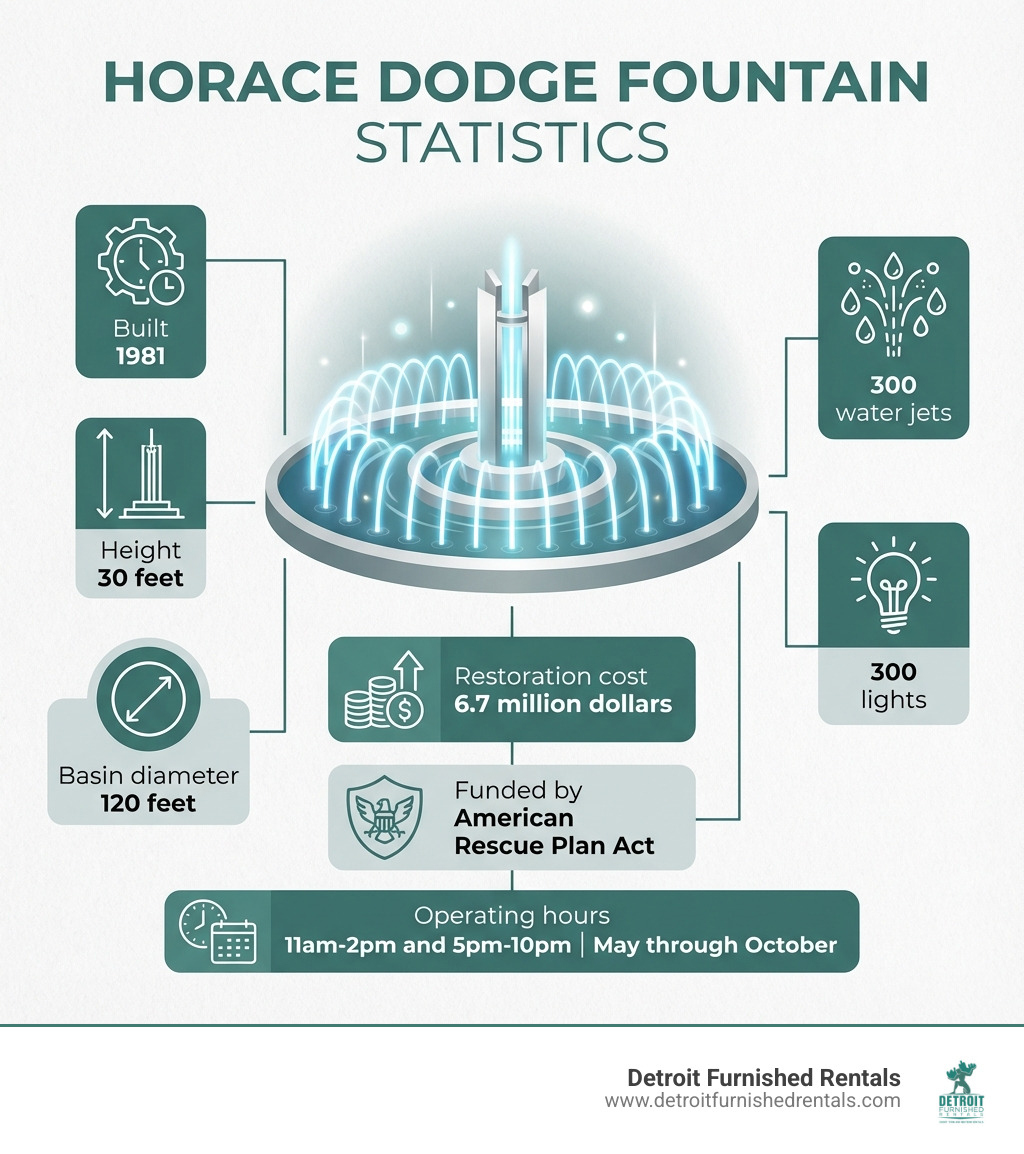
Quick look at Horace Dodge Fountain:
A Monument Reborn: The Restoration of the Horace Dodge Fountain
For over a decade, the once-vibrant Horace Dodge Fountain stood silent, a stark reminder of past challenges. Its jets, designed to soar 30 feet into the air, remained still, and its intricate lights, meant to dance across the water, stayed dark. This period of dormancy wasn’t merely due to neglect; it was a complex narrative involving technical issues, a bizarre incident, and the city’s broader financial struggles.
Back in the 1970s, the fountain’s original computer-run system, which controlled its water and light configurations, was notoriously problematic. It became, as some Detroiters would say, a “running joke” in the city because it just couldn’t seem to work right. The system was unreliable, leading to frequent shutdowns and a reputation for being temperamental. Then, in the 1980s, an unfortunate incident involving a paint can getting stuck in the jets caused a complete shutdown. Without the necessary basic maintenance and priority from the city, the fountain fell into further disrepair.
The decline of the Horace Dodge Fountain and other public spaces in Detroit was deeply felt. Mayor Mike Duggan openly acknowledged that this neglect was a serious deficiency for the city. Following Detroit’s bankruptcy in 2013, resources were even scarcer, and the fountain remained inoperable for years, its fate uncertain. Many long-time residents grew up seeing it shut off, unaware of its true potential to spray water skyward.
However, Detroit is a city of resilience, and its landmarks are no different. In a testament to the city’s revitalization efforts, a comprehensive renovation project was launched. The fountain alone needed nearly $7 million for its restoration, a significant portion of the $9 million dedicated to the overall Hart Plaza renovation. The funding for this monumental task largely came from federal American Rescue Plan Act (ARPA) money, with $6.7 million specifically allocated to the fountain’s revival.
The restoration was a massive undertaking, far more than just a quick fix. It involved removing metal panels from the fountain’s dome, installing new nozzles, waterproofing the entire Hart Plaza area, and repairing the jets, lighting, and plumbing systems. The goal wasn’t just to bring the fountain back to its 1978 glory but to modernize it to 2024 standards, ensuring its longevity and reliability for future generations.
The culmination of this effort was a celebratory reopening, where officials proudly let the water flow once again. It was a moment of collective joy and a powerful symbol of Detroit’s commitment to restoring its cherished public spaces.
The Fountain’s Triumphant Return
The true measure of the Horace Dodge Fountain‘s rebirth came during the 2024 Movement Festival, Detroit’s renowned electronic music festival. For years, festival-goers had seen the fountain as a dormant structure. But this year, as the water surged and the lights illuminated the night sky, the reaction was nothing short of amazing. People were emotionally engaged, marveling at a sight many had never witnessed before. Councilman Fred Durhal III, who had childhood memories of playing in the fountain, shared how his own daughter had often asked why it didn’t work. Now, she, and countless others, could see it in its full splendor.
This triumphant return transcended mere aesthetics. The Horace Dodge Fountain‘s revival became a powerful symbol of Detroit’s ongoing revitalization. It embodied the city’s journey from economic hardship to renewed prosperity, from neglect to meticulous care. It instilled a deep sense of community pride, reminding everyone that Detroit was not just rebuilding its infrastructure but also reclaiming its identity and spirit. From a state of disrepair, the fountain once again took its rightful place as the vibrant centerpiece of Hart Plaza, ready to inspire and delight residents and visitors alike.
By the Numbers: A Modern Overhaul
The restoration of the Horace Dodge Fountain was an intricate process, going far beyond simple repairs. It was a complete modernization, bringing the fountain up to 2024 standards. The federal grant money was carefully used to finance a wealth of new components, ensuring both dazzling performance and long-term durability.
Here’s a look at the impressive statistics of this modern overhaul:
- 184 new lights to create dynamic and vibrant illumination patterns.
- 144 misters to add a delicate, ethereal quality to the water displays.
- 22 powerful down jets that send water cascading downwards.
- Three distinct spray rings to create varied and intricate water formations.
- 72 new panels to improve the fountain’s structural integrity and aesthetic.
This comprehensive approach ensured that the Horace Dodge Fountain wouldn’t just work again, but would perform better and more reliably than ever before. It was a significant upgrade from its original 1978 specifications, reflecting a commitment to excellence in public art and infrastructure.
The Visionary Design of Isamu Noguchi
The Horace Dodge Fountain is not just a water feature; it’s a masterpiece of modern sculpture, born from the mind of one of the 20th century’s most influential artists, Isamu Noguchi. Noguchi, a Japanese-American sculptor and landscape architect, was renowned for his ability to blend art with public spaces, creating environments that were both functional and deeply contemplative.
His design for the Horace Dodge Fountain was a collaborative effort, involving his associate Shoji Sadao and the architectural firm Smith, Hinchman & Grylls. Noguchi’s vision for the fountain and the surrounding Hart Plaza was ambitious. What began as a commission for a fountain evolved into a comprehensive design for the entire plaza, which he envisioned as “a horizon for people” – a flexible public space designed for community gathering.
Noguchi’s inspiration for the fountain was truly futuristic. He once stated that he conceived of it as representing “our times and relationship with the outer space,” a profound idea for a public artwork. The fountain’s aesthetic certainly reflects this forward-thinking approach. It makes a “decidedly industrial statement,” featuring a striking horizontal ring of stainless steel suspended above a black granite pool. This upper circular portion rises 30 feet, creating a dramatic focal point. The basin below, with its impressive 120-foot diameter, provides a grand stage for the water’s performance.
Isamu Noguchi also designed the 120-foot tall Pylon sculpture, a companion piece within Hart Plaza whose design was reportedly inspired by the double helix of DNA. His involvement in both the fountain and the plaza’s overall layout cemented his indelible mark on Detroit’s urban landscape. To dig deeper into the breadth of his extraordinary work, we encourage you to explore More about Noguchi’s public works.
The Horace Dodge Fountain’s Technological Marvel
At its core, the Horace Dodge Fountain is a technological marvel, designed to create a captivating interplay of water and light. It boasts an impressive array of 300 jets and 300 lights, orchestrated by a sophisticated computer system. This system allows for a myriad of computer-programmed water patterns, creating dynamic and ever-changing displays that respond to environmental factors like temperature. Imagine water spouting from the basin and simultaneously cascading downward from the suspended steel ring, creating a mesmerizing crisscrossing effect.
However, this technological ambition wasn’t without its early challenges. As we mentioned, the original computer-run system from the 1970s was famously unreliable, contributing to the fountain’s frequent shutdowns and its eventual dormancy. It was a testament to the cutting-edge (and sometimes finicky) technology of its time.
Today, thanks to the recent restoration, the Horace Dodge Fountain operates with a modern control system. This ensures that the dynamic water and light shows are not only breathtaking but also consistent and dependable. Visitors can now experience the full artistic intent of Noguchi’s design, enjoying intricate sequences of sprays, misters, and illuminated patterns that transform the plaza into an enchanting spectacle, especially during the evening hours.
A Legacy in Steel and Water: The Dodge Family Connection
The Horace Dodge Fountain is more than just an artistic and engineering marvel; it’s a profound memorial, bearing the name of a family synonymous with Detroit’s industrial might and philanthropic spirit. The fountain is named in honor of Horace E. Dodge and his son, Horace Jr., a tribute made possible by Horace Sr.’s widow, Anna Thomson Dodge.
Horace Elgin Dodge, alongside his brother John Francis Dodge, were true automotive pioneers. Moving to Detroit in 1886, they started as skilled machinists. Horace even invented and patented a dirt-proof ball bearing, showcasing their innovative spirit early on. Their company, Dodge Brothers, quickly became a powerhouse in the burgeoning automotive industry. By 1902, they were manufacturing transmissions for R.E. Olds, and from 1903 to 1913, they were the main or largest provider of engines and parts for Henry Ford’s cars. In 1914, they launched their own automobile brand, Dodge, which rapidly became one of the most popular car lines in the country. Their firm was a key component when Walter P. Chrysler assembled the Chrysler Corporation in the late 1920s.
Tragically, both brothers died relatively young in 1920, leaving behind immense wealth and a formidable legacy. Anna Thomson Dodge, Horace Sr.’s widow, became a prominent figure in Detroit philanthropy. It was her incredible generosity that funded the fountain. In the 1960s, responding to a plea from then-Mayor Jerome Cavanaugh and Detroit News Editor Martin Hayden, Anna Thomson Dodge donated $2 million to the city for the fountain’s construction. Her intention was clear: to honor her deceased husband and son and to make Hart Plaza a “warmer” and more attractive site. This significant contribution underscored the Dodge family’s enduring impact on Detroit, not just through industry but through their commitment to civic beautification and public spaces.
We can learn even more about this influential family and their contributions to the city by exploring Learn about the Dodge family legacy.
The Heart of Hart Plaza: A Detroit Community Hub

The Horace Dodge Fountain isn’t an isolated artwork; it’s the undisputed centerpiece of Philip A. Hart Plaza, a 14-acre municipal park along the Detroit Riverfront that serves as Detroit’s premier public gathering space. Designed with flexibility in mind, the plaza can accommodate up to 40,000 people, making it the perfect venue for a wide array of community events.
Throughout the warmer months, Hart Plaza truly comes alive, hosting countless concerts, festivals, and celebrations that draw people from all walks of life. From the jazz festival to the Movement Festival, the plaza pulsates with energy, and the fountain, now fully operational, adds to the vibrant atmosphere. It’s a place where Detroiters and visitors alike come together to celebrate, relax, and enjoy the stunning views of the Detroit River and the Windsor, Ontario skyline. You can easily find this iconic location on a map: View on Google Maps.
Beyond the Horace Dodge Fountain, Hart Plaza is rich with other significant art installations and memorials that tell Detroit’s story. Isamu Noguchi’s 120-foot stainless steel Pylon sculpture, a companion piece to the fountain, stands tall, its design inspired by the double helix of DNA. Another powerful monument is the Gateway to Freedom International Memorial to the Underground Railroad, which commemorates Detroit’s crucial role as “Midnight,” a major terminal on the path to freedom for enslaved people. These elements, combined with the plaza’s open design, make it a dynamic and historically rich public space.
Visiting the Horace Dodge Fountain
We know you’ll want to experience the Horace Dodge Fountain in all its restored glory, especially during the warmer months. The fountain operates daily from 11 a.m. to 2 p.m. and again from 5 p.m. to 10 p.m. These hours allow for both daytime enjoyment and spectacular evening light shows.
The fountain’s operation is seasonal, typically running from at least May to October, depending on the weather conditions. On hot summer days, the fountain becomes a popular spot to cool off, with its mist and splashing water offering a refreshing respite. It’s also an incredible photography spot, with its sleek design and dynamic water patterns providing endless opportunities for stunning shots, particularly as the sun sets and the lights come alive. Whether you’re looking for a peaceful moment of contemplation, a family outing, or a vibrant backdrop for your Detroit adventure, the Horace Dodge Fountain is a must-see.
Frequently Asked Questions about the Horace Dodge Fountain
Why was the fountain not working for so long?
The Horace Dodge Fountain experienced a perfect storm of issues that led to its decade-long dormancy. Its original computer-controlled system from the 1970s was notoriously unreliable and often malfunctioned. A significant breakdown occurred in the 1980s when a paint can accidentally got stuck in the jets, leading to a complete shutdown. Compounding these technical woes, the city faced severe financial difficulties, culminating in its 2013 bankruptcy. During this period, funding for maintenance and repairs of public amenities like the fountain became scarce, leading to its prolonged silence. For many years, the fountain simply wasn’t a priority amidst other pressing urban challenges.
How much did it cost to fix the fountain?
Bringing the Horace Dodge Fountain back to life was a substantial investment, reflecting the complexity of its systems and the extent of its disrepair. The fountain’s restoration alone cost nearly $7 million. This was part of a larger $9 million renovation project for the entire Hart Plaza. The bulk of the fountain’s funding, specifically $6.7 million, came from the federal American Rescue Plan Act (ARPA), a critical source of support that enabled Detroit to revitalize this iconic landmark.
Who is the fountain named after?
The Horace Dodge Fountain is named in honor of Horace E. Dodge, the co-founder of the famous Dodge automobile brand, and his son, Horace Jr. The fountain was a generous gift to the city from Horace Sr.’s widow, Anna Thomson Dodge. She bequeathed $2 million for its construction, intending it as a lasting memorial to her husband and son, who were pivotal figures in Detroit’s industrial history and community.
Conclusion
The Horace Dodge Fountain is more than just a beautiful landmark; it’s a powerful symbol of Detroit’s remarkable resilience and its vibrant future. Its journey from a spectacular, futuristic design, through a decade of silence, and back to a dazzling display of water and light, mirrors the very spirit of the city itself. It stands as a testament to both ingenious engineering and captivating art, a true community centerpiece that invites us to pause, reflect, and enjoy.
For visitors seeking to experience the city’s iconic sites, the fully restored Horace Dodge Fountain is an absolute must-see. Its dynamic water displays, especially against the backdrop of the Detroit skyline, offer a unique and memorable experience. If you’re planning a trip to Detroit and want to stay close to these incredible attractions, Detroit Furnished Rentals offers comfortable, centrally located accommodations that provide the perfect home base for your urban adventures.
We invite you to explore more of Detroit’s rich history and vibrant present. Find the many other monuments and landmarks that tell the story of this incredible city. Explore more Detroit monuments and landmarks.